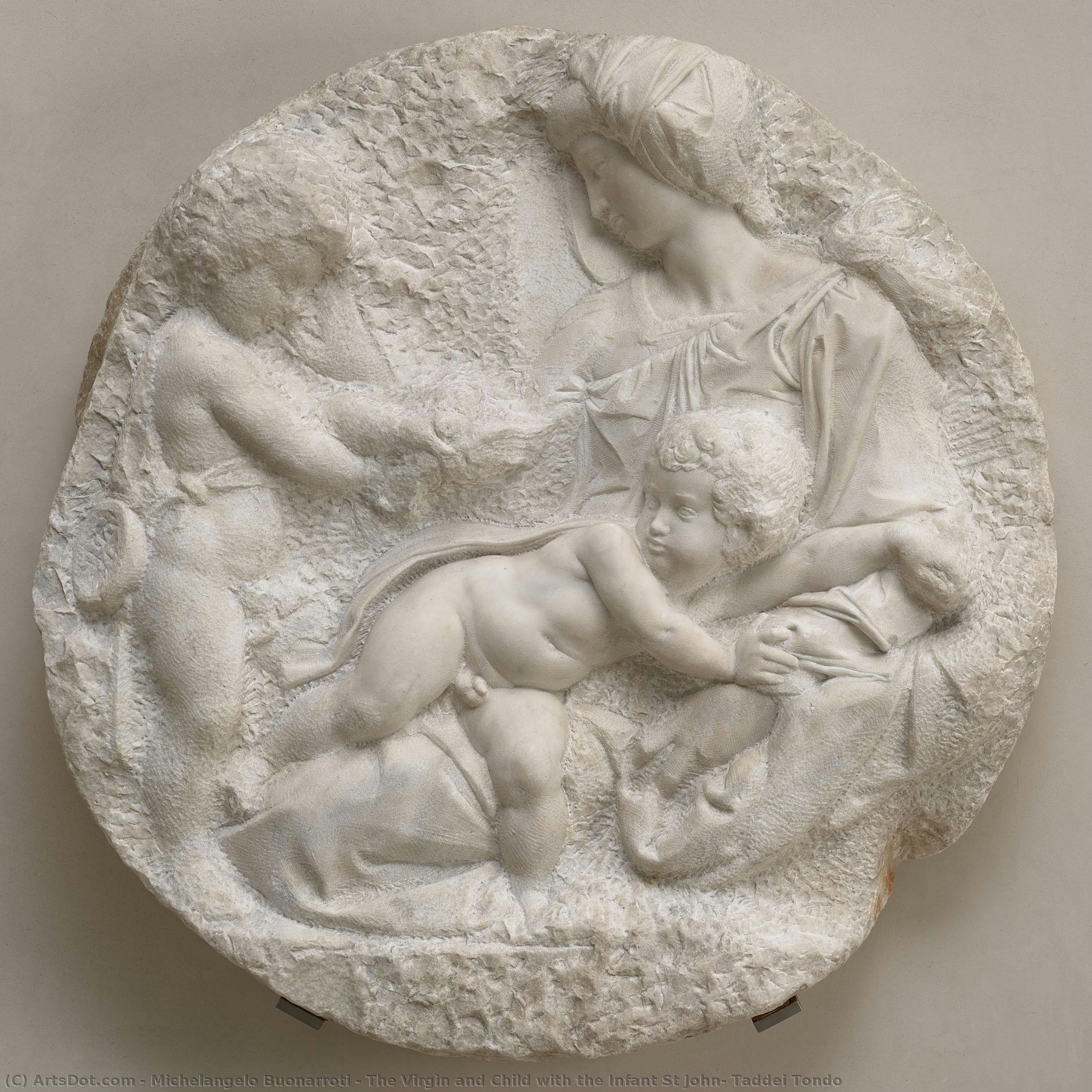
Explore Michelangelo's poignant Taddei Tondo – an unfinished marble sculpture depicting Mary cradling Jesus and St. John, symbolizing compassion & divine grace. Admire its Renaissance beauty at the Royal Academy.
ミケランジェロ・ブオナローティ(1475-1564):ダビデ像やピエタ、システィナ礼拝堂の天井画など、ルネサンスを代表する巨匠の世界。彫刻、絵画、建築における革新的な才能と、美術史への永続的な影響を紐解きます。
ロイヤル・アカデミー・オブ・アーツ:1768年創立の歴史ある芸術拠点。英国美術とデザインを祝い、展覧会や講演を通じて創造性を育む活気あるコミュニティをご紹介します。
The Virgin and Child with the Infant St John; Taddei Tondo
This marble sculpture by Michelangelo Buonarroti stands as a testament to the artistic fervor of the High Renaissance, embodying ideals of beauty, piety, and humanist contemplation. Executed circa 1504-1505 during Michelangelo’s formative period in Florence—a time marked by groundbreaking innovations in art and architecture—the Taddei Tondo transcends mere representation; it communicates profound emotion and narrative depth through masterful craftsmanship. Commissioned by the wealthy cloth merchant Taddeo Taddei, this circular relief sculpture wasn't intended for a grand cathedral but rather for a domestic setting, reflecting the Renaissance fascination with idealized human form within intimate spaces. Its enduring appeal lies in its ability to capture a pivotal moment of Christian iconography—the nurturing embrace of Mary and Jesus alongside the symbolic gesture of St John the Baptist presenting a goldfinch to Christ—a detail laden with layered meanings that continue to fascinate scholars today.
A Masterpiece of Technique and Composition
Michelangelo’s approach to sculpting this monumental piece exemplifies his unparalleled skill in manipulating marble—a medium he considered “the stone that speaks.” Unlike many other sculptors of the era who favored idealized forms derived from classical models, Michelangelo prioritized anatomical accuracy combined with expressive dynamism. The sculpture's surface is characterized by a remarkable interplay of textures: smooth, polished areas delineate Mary’s drapery and torso, contrasting sharply with rougher surfaces that convey the physicality of Christ’s pose and the infant St John’s stance. This textural contrast isn’t merely aesthetic; it contributes to the sculpture’s emotional impact, mirroring Michelangelo's own conviction that “the stone speaks” – conveying a palpable sense of movement and vitality. The sculptor skillfully employed chisel and mallet—traditional tools honed over decades of experience—to carve out the intricate details of each figure, demonstrating an unwavering commitment to capturing the essence of human form with breathtaking precision.
Symbolism Rooted in Classical Tradition
The Taddei Tondo draws heavily upon classical artistic conventions, particularly those prevalent during Michelangelo’s exposure to Roman sculpture. The depiction of Mary and Jesus embodies Christian iconography—the Virgin Mother cradling her son—a motif that had been revived by Renaissance artists from Greek myths and sculptures. However, Michelangelo infused this familiar image with subtle nuances reflecting humanist thought. The gesture of St John the Baptist presenting a goldfinch to Christ is particularly noteworthy. Traditionally interpreted as representing Christ’s “passion” – specifically his suffering before crucifixion – scholars have recently argued that Christ's pose is playful rather than fearful. The goldfinch, a common pet in Florence during Michelangelo’s time, symbolized not only Christ’s sacrifice but also the beauty and innocence of childhood—a poignant juxtaposition that underscores the sculpture’s overarching theme of divine grace amidst earthly vulnerability.
Historical Context and Legacy
Michelangelo's Taddei Tondo emerged from a period of artistic innovation in Florence—the epicenter of the Renaissance—where artists sought to emulate the grandeur and idealism of ancient Greece and Rome. Giorgio Vasari, a celebrated biographer of artists, famously described Michelangelo as “supreme in not one art alone but in all three,” recognizing his mastery across sculpture, painting, and architecture. The unfinished state of the tondo—a deliberate choice by Michelangelo—has fueled ongoing debate among scholars regarding his artistic motivations. Some contend that he abandoned the project due to creative frustration—a notion solidified by Vasari’s assertion that Michelangelo “did not complete some works out of creative frustration”—while others suggest that he embraced imperfections as a reflection of the sculptor's unwavering belief in the transformative power of stone. Nevertheless, the Taddei Tondo remains an enduring symbol of Renaissance artistic excellence and continues to inspire admiration for its technical virtuosity and profound emotional resonance. Its presence in the Royal Academy of Arts serves as a tangible reminder of Michelangelo’s genius and his indelible contribution to Western art history.