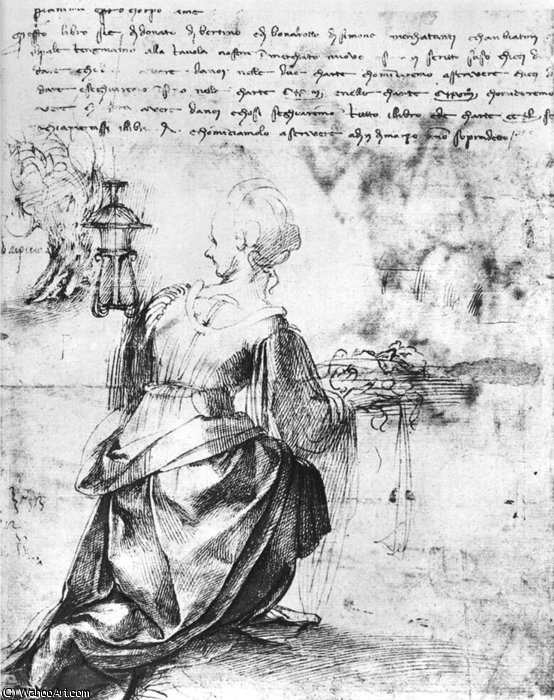
A Portrait of Contemplation: Michelangelo’s Female Figure
Michelangelo Buonarroti's “Woman,” a monochrome chalk drawing housed in Haarlem’s Teylers Museum, stands as a poignant emblem of Renaissance artistic introspection. Executed around 1503-1504, this preparatory sketch offers a glimpse into the artist’s creative process and embodies the humanist ideals that defined his era.
- Subject Matter: The drawing portrays a solitary woman kneeling in prayerful repose—a motif prevalent in Renaissance devotional art. Her posture exudes serenity and suggests an engagement with spiritual contemplation, reflecting the profound influence of Christian faith on artistic expression during this period.
- Style & Technique: Michelangelo’s style aligns closely with Mannerism, characterized by elongated figures and stylized drapery – a deliberate departure from the idealized proportions championed by Raphael and Leonardo da Vinci. The artist employs meticulous hatching and cross-hatching techniques to achieve remarkable tonal gradation, capturing subtle nuances of light and shadow.
- Material & Method: Crafted on paper using chalk and ink, “Woman” exemplifies Michelangelo’s favored method for sketching preliminary compositions. Dry point etching—a technique involving incising lines into copper plates—was utilized to create the drawing's intricate textures and contours.
Exploring Renaissance Symbolism
Beyond its formal qualities, “Woman” resonates with symbolic significance rooted in humanist thought. The female figure represents purity, humility, and divine grace – concepts central to Christian theology. Michelangelo’s depiction aligns with the broader artistic tradition of portraying women as embodiments of virtue and spiritual aspiration.
The Artist's Process: A Study in Form
This sketch isn’t merely a representation; it’s an investigation into form—a cornerstone of Michelangelo’s sculptural genius. Like his monumental sculptures, “Woman” demonstrates a masterful command of anatomy and proportion, albeit expressed through a more restrained medium. The artist's careful attention to detail underscores the importance of observation and intellectual understanding in artistic creation.
A Legacy of Elegance & Reflection
“Woman,” alongside Parmigianino’s “Madonna with the Long Neck” and Michelangelo’s “Man Abducting a Woman (verso),” exemplifies the Renaissance fascination with beauty and contemplation. These artworks invite viewers to ponder questions of faith, morality, and human experience—a testament to Michelangelo Buonarroti's enduring contribution to art history.