A Portrait of Command and Courtship: Nicolaes Maes’s Admiral Jacob Binkes
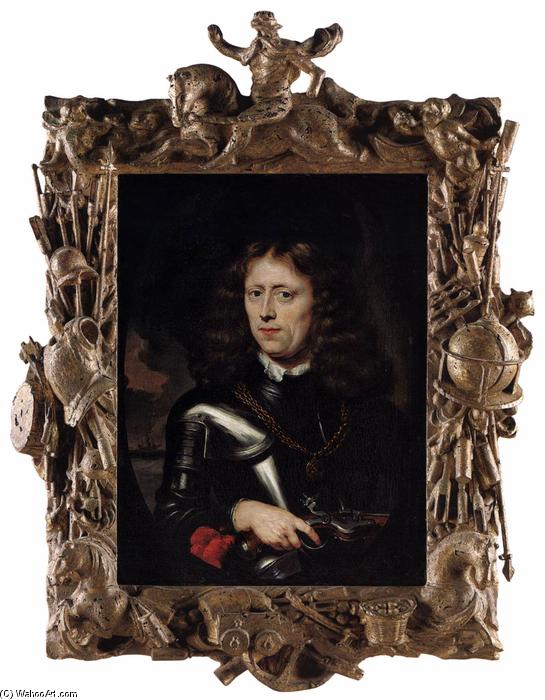
Nicolaes Maes's "Admiral Jacob Binkes," painted in 1676, is more than a simple portrait; it’s a meticulously crafted tableau of Dutch Golden Age society, brimming with subtle symbolism and reflecting the ambitions of a rising naval officer. The painting captures a man poised between duty and domesticity – Admiral Jacob Binkes, a figure of considerable renown within the Dutch East India Company, stands alongside his betrothed, Ingena Rotterdam, creating an intimate yet formally structured scene that speaks volumes about their impending union.
The composition immediately draws the eye to Binkes himself. Dressed in the rich, dark fabrics and elaborate embellishments characteristic of a high-ranking naval officer – a black coat trimmed with silver, a crisp white collar, and a chain signifying his rank – he exudes an air of authority tempered by a dignified composure. His posture is upright, his gaze direct, conveying both confidence and a hint of reserved formality. The inclusion of the book in his hand suggests intellectual pursuits alongside his military responsibilities, while the small object held delicately between his fingers—likely a ring or seal—hints at his status and connections.
The Language of Light and Shadow: Maes’s Technique
Maes was renowned for his masterful manipulation of light and shadow, a technique deeply rooted in the influence of Rembrandt van Rijn. Observe how he employs *chiaroscuro* to sculpt Binkes's form, creating dramatic contrasts that highlight his features and imbue the scene with depth and atmosphere. The dark background serves not as mere backdrop but actively contributes to the portrait’s overall impact, drawing attention to the figures within and lending a sense of gravitas to their presentation. The subtle gradations of light across Binkes's face and hands are particularly noteworthy – they aren’t merely illuminating his features; they’re revealing character, conveying a quiet intensity.
Furthermore, Maes’s attention to detail is remarkable. The intricate embroidery on the coat, the delicate rendering of the jewelry, and the meticulously painted textures all demonstrate a painstaking level of craftsmanship. The frame itself—a baroque extravagance adorned with cherubs, lions, and swirling scrollwork—is not merely decorative; it elevates the portrait to a work of art in its own right, reflecting the opulent tastes of the period.
Symbolism and Social Context
Beyond the individual portraits, “Admiral Jacob Binkes” offers a glimpse into the social dynamics of 17th-century Holland. The pairing of a naval officer with his betrothed speaks to the importance of marriage alliances in securing wealth and influence within the burgeoning mercantile society. The inclusion of Ingena Rotterdam, rendered in a slightly softer light, suggests her role as a symbol of domestic stability and future prosperity for Binkes’s career.
The presence of mythological figures within the frame—cherubs representing innocence and divine grace, lions symbolizing strength and courage—further reinforces this symbolic narrative. These elements align with the prevailing artistic conventions of the Dutch Golden Age, where portraits were often imbued with allegorical meaning, reflecting both the subject’s virtues and their place within a broader social and cultural framework.
A Window into a Lost Era
“Admiral Jacob Binkes” is more than just a portrait; it's a meticulously preserved moment in time. Through Maes’s skillful brushwork and astute observation, we gain access to the world of Dutch naval command, courtly courtship, and the intricate social codes of the 17th century. The painting’s enduring appeal lies not only in its technical brilliance but also in its ability to evoke a sense of intimacy and historical resonance—a reminder of a bygone era when art served as both a reflection of identity and a testament to ambition.