A Woodland Reverie: Otto Mueller’s “Zwei Akte Im Freien”
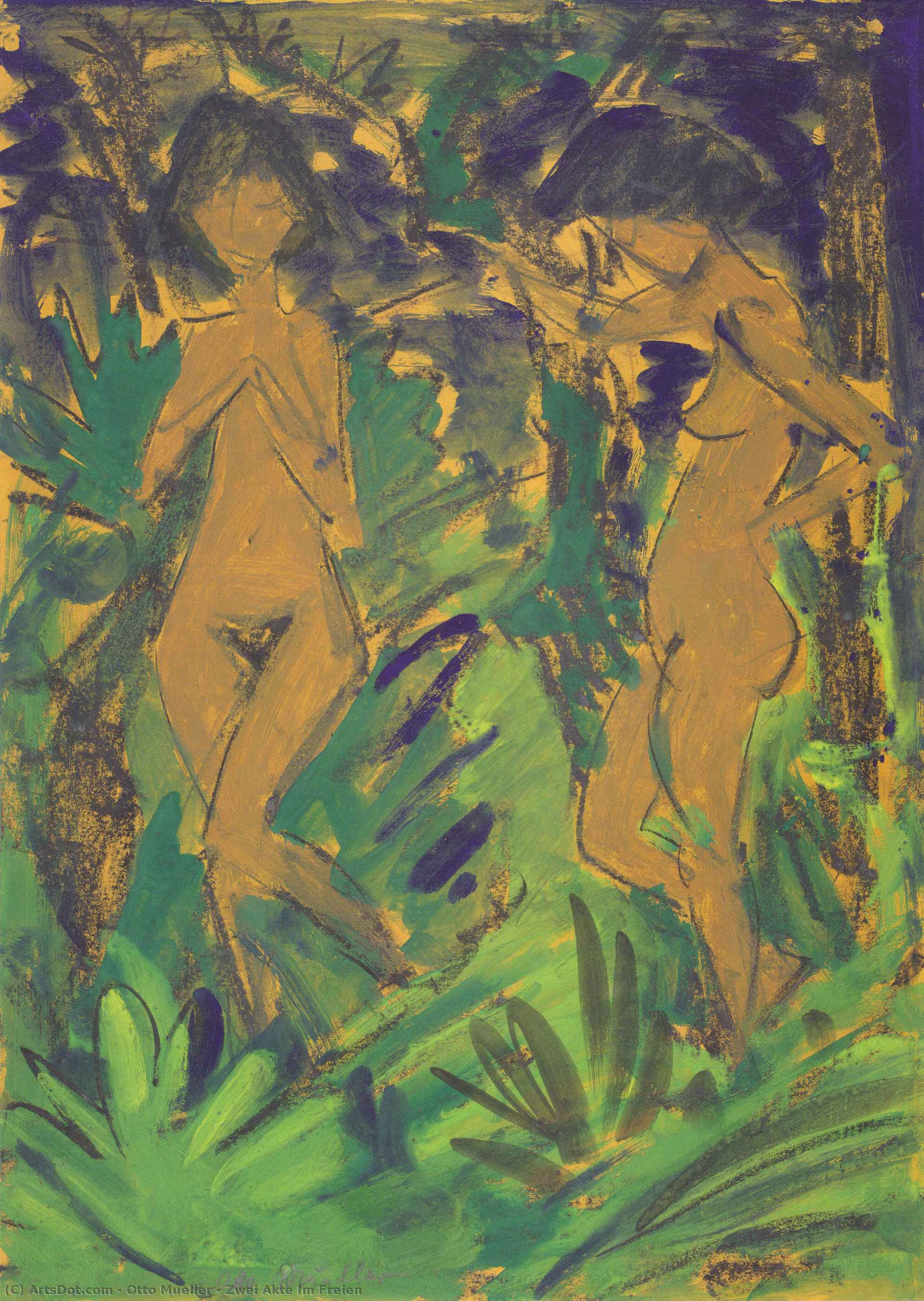
Otto Mueller's "Zwei Akte Im Freien" (Two Figures in the Open Air), painted in 1927, is more than just a depiction of two nude women amidst a verdant forest; it’s a profound meditation on human connection with nature and the subtle complexities of female relationships. Born in Liebau, Poland – a region steeped in both German and Slavic history – Mueller spent his life grappling with themes of isolation, longing, and the search for harmony between the individual and their surroundings. This painting exemplifies that journey, offering a glimpse into a world where form and color coalesce to evoke a powerful sense of quiet contemplation.
The scene unfolds within a densely packed woodland, rendered in Mueller’s signature style – a deliberate simplification of forms combined with an intense use of color. He eschewed the hyperrealism favored by some of his contemporaries, opting instead for a flattened perspective and bold, almost graphic brushstrokes. The figures themselves are presented with a remarkable degree of anonymity; their backs are turned to the viewer, preventing us from fully grasping their individual identities or emotions. Instead, we’re invited to focus on their shared posture – a relaxed leaning against one another, suggesting a comfortable intimacy born not of explicit communication but of mutual understanding and presence.
The Expressionist Palette and Technique
Mueller's technique is distinctly rooted in the early years of German Expressionism, yet he developed a unique approach that set him apart. He primarily employed distemper on coarse canvas – a method that produced a matte, slightly textured surface, lending an earthy quality to the work. This choice of medium, combined with his limited palette of predominantly greens, browns, and ochres, creates a sense of immediacy and rawness. The colors aren’t blended smoothly; rather, they are applied in distinct blocks, emphasizing their individual presence and contributing to the painting's overall feeling of solidity and groundedness.
The artist’s use of line is equally significant. Mueller employed clean, decisive lines to define the figures and the surrounding foliage, creating a sense of clarity and control within an otherwise somewhat ambiguous composition. These lines aren’t rigid or formal; they possess a subtle dynamism, suggesting movement and life. The interplay between these strong lines and the textured surface of the canvas adds another layer of visual interest, inviting the viewer to explore the painting's depths.
Symbolism and the Romantic Ideal
“Zwei Akte Im Freien” is rich in symbolic resonance. The forest itself represents a sanctuary – a space removed from the constraints of societal expectations and offering refuge for contemplation. The nude figures, often associated with vulnerability and innocence, are presented not as objects of desire but as embodiments of natural beauty and harmony. Their posture suggests a connection to the earth, mirroring the organic forms of the surrounding trees and undergrowth.
Mueller’s fascination with Egyptian art is evident in his simplified forms and emphasis on geometric patterns. He sought to capture the essence of human experience through abstraction, drawing inspiration from ancient civilizations that valued order and balance. The painting can be interpreted as a romanticized vision of nature – a place where individuals can reconnect with their primal instincts and find solace in the beauty of the natural world. It’s a yearning for a simpler existence, free from the complexities and anxieties of modern life.
A Legacy of Quiet Intensity
Otto Mueller's “Zwei Akte Im Freien” stands as a testament to his unique artistic vision – a synthesis of Expressionist principles, Romantic ideals, and a deep appreciation for the natural world. The painting’s enduring appeal lies in its ability to evoke a sense of quiet intensity, inviting viewers to contemplate the mysteries of human connection and the timeless beauty of the forest. Today, high-quality reproductions offer an accessible way to experience this remarkable work of art, bringing its evocative atmosphere into homes and galleries alike.