ピカソ(1881-1973)は、キュビスムの創始者であり、グエルニカやアヴィニョンの娘たちなどの象徴的な作品で知られるスペインの革命的な画家・彫刻家。多様なスタイルを駆使し、20世紀美術に多大な影響を与え続けています。
Still Life with Compote and Glass: A Reflection of Quiet Observation
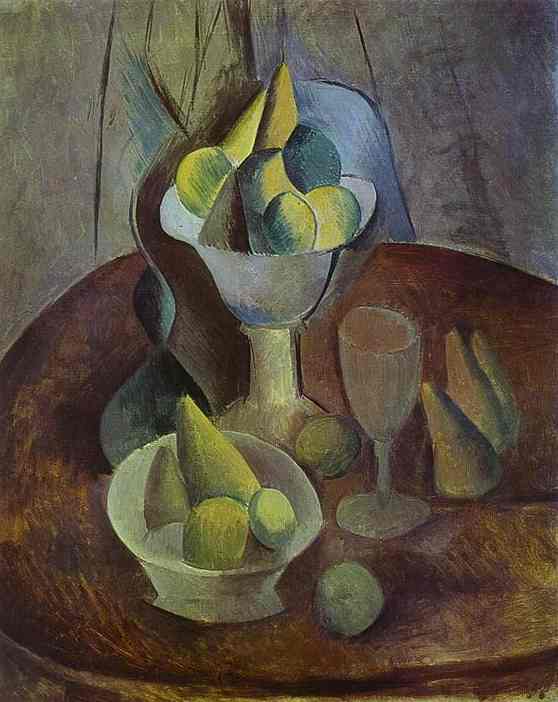
Pablo Picasso’s “Compotier, Fruit, and Glass” stands as a deceptively simple yet profoundly resonant testament to the artist's mastery of observation and his pioneering exploration of Cubist principles. Completed during the turbulent winter months of 1917-1918 – a period marked by the escalating horrors of World War I – this painting transcends mere depiction; it invites contemplation on themes of domestic tranquility juxtaposed with the anxieties of an era consumed by conflict. The artwork was on loan to the museum and has since been returned to its lender. Picasso meticulously rendered a tabletop arrangement featuring a compote brimming with citrus fruits—lemons and oranges—and three wine glasses, establishing a visual dialogue between natural beauty and human experience.
Cubist Innovation: Fragmented Perspectives
Picasso’s stylistic approach is undeniably rooted in Cubism, a movement he co-founded alongside Georges Braque. Unlike traditional representational art that strives for illusionistic depth, Cubism dismantles objects into geometric planes, presenting multiple viewpoints simultaneously. Here, Picasso achieves this effect through fractured lines and overlapping surfaces—notice how the bowl’s contours are broken down into angular shards, mirroring the fragmented reality perceived during wartime. The oranges and lemons aren't rendered as solid spheres but rather as flattened masses of color and texture, emphasizing their materiality while disrupting conventional spatial conventions. This technique wasn’t merely stylistic; it was a deliberate attempt to capture the complexities of perception and challenge viewers’ assumptions about how they see the world.
Symbolism Within Everyday Objects
Beyond its formal innovation, “Compotier, Fruit, and Glass” carries subtle symbolic weight. The fruit itself—particularly citrus fruits—often represent vitality and optimism amidst hardship. Their bright hues serve as a counterpoint to the muted tones of the surrounding composition, suggesting resilience and hope. Simultaneously, the wine glasses symbolize conviviality and social connection – an aspiration for normalcy in times of upheaval. Picasso’s careful positioning of these elements speaks volumes about his artistic intention: he seeks not just to record what is seen but also to convey a deeper emotional resonance. The artist's meticulous attention to detail underscores the importance of capturing the essence of a moment, transforming ordinary objects into vehicles for conveying profound ideas.
A Legacy of Artistic Transformation
Pablo Picasso’s influence on 20th-century art remains unparalleled. “Compotier, Fruit, and Glass” exemplifies his commitment to experimentation and his unwavering belief in the transformative power of artistic vision. It stands as a cornerstone of Cubism's legacy—a movement that irrevocably altered the course of Western painting and continues to inspire artists today. Investing in a high-quality reproduction allows collectors to appreciate not only Picasso’s technical brilliance but also the enduring emotional impact of this remarkable artwork, encapsulating a moment of quiet contemplation within the broader context of historical significance.