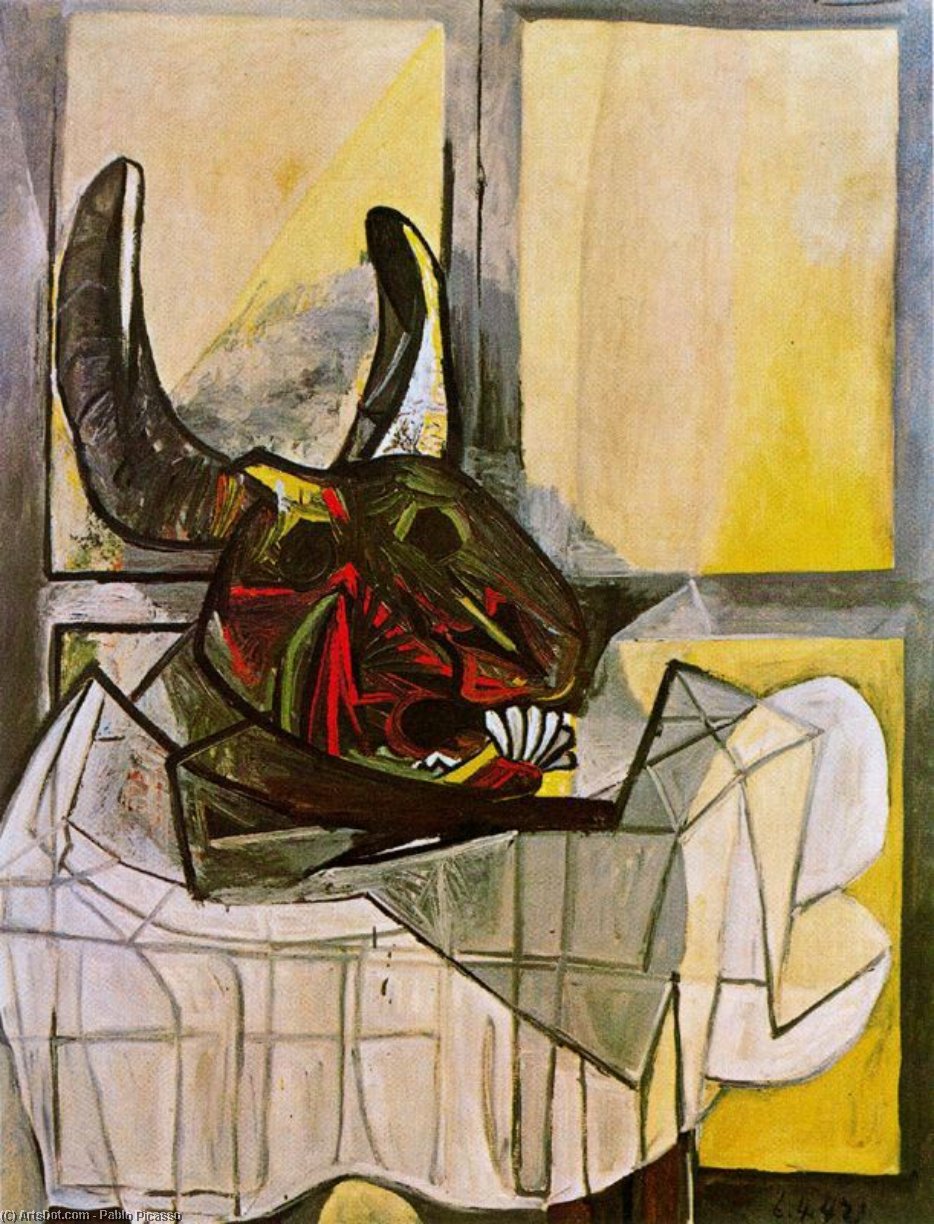
Explore Pablo Picasso’s ‘Head of a Bull on the Table,’ a striking Cubist masterpiece! Fragmented forms, bold colors & dynamic lines create an unsettling yet captivating abstract portrait. Discover this iconic artwork today.
ピカソ(1881-1973)は、キュビスムの創始者であり、グエルニカやアヴィニョンの娘たちなどの象徴的な作品で知られるスペインの革命的な画家・彫刻家。多様なスタイルを駆使し、20世紀美術に多大な影響を与え続けています。
A Revolutionary Still Life: Deconstructing Form in Picasso’s Bull
This captivating artwork embodies Pablo Picasso's pivotal role in the development of Cubism, presenting a fragmented and intellectually stimulating depiction of a bull’s head. Rather than offering a traditional representation, Picasso dissects and reassembles the subject, challenging conventional perceptions of form and reality. The work isn’t merely *of* a bull; it is an exploration *into* the very essence of seeing.
Style & Technique: Analytic Cubism in Action
Executed during Picasso's crucial Analytic Cubist period (approximately 1907-1912), this piece showcases the hallmarks of the style. A restrained palette – dominated by earthy yellows, rich browns, stark blacks, and punctuated reds – focuses attention on the deconstruction of form rather than vibrant color. Notice how the bull’s head is broken down into interlocking geometric planes: triangles, rectangles, and curves overlap and intersect, presenting multiple viewpoints simultaneously.
The application of paint is equally significant. Visible brushstrokes and evidence of palette knife work create a textured surface, lending an expressive rawness to the composition. The flattened perspective deliberately rejects traditional depth, emphasizing the two-dimensionality of the canvas while subtly suggesting volume through nuanced light and shadow originating from the upper left.
Symbolism & Historical Context: Beyond Representation
The bull holds deep cultural significance, particularly within Picasso’s Spanish heritage. It traditionally symbolizes strength, power, and even aggression – inextricably linked to the spectacle of bullfighting and its associated themes of ritualistic combat and mortality. However, within the context of Cubism, the bull transcends a simple animal representation. It becomes a vehicle for exploring the fundamental nature of perception itself.
This artwork emerged during a period of intense artistic experimentation in early 20th-century Paris. Picasso, alongside Georges Braque, actively rejected centuries of representational art, questioning the notion that paintings should merely *mimic* the visible world. Their aim was to capture the underlying structure of objects and convey a more complete understanding through fragmented perspectives – a direct response to the intellectual and artistic ferment of the time.
Emotional Impact & Interior Design Considerations
The overall effect is both unsettling and profoundly captivating. The fragmentation disrupts expectations, compelling viewers to actively reconstruct the image in their minds. It’s a work that demands attention and rewards sustained contemplation.
From an interior design perspective, this artwork serves as a powerful focal point. Its bold lines and limited color palette complement modern or minimalist spaces beautifully. The earthy tones harmonize with neutral schemes, while flashes of red provide dramatic accents. A high-quality reproduction would be particularly impactful in a study, living room, or dining area – any space designed to inspire conversation and intellectual engagement. This is a statement piece that reflects an appreciation for art history and innovative design.
About the Artist: Pablo Picasso (1881-1973)
Born in Málaga, Spain, Pablo Ruiz y Picasso demonstrated extraordinary artistic talent from a young age. His father, José Ruiz y Blasco, an art teacher, provided his initial training. Picasso quickly surpassed his father’s skill, displaying remarkable aptitude for naturalistic drawing. He studied at the School of Fine Arts in Barcelona and briefly attended the Royal Academy of San Fernando in Madrid, but found traditional academic instruction stifling. Instead, he immersed himself in the works of masters like Velázquez and Goya, laying the foundation for his revolutionary artistic journey. Picasso’s relentless experimentation led to the development of Cubism, forever changing the course of art history.