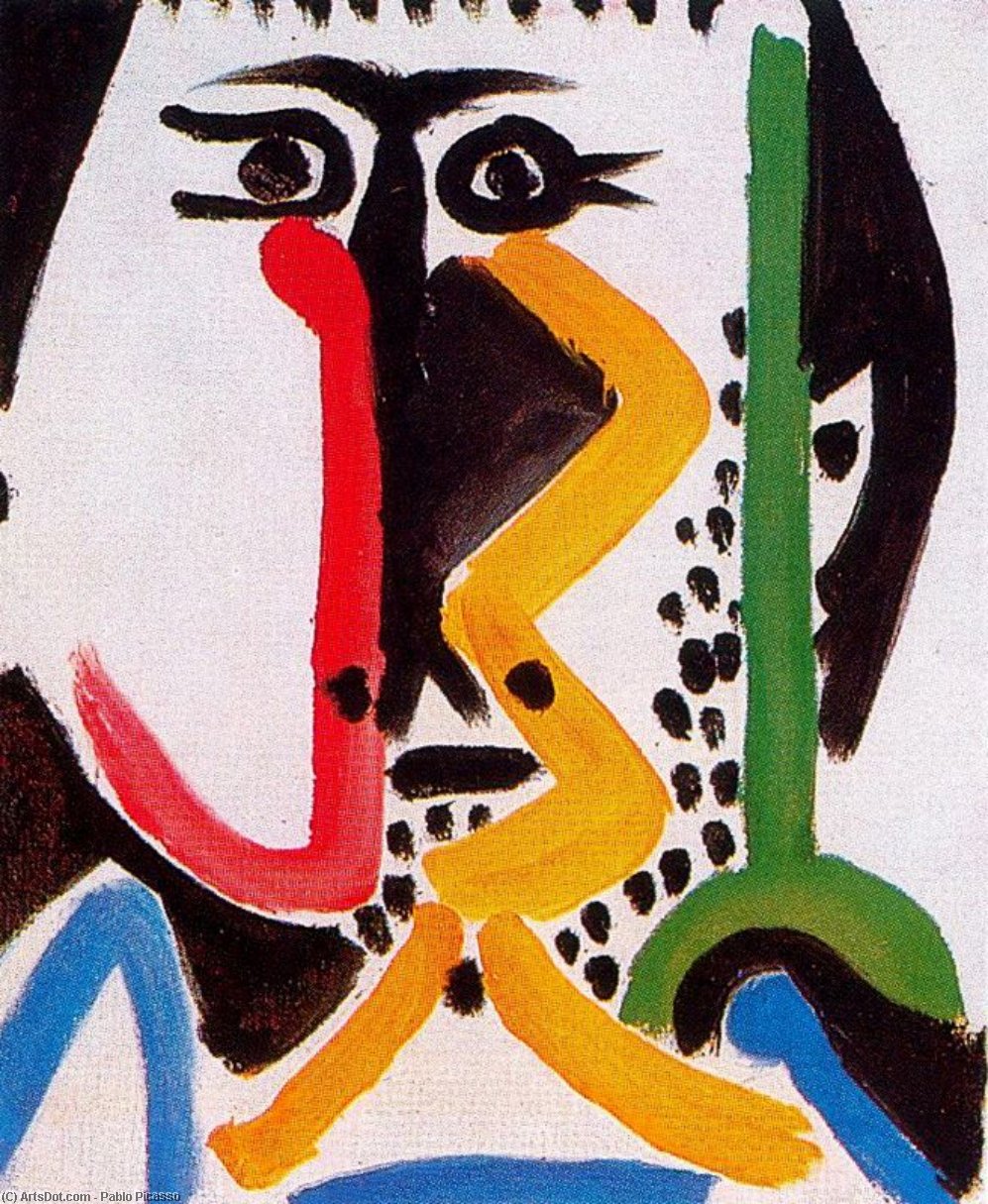
A Cubist Deconstruction: Unveiling Picasso’s ‘Head of a Man 15’
This artwork is a powerful testament to Pablo Picasso's groundbreaking exploration of form and perception during his pivotal Cubist period. It isn’t merely a representation *of* a man, but rather an intellectual dissection and reassembly of what it means to *see* a man – a radical departure from traditional portraiture. The work challenges viewers to reconsider their understanding of reality itself, presenting multiple viewpoints simultaneously on a single canvas.
Decoding the Analytical Cubist Style
‘Head of a Man 15’ is deeply rooted in the principles of Analytical Cubism, a style Picasso pioneered with Georges Braque between approximately 1908 and 1912. This phase moved away from visual fidelity, instead focusing on breaking down objects into fragmented geometric shapes – primarily rectangles and triangles – and reassembling them in an abstracted manner. Notice how traditional perspective is abandoned; depth is suggested not through shading or vanishing points, but through the overlapping of planes. The limited palette and flattened space are hallmarks of this approach, prioritizing conceptual understanding over illusionistic realism.
Picasso wasn’t aiming to replicate what he saw, but rather to represent what he *knew* about the subject.
Technique & Materiality: A Textured Exploration
The visible brushstrokes, particularly in the darker areas of the composition, reveal a dynamic and expressive application of oil paint. This isn’t about seamless blending; it's about the physicality of the medium itself contributing to the artwork’s impact. The texture adds complexity, offering insight into Picasso’s process – as if he were constructing the face layer by layer rather than simply painting it.
The deliberate layering suggests a building up of form, an almost sculptural approach to two-dimensional representation.
Historical Context: A Revolution in Art
To fully appreciate this work, one must understand the artistic climate of the early 20th century. Traditional academic art was under scrutiny, challenged by new theories about perception and representation. Artists like Paul Cézanne had already begun to question conventional perspective, paving the way for more radical experimentation. Picasso, influenced by Iberian sculpture and African masks (evident in his earlier works), took this exploration further, dismantling traditional form altogether. Cubism wasn’t just a stylistic innovation; it was a philosophical statement about the subjective nature of reality – our understanding is always partial and dependent on perspective.
Symbolism & Emotional Resonance: Fragmentation and Inner Turmoil
Despite its abstraction, ‘Head of a Man 15’ carries significant emotional weight. The fragmentation of the face can be interpreted as symbolic of inner conflict or psychological distress. The angularity of the lines and disjointed composition evoke feelings of unease and alienation. This is a far cry from idealized portraits; instead, it presents a raw, almost brutal honesty about the complexities of human experience.
The subject’s gaze, though abstracted, feels intensely present, conveying introspection or even anguish.
Interior Design & Collectibility: A Statement Piece
A high-quality reproduction of this artwork would serve as a striking focal point in any modern or contemporary interior. Its bold geometric forms and muted palette complement minimalist spaces while adding depth and intellectual intrigue. The piece’s historical significance, coupled with its association with one of the most influential artists of all time, makes it a highly desirable addition to any art collection. It appeals to those who appreciate challenging perspectives and innovative artistic expression.
Key Characteristics
- Style: Analytical Cubism
- Medium: Oil on Canvas (likely)
- Dominant Forms: Rectangular and triangular shapes
- Palette: Muted, earthy tones
- Emotional Impact: Unease, introspection, fragmentation