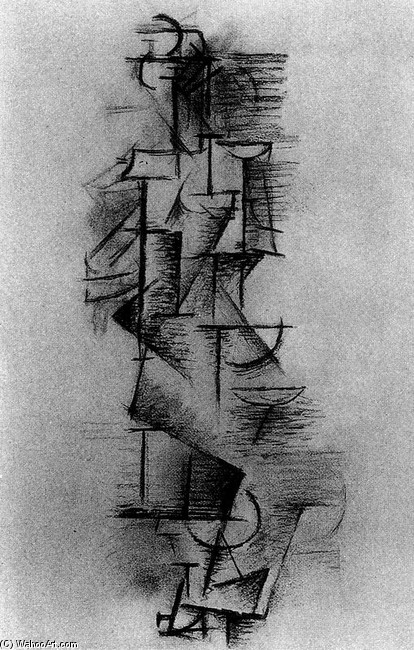
Black & white Picasso drawing: Fragmented figure, Cubist/Expressionistic style. Explore this dynamic, emotionally charged artwork – a key piece by the master.
ピカソ(1881-1973)は、キュビスムの創始者であり、グエルニカやアヴィニョンの娘たちなどの象徴的な作品で知られるスペインの革命的な画家・彫刻家。多様なスタイルを駆使し、20世紀美術に多大な影響を与え続けています。
Pablo Picasso’s Fragmented Feminine Figure – A Study in Expressionist Minimalism
Pablo Ruiz y Picasso, born October 25, 1881, in Málaga, Spain, stands as one of the most influential figures in twentieth-century art. From his earliest drawings—legend recounts he uttered “piz, piz,” attempting to say ‘pencil’—Picasso demonstrated an unparalleled aptitude for visual representation that foreshadowed his revolutionary artistic trajectory. His formative years were marked by familial upheaval and personal loss, experiences which subtly permeated his oeuvre with themes of melancholy and mortality, shaping him into the artist he would become. Despite initial inclinations toward naturalistic depiction, Picasso swiftly embraced abstraction, fundamentally altering the course of art history alongside Georges Braque.
A Cubist Echo in Monochrome
“Mujer desnuda de pie con una toalla,” a drawing executed by Picasso around 1923-1924, exemplifies his masterful distillation of Cubist principles into a strikingly reductive monochrome palette. The artwork presents a figure—likely male—positioned upright, rendered with an unsettling stillness that belies the dynamism inherent in its geometric construction. Unlike traditional depictions of the nude form, Picasso dismantles it into fragmented planes and intersecting lines—a hallmark of Cubism’s analytical phase—creating a visual experience that prioritizes structure over illusion. The dominant use of charcoal or graphite lends the piece a palpable textural quality, mirroring the artist's preoccupation with conveying emotion through surface materiality.
Deconstructing Form Through Line and Plane
The composition is vertically oriented, emphasizing height and linearity, reinforcing the sense of tension conveyed by Picasso’s stylistic choices. Sharp angles define the figure’s contours, while rectangular and triangular shapes contribute to the overall fragmentation—a deliberate rejection of representational accuracy in favor of exploring underlying spatial relationships. The artist skillfully manipulates shading to suggest depth without resorting to conventional perspective, furthering the impression of psychological intensity. Light appears to emanate from above, casting shadows that accentuate the form’s dimensionality and heighten its expressive power.
Symbolism of Alienation and Emotional Resonance
Beyond its formal innovations, “Mujer desnuda de pie con una toalla” speaks volumes about Picasso's artistic vision. The fractured figure can be interpreted as a symbol of alienation—a reflection of the anxieties prevalent in the interwar period—and embodies the artist’s exploration of inner turmoil. Picasso’s masterful use of monochrome enhances the artwork’s emotional impact, stripping away distracting color to focus on the raw essence of human experience. It's a testament to his ability to communicate profound feelings through deceptively simple visual elements.
A Legacy of Innovation
Picasso’s enduring influence stems from his unwavering commitment to experimentation and his refusal to adhere to artistic conventions. “Mujer desnuda de pie con una toalla” stands as a cornerstone of Expressionist minimalism, demonstrating Picasso's capacity for transforming complex ideas into powerfully evocative images—a legacy that continues to inspire artists and captivate audiences worldwide.