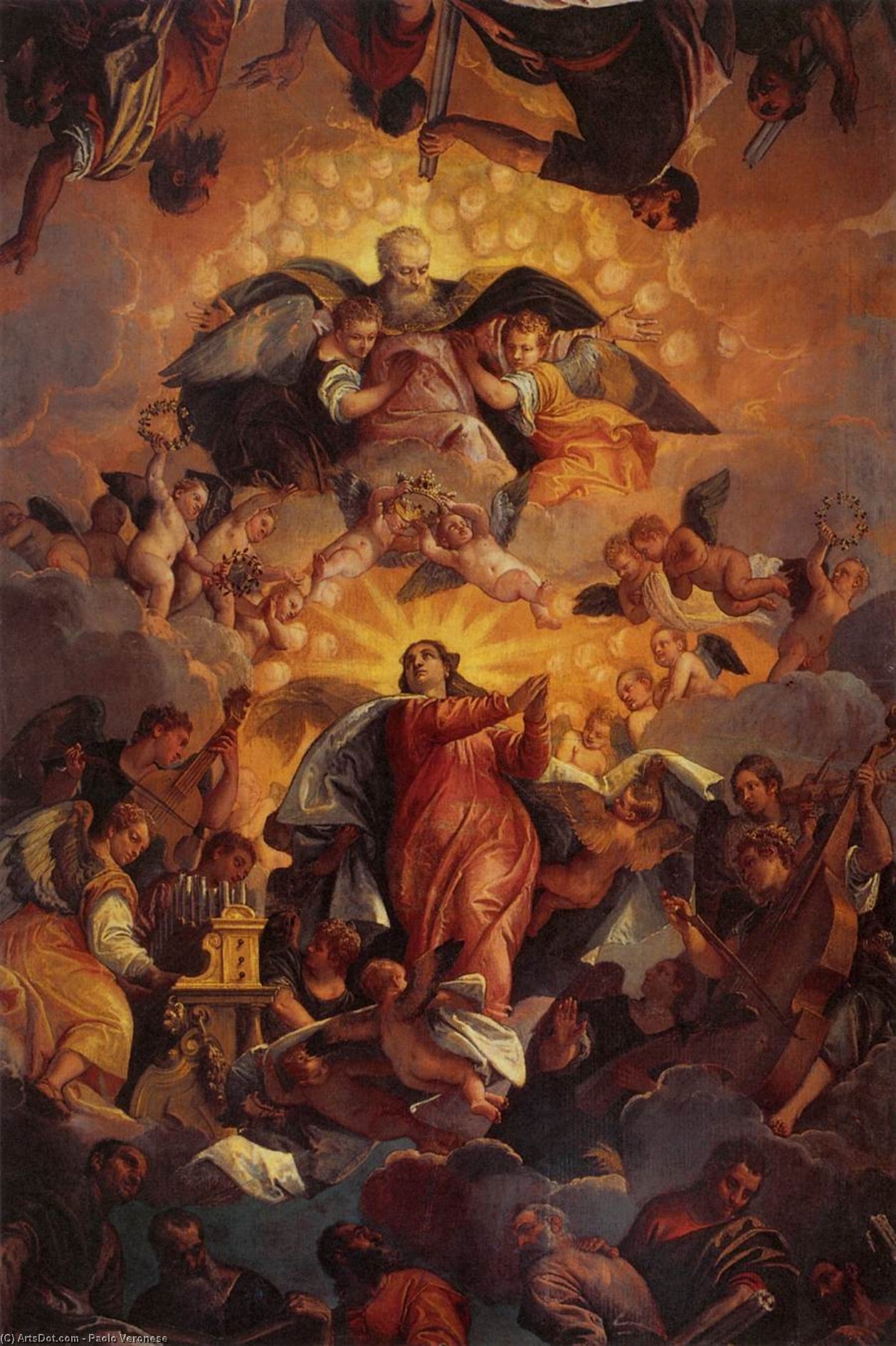
A Celestial Ascent: The Grandeur of Veronese’s Assumption
In the vast, sweeping expanse of Paolo Veronese’s Assumption, the viewer is not merely an observer but a witness to a divine phenomenon. Painted in 1587, this monumental masterpiece captures the profound moment when the Virgin Mary is lifted from the earthly realm toward the heavens. The composition is a breathtaking whirlwind of motion and light, where the boundaries between the terrestrial and the celestial dissolve. As Mary ascends, she is enveloped by a celestial host; angels drift through the clouds like fragments of light, their forms strategically placed to guide the eye upward in a rhythmic, swirling dance. This dynamic arrangement creates a sense of weightlessness, pulling the soul toward the heavens alongside the central figure.
Veronese, a titan of the Venetian Renaissance, employs his signature mastery of color and light to breathe life into this sacred event. The palette is nothing short of opulent, characterized by the luminous, shimmering tones that defined the Venetian school. One can almost feel the warmth of the divine radiance reflecting off the silken draperies of the angels and the soft, ethereal glow surrounding Mary’s visage. His technique utilizes a sophisticated interplay of light and shadow—chiaroscuro—to provide depth to the massive 472 x 302 cm canvas, ensuring that even from a distance, the figures possess a sculptural presence that commands the room.
Symbolism and the Venetian Spectacle
Beyond its religious significance, the painting serves as a profound study in human emotion and divine order. While the upper register of the painting is a theater of angelic splendor, the lower portion grounds the viewer in the earthly experience. The presence of figures near the bottom—men and onlookers caught in moments of awe, confusion, or prayer—serves to bridge the gap between the mortal and the divine. These figures act as emotional anchors, reflecting the human response to the miraculous. Veronese uses these secondary characters to weave a narrative of communal reverence, making the cosmic event feel intimately connected to the human condition.
For the discerning collector or interior designer, this work represents more than just a religious icon; it is an architectural statement of elegance and prestige. The sheer scale and complexity of the Assumption make it an ideal centerpiece for grand halls, sophisticated galleries, or luxurious living spaces. A high-quality reproduction of this piece allows one to invite the dramatic, light-filled atmosphere of 16th-century Venice into a modern setting. It offers a sense of historical continuity and intellectual depth, providing a focal point that sparks conversation and evokes a sense of timeless wonder.