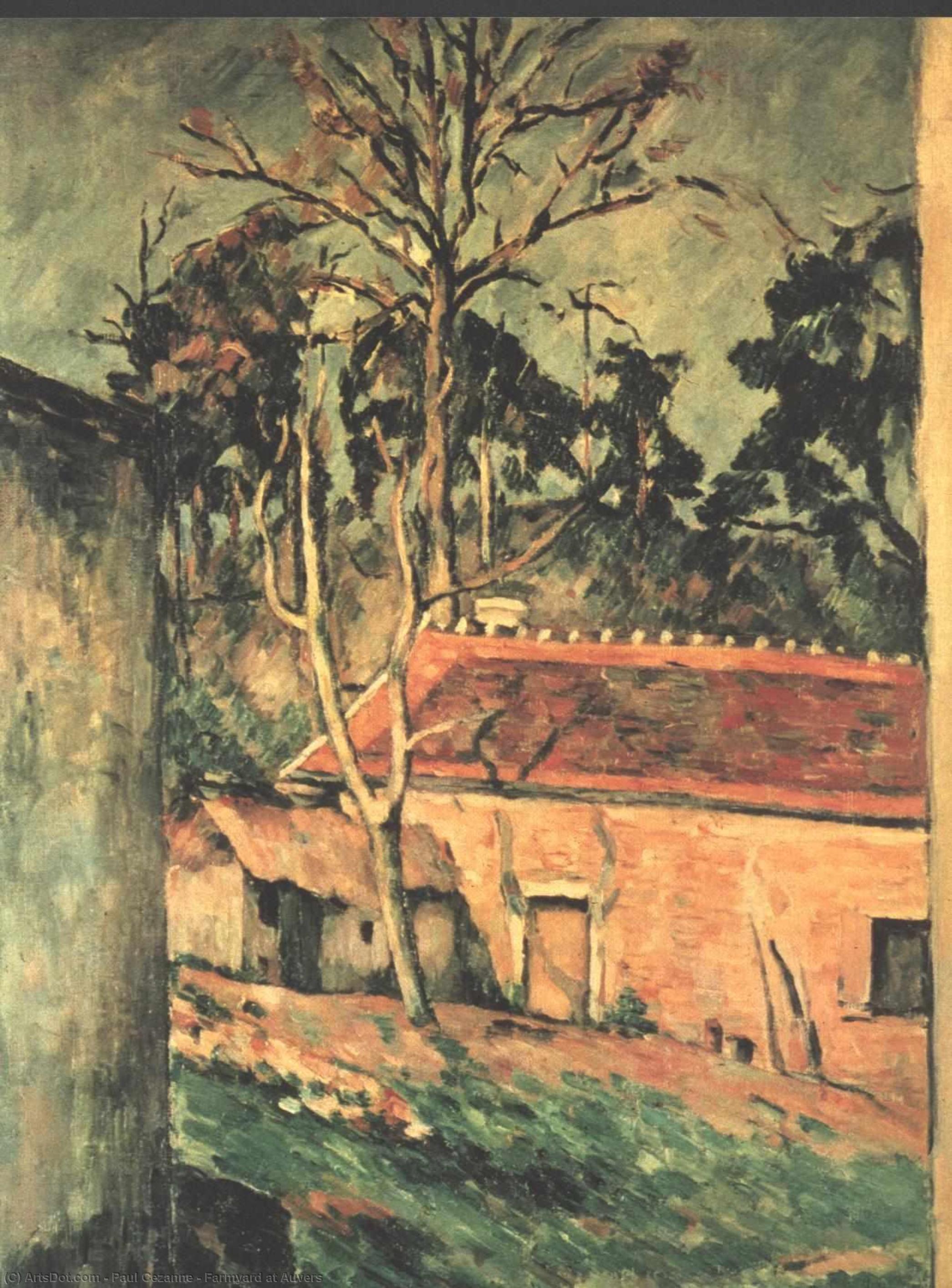
Paul Cézanne’s “Farmyard at Auvers”: A Bridge Between Worlds
Paul Cézanne's "Farmyard at Auvers," painted in 1880, isn’t merely a depiction of rural life; it’s a profound statement about the nature of seeing and representing reality. This oil on canvas, measuring just 65 x 54 cm, embodies Cézanne’s revolutionary approach to Post-Impressionism – a deliberate dismantling of traditional perspective and a passionate exploration of form and color that would irrevocably influence generations of artists. More than a snapshot of a French countryside scene, it's an invitation into the artist’s mind, revealing his meticulous observation and his desire to capture not just what he saw, but *how* he perceived it.
The painting immediately draws the eye to the central farmhouse, its distinctive red roof blazing against the muted tones of the surrounding landscape. Cézanne doesn't offer a realistic rendering; instead, he simplifies and geometricizes the forms – the house becomes a collection of interlocking rectangles and planes, while the trees are abstracted into dynamic, almost sculptural shapes. This deliberate reduction isn’t about inaccuracy; it’s about distilling the essence of the subject down to its fundamental components. The two figures present—a man standing near the house and another further away—add a touch of human presence, yet they remain secondary to the dominant architectural forms. They are not characters in a story but rather anchors within this carefully constructed visual space.
The Language of Color and Form
Cézanne’s technique is as crucial as his composition. He employs bold, expressive brushstrokes – thick impasto applied with a confident hand – that create a palpable sense of texture and movement. The colors are not blended smoothly; instead, they are juxtaposed in vibrant, often unexpected combinations. Notice the interplay between the warm reds and yellows of the farmhouse and the cooler greens and blues of the surrounding trees. This deliberate contrast creates visual tension and dynamism, preventing the scene from feeling static or lifeless. Cézanne’s use of color is not descriptive; it's emotive – designed to evoke a particular mood and atmosphere.
The painting’s structure reflects Cézanne’s fascination with geometry. He meticulously analyzed the shapes and angles of objects, translating them into a new visual language. This approach was deeply influenced by his studies of Japanese prints, which emphasized flattened perspectives and simplified forms. “Farmyard at Auvers” is therefore not simply a landscape; it's an exercise in spatial reasoning – a demonstration of how to represent three-dimensional space on a two-dimensional surface.
Context and Legacy
Painted during Cézanne’s time in Auvers-sur-Oise, near Paris, the painting reflects his growing interest in rural life and his desire to capture the essence of everyday existence. He spent much of his career observing and documenting the landscapes around him, seeking to understand their underlying structure and form. “Farmyard at Auvers” is part of a larger body of work that explored this theme – works like "Mountains in Provence. L'Estaque" demonstrate a similar preoccupation with capturing the essence of nature through simplified forms and bold colors.
Cézanne’s influence extends far beyond his immediate contemporaries. He paved the way for Cubism, with its fragmented perspectives and geometric abstractions, and inspired countless artists who sought to break free from traditional representational art. Artists like Picasso and Braque directly acknowledged Cézanne's profound impact on their work. His legacy lies not just in individual paintings but in his revolutionary approach to seeing and representing the world – a method that continues to resonate with artists and viewers today.
Bringing “Farmyard at Auvers” Home
ArtsDot offers meticulously crafted, hand-painted reproductions of "Farmyard at Auvers," allowing you to bring this iconic masterpiece into your own space. Each reproduction is created by skilled artisans using the same techniques and materials as Cézanne himself, ensuring an authentic representation of his artistic vision. Whether you’re a seasoned art collector or simply seeking to add a touch of timeless beauty to your home, our reproductions provide a stunning way to experience the power and elegance of this pivotal work.
Explore more works by Paul Cézanne on ArtsDot.com, including “Mountains in Provence. L'Estaque” and “Pine Trees in Front of the Wall of the Asylum,” and discover the breadth of his artistic genius. For a deeper dive into Cézanne’s life and work, consider visiting the resources linked below:
ArtsDot.com – Where art history comes to life.