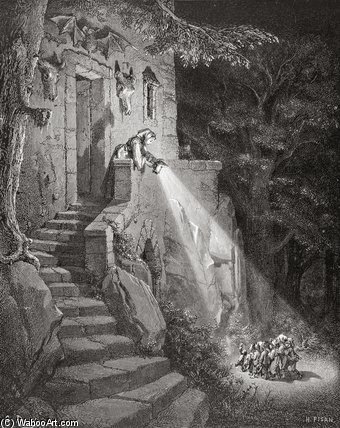
The Dwelling Of The Ogre: A Gothic Vision Brought To Life By Gustave Doré
Paul Gustave Doré’s “The Dwelling Of The Ogre,” created circa 1868, stands as a testament to Romanticism's fascination with the grotesque and its ability to evoke profound psychological drama. Engraved by Heliodore Joseph Pisan after Doré’s original sketch, this monumental print captures a chilling tableau of biblical terror—specifically, the descent into Gehenna depicted in Dante Alighieri’s Inferno. More than just an illustration; it's a meticulously crafted artistic statement that delves into themes of morality, damnation, and the human condition.
- Composition & Perspective: Doré employs a masterful pyramidal composition, anchoring the viewer’s gaze on the central figure—a lone man illuminated by a radiant beam of light—atop a towering stone edifice. The staircase spiraling downwards symbolizes the arduous journey toward salvation and contrasts sharply with the shadowy abyss below. Linear perspective skillfully creates depth, drawing the eye into the unsettling scene and reinforcing its dramatic impact. This deliberate arrangement underscores the narrative’s core conflict: humanity's confrontation with divine judgment.
- Technique & Material: Doré’s technique is characterized by painstaking engraving—a process demanding immense patience and precision. Hatching and crosshatching dominate the rendering of the stone structure and foliage, generating a palpable sense of texture and conveying the oppressive atmosphere of Gehenna. The artist's meticulous attention to detail elevates the print beyond mere depiction; it strives for an immersive experience that captures the essence of Dante’s vision. This painstaking method ensured unparalleled realism and emotional resonance—a hallmark of Doré’s oeuvre.
- Color Palette & Lighting: Strikingly devoid of color, “The Dwelling Of The Ogre” relies entirely on grayscale tones—ranging from deepest blacks to brilliant whites—to maximize contrast and heighten emotional intensity. The dramatic lighting—a single, piercing beam emanating from above—serves as a beacon of divine grace amidst the pervasive darkness, symbolizing hope amidst despair. This masterful use of chiaroscuro powerfully communicates the psychological torment experienced by Dante’s protagonist.
- Symbolism & Narrative Depth: Beyond its visual grandeur, the print resonates with symbolic significance. The solitary figure embodies humanity’s struggle against evil and represents the individual confronting mortality. Bats circling overhead contribute to the unsettling mood, representing corruption and demonic influence—a deliberate allusion to Dante's depiction of Hell’s inhabitants. These elements collectively convey a profound meditation on faith, fear, and redemption.
- Historical Context & Artistic Influence: Doré’s engraving emerged during a period marked by intellectual ferment and artistic experimentation. It reflects Romanticism’s preoccupation with emotion, imagination, and the sublime—qualities that Doré expertly embodies in his artwork. Furthermore, “The Dwelling Of The Ogre” profoundly impacted subsequent artists, establishing Doré as a pioneer of theatrical illustration and cementing his legacy as one of the most influential printmakers of the Victorian era. Its influence can be seen in countless later depictions of hellish landscapes and tormented figures—a testament to Doré’s enduring artistic vision.
Where to Find High-Quality Reproductions: Explore stunning giclee prints of “The Dwelling Of The Ogre” at ArtsDot.com:
ArtsDot – Experience the gothic grandeur of Doré’s masterpiece in exceptional detail!
Explore More About Gustave Doré: Discover his life and artistic journey at
ArtsDot.