A Window Into Renaissance Bruges
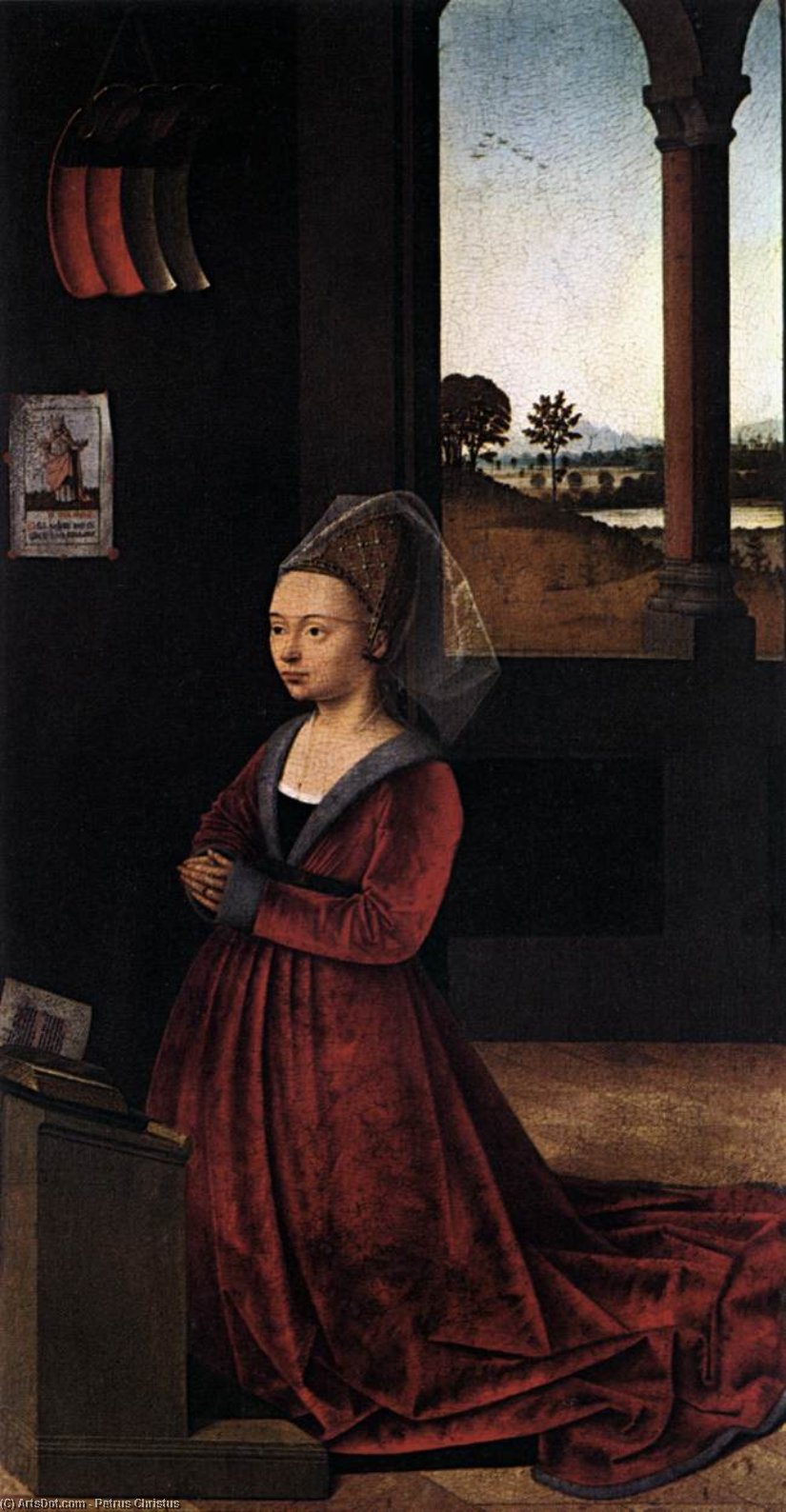
In the quiet, contemplative stillness of Petrus Christus’s "Wife of a Donor," completed around 1450, we are invited to step through a portal into the golden age of Flanders. This masterpiece of Early Netherlandish art does far more than capture a likeness; it serves as an exquisite meditation on the intersection of earthly prosperity and spiritual devotion. As one gazes upon the central figure, a woman seated with profound grace at her desk, there is an immediate sense of being transported to a private, sacred moment in 15th-century Bruges. The painting breathes with the atmosphere of a world where every texture, from the heavy velvet of a sleeve to the soft light filtering through a window, was imbued with meaning and reverence.
The visual journey begins with the artist's pioneering use of linear perspective, a technique that revolutionized how depth was perceived in Northern Europe. Christus, working in the shadow of giants like Jan van Eyck, achieved a breathtaking illusion of three-dimensional space. The architectural elements—the sturdy columns and elegant arches—do not merely frame the subject; they anchor her within a tangible, believable reality. This mastery of space is complemented by a sophisticated use of chiaroscuro, where the delicate interplay between light and shadow sculpts the woman's form, lending her a lifelike presence that feels almost palpable to the viewer.
The Language of Symbolism and Splendor
To look closely at this work is to read a silent poem written in color and light. The sitter is draped in opulent crimson robes, a hue that speaks of both royal dignity and the profound spiritual passion of the era. Her attire, paired with a meticulously rendered blue bodice, creates a striking visual harmony that commands attention against the more muted, somber tones of the interior. Every detail—the open book upon her lectern, the way her gaze drifts toward an unseen point of reflection, and the landscape visible through the window—serves as a symbol of her piety and intellectual engagement. The book suggests a life of study and prayer, while the distant, sunlit world outside provides a beautiful contrast to the intimate, cloistered atmosphere of her study.
For the discerning collector or interior designer, this painting offers more than just aesthetic beauty; it offers a sense of timelessness and intellectual depth. The way the natural light illuminates the textures of the wood and fabric creates a dynamic energy that can transform any space, bringing a touch of historical grandeur and quiet sophistication to a room. It is a piece that invites long periods of contemplation, acting as a focal point that stimulates both the eye and the soul.
A Legacy of Technical Mastery
The enduring allure of Petrus Christus lies in his ability to blend meticulous realism with profound emotional resonance. His brushwork, though incredibly fine, never feels clinical; instead, it possesses a warmth that celebrates the human experience. The way he captures the subtle variations in skin tone and the soft glow of light on a polished surface demonstrates a level of technical skill that remains awe-inspiring centuries later. Owning a high-quality reproduction of this work allows one to preserve this legacy of Northern Renaissance brilliance, making the profound beauty of Bruges a permanent part of one's personal sanctuary.