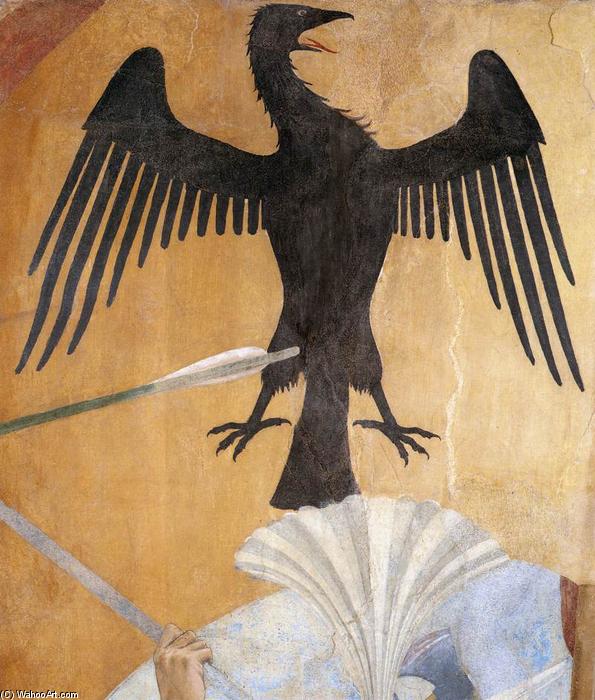
8. Battle between Heraclius and Chosroes (detail) (12)
The “Battle between Heraclius and Chosroes” is a captivating fresco by the renowned Italian artist Piero Della Francesca, created in 1452. This masterpiece is part of his larger work, “The Legend of the True Cross,” which adorns the walls of the Basilica of San Francesco in Arezzo, Italy.
The Historical Context
This fresco depicts a pivotal moment in history: the battle between Heraclius, the Byzantine Emperor, and Chosroes, the Sassanian King. The scene is set against the backdrop of a cityscape, with fluttering banners and architectural elements that reflect Piero della Francesca’s advanced knowledge of perspective. It commemorates a decisive confrontation between two empires vying for dominance in the Levant during the Seventh Ecumenical Council (692–693). The conflict symbolized the clash between Christianity and Zoroastrianism—the latter being the dominant religion in Persia at the time—and represented a struggle for spiritual supremacy as much as it did for political control. Historians believe that Piero della Francesca meticulously researched the event, incorporating details from contemporary chronicles to convey its significance accurately.
Artistic Techniques
Piero della Francesca employs a muted color palette punctuated by vivid hues, lending gravity to the historic narrative. The use of perspective creates a sense of depth, with figures in the foreground appearing larger than those in the distance. This technique was characteristic of the Early Renaissance period and exemplifies Della Francesca’s mastery of illusionistic painting—a cornerstone of his artistic vision. He skillfully renders textures and drapery folds, demonstrating an exceptional understanding of anatomy and spatial representation. The fresco's composition is carefully balanced, guiding the viewer’s eye across the scene with deliberate precision.
Key Elements
-
Chaotic Clash: The central focus is on the chaotic clash of warriors, with horses rearing amidst the melee. Piero della Francesca captures the dynamism of battle through dynamic lines and overlapping forms, conveying a palpable sense of urgency and violence.
-
Observers and Procession: On the left, a group of observers watches the battle unfold, while on the right, the scene extends into a more orderly procession of figures, hinting at the aftermath of the conflict. This juxtaposition underscores the contrast between active engagement and contemplative reflection—themes central to Renaissance humanist thought.
-
Symbolism: The cityscape serves as a visual metaphor for the broader struggle between civilizations, highlighting the importance of faith and resilience in overcoming adversity. The meticulous rendering of architectural details reinforces this symbolic dimension.
Relevance in Art History
This fresco is part of “The Legend of the True Cross,” a sequence of frescoes that narrates the triumph of the True Cross over pagan idolatry. It demonstrates Piero della Francesca’s skill in pictorial construction and his attention to historical accuracy and human emotion. He stands as one of the foremost artists of his time, embodying the ideals of Renaissance art—clarity, balance, and intellectual rigor—and securing a place among the most influential figures in Western artistic heritage.
Other Notable Works by Piero Della Francesca
-
6. Torture of the Jew (detail)
-
6. Torture of the Jew (detail)
-
Piero Della Francesca
-
San Lorenzo
-
San Francesco
For more information on Piero della Francesca and his works, visit https://ArtsDot.com.