A Divine Encounter: Piero della Francesca’s “Madonna and Child”
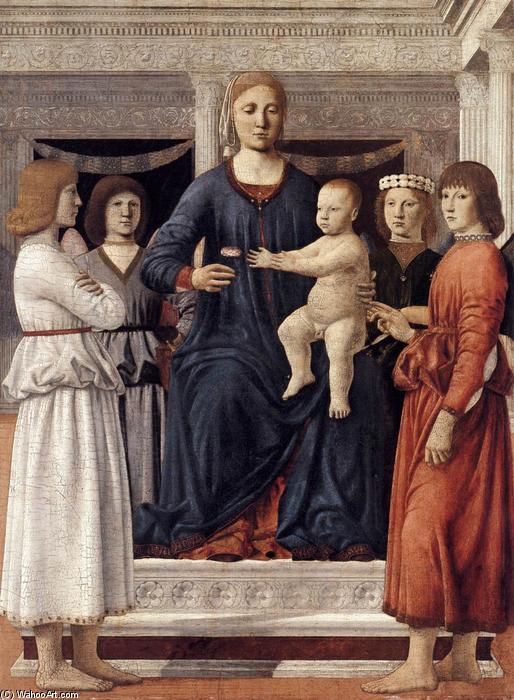
Piero della Francesca's "Madonna and Child Attended by Angels," painted around 1460, isn’t merely a depiction of the Virgin Mary and her son; it’s a profound meditation on faith, harmony, and the very essence of Renaissance humanism. This oil-on-panel masterpiece, currently residing in the Sterling and Francine Clark Art Institute, transcends its religious subject matter to offer a glimpse into the artist's meticulously crafted worldview – a world where geometry, perspective, and serene beauty converge.
The painting immediately captivates with its remarkable spatial clarity. Unlike many of his contemporaries who favored dramatic lighting and emotional intensity, Piero employs a cool, almost clinical precision. The figures are rendered with an astonishing degree of realism, appearing as if sculpted from marble – a technique deeply influenced by classical antiquity, which he so admired. This isn’t a scene brimming with passionate gestures; instead, it exudes a quiet dignity and contemplative stillness. The composition is carefully balanced, drawing the eye towards the central figures while subtly guiding it through the architectural backdrop.
The Architecture of Faith: Setting and Symbolism
The setting itself is crucial to understanding the painting’s meaning. The building with its imposing columns isn't a mere decorative element; it represents a temple or palace, perhaps even an idealized representation of Florence itself. This architectural framework elevates the scene, suggesting a sacred space – a realm where earthly concerns momentarily recede and divine grace prevails. The placement of the figures within this structure reinforces their importance, creating a sense of reverence and protection.
Beyond the architecture, every detail contributes to the painting’s symbolic richness. The angels flanking Mary and Christ aren't depicted as flamboyant messengers; they are rendered with an understated elegance, their wings subtly suggested rather than dramatically displayed. The gesture of the angel on the right, offering a flower to the infant Jesus, is particularly poignant – a visual representation of divine love and nurturing. Even the muted color palette—primarily blues, browns, and ochres—contributes to the painting’s sense of solemnity and timelessness.
A Renaissance Vision: Piero della Francesca's Technique
Piero della Francesca was a master of perspective and geometry, concepts he meticulously studied and applied to his art. His use of linear perspective—the illusion of depth created through converging lines—is remarkably sophisticated for the time, lending an extraordinary sense of realism to the scene. The figures appear to exist within a three-dimensional space, inviting the viewer to step into the painting and become part of the divine encounter.
Furthermore, his mastery of oil paint allowed him to achieve incredible detail and luminosity. The textures of the fabrics, the smoothness of the skin, and the subtle gradations of light are all rendered with breathtaking precision. This technical virtuosity is not merely a display of skill; it’s an integral part of Piero's artistic vision—a way of capturing the beauty and order of the natural world.
A Legacy of Serenity: Relevance Today
“Madonna and Child Attended by Angels” remains a profoundly moving work of art, offering a timeless meditation on faith, family, and the enduring power of human creativity. Its serene composition, meticulous technique, and symbolic richness continue to resonate with viewers today, reminding us of the beauty and spiritual depth that can be found in even the most seemingly simple images. Reproductions by ArtsDot.com offer an exceptional opportunity to bring this Renaissance masterpiece into your home or office, allowing you to experience its timeless appeal firsthand.