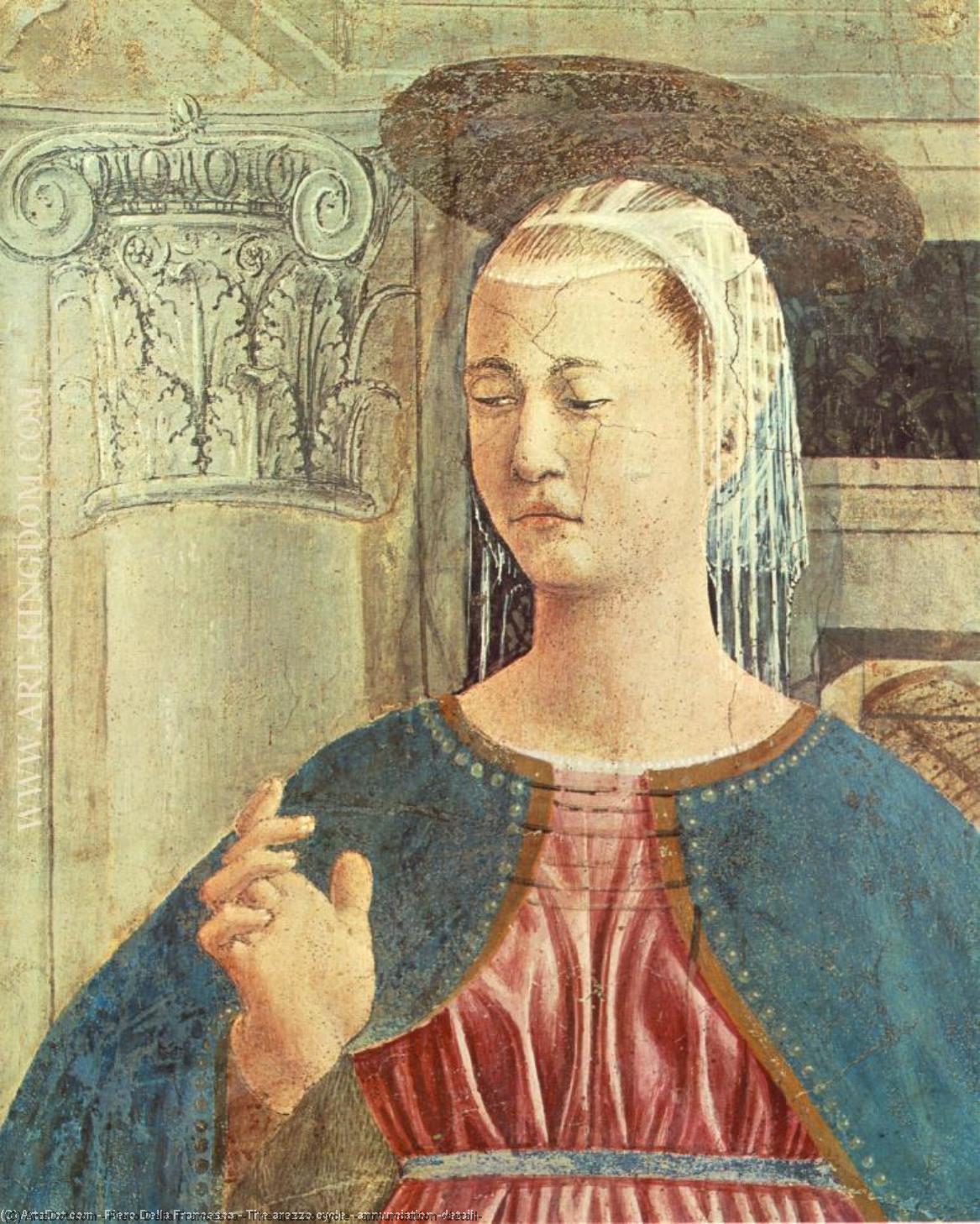
A Glimpse into Divine Grace: Examining Piero della Francesca’s ‘The Annunciation’ (Detail)
Piero della Francesca, born around 1415 in San Sepolcro, Umbria, stands as a singular figure within the Early Renaissance landscape – an artist whose intellectual curiosity rivaled his artistic prowess. Unlike many of his contemporaries who basked in the limelight of Florentine patronage and documented lives brimming with social activity, Piero’s existence remains shrouded in relative obscurity, leaving scholars to piece together fragments of information about his family and formative years. Yet, what emerges is undeniably remarkable: a mind captivated by both the burgeoning artistic innovations of Florence and the exacting precision of mathematics and geometry – principles that would permeate his oeuvre and solidify his reputation as one of the most conceptually astute painters of his time.
- The Fresco’s Silent Narrative
- Geometric Harmony: Della Francesca's Mathematical Vision
- Symbolism of Light and Virginity
- A Window into Medieval Legend
- Emotional Resonance: Contemplation and Serenity
The Fresco’s Silent Narrative
This exquisite detail from Piero della Francesca's monumental fresco cycle, “The Legend of the True Cross,” transcends mere visual representation; it speaks volumes about humanist ideals and theological contemplation. The central figure—a woman draped in a luminous blue gown—dominates the composition with an understated elegance. Her gaze is downward, conveying not merely repose but profound introspection – a gesture that invites viewers to engage in their own spiritual reflection. Accompanying her are two men, positioned on either side of the scene, adding depth and complexity to the narrative without resorting to dramatic gestures or overt emotion. The inclusion of a veiled crown atop her head subtly references royal dignity and holiness, anchoring the image within the framework of Christian iconography.
Geometric Harmony: Della Francesca's Mathematical Vision
Della Francesca’s artistic genius extended far beyond mere aesthetic beauty; it resided in his unwavering commitment to mathematical rigor—a characteristic that distinguishes him from many of his contemporaries. The fresco’s spatial arrangement adheres meticulously to principles of perspective, achieved not through illusionistic techniques but through precise calculations based on Euclidean geometry. Lines converge towards vanishing points with astonishing accuracy, creating an illusion of depth that defies the limitations of conventional painting. This deliberate use of mathematics wasn't merely a stylistic choice; it reflected Della Francesca’s belief that art could illuminate fundamental truths about the universe and elevate the human spirit.
Symbolism of Light and Virginity
The pervasive luminescence bathing the scene is crucial to understanding its symbolic significance. Light, in Renaissance theology, represented divine grace—the illumination of God's truth and goodness. Della Francesca skillfully employs chiaroscuro – the dramatic interplay between light and shadow – to sculpt form and convey emotion subtly. The woman’s blue gown symbolizes purity and virginity, aligning with traditional depictions of Mary—a testament to the enduring influence of medieval Christian symbolism on Renaissance art.
A Window into Medieval Legend
“The Legend of the True Cross” draws upon established biblical narratives and medieval folklore, presenting a reimagining of the story of Christ’s crucifixion. The woman depicted is believed to represent Mary Magdalene, awaiting the arrival of Jesus—a poignant reminder of faith and devotion amidst historical context. The bird-like object in the upper right corner may symbolize resurrection or divine providence – elements that underscore the overarching theme of spiritual renewal.
Emotional Resonance: Contemplation and Serenity
Ultimately, Piero della Francesca’s ‘The Annunciation’ achieves a remarkable feat—capturing an atmosphere of profound serenity and contemplative stillness. The painting invites viewers to pause and consider the weighty implications of faith and divine grace. Its understated beauty speaks to a deeper yearning for spiritual understanding—a legacy that continues to inspire artists and collectors alike.