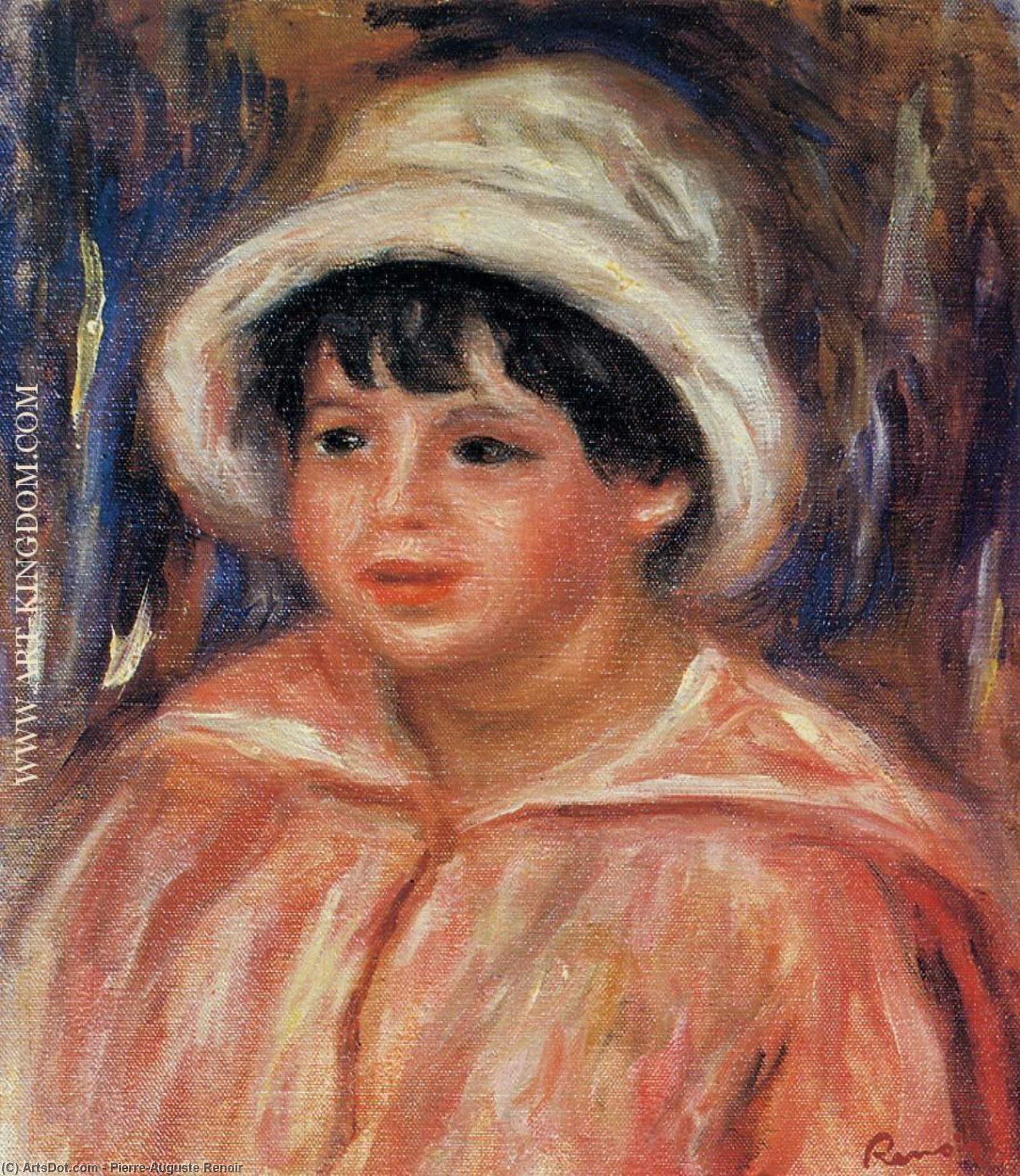
A Glimpse into a Young Life: The Enigmatic Figure of Claude Renoir
Pierre-Auguste Renoir's “Claude Renoir,” painted around 1904, isn’t merely a portrait; it’s a tender and quietly observant capture of childhood. The subject, the artist’s youngest son Claude, is presented in a close-up that draws the viewer into his world – a world of curious contemplation. The painting immediately evokes a sense of intimacy, as if we've stumbled upon a private moment. Renoir masterfully utilizes light and shadow to sculpt the boy’s face, highlighting the delicate curve of his cheekbone and the inquisitive tilt of his head. The composition is remarkably simple, yet profoundly effective in conveying a complex emotional landscape – a blend of youthful curiosity and a subtle awareness beyond his years.

Impressionism's Embrace: Technique and Light
As with much of Renoir’s work, “Claude Renoir” is a testament to the principles of Impressionism. The artist employs loose, visible brushstrokes – a hallmark of the movement – to capture the fleeting effects of light and atmosphere. Notice how he uses broken color to create a sense of luminosity on the boy's dress and skin, avoiding sharp outlines in favor of soft transitions. The background, a simple blue wall, serves not as a distraction but as a carefully considered element that enhances the subject’s presence. Renoir wasn’t interested in photographic realism; instead, he sought to convey an *impression* of the scene – the feeling of light, color, and atmosphere—a technique perfected during his time studying at the Louvre.
- Brushwork: Loose, expressive strokes create a sense of movement and vibrancy.
- Color Palette: A delicate blend of pinks, blues, and whites evokes a feeling of innocence and serenity.
- Light & Shadow: Renoir skillfully uses light to sculpt the boy’s features and define his form.
The Artist's Family and Parisian Life
Understanding “Claude Renoir” requires considering Renoir’s personal life and artistic context. Born in Limoges, France, in 1841, Renoir’s early career was shaped by his apprenticeship as a porcelain painter. This experience instilled in him an appreciation for detail and craftsmanship, which he later applied to his painting. However, it was his move to Paris and the vibrant artistic community that truly fueled his development. The bustling streets of Paris, filled with diverse characters and captivating scenes, became the inspiration for many of his works. The portrait itself reflects this Parisian sensibility – a glimpse into the everyday life of a family within the city’s dynamic atmosphere.
Furthermore, Renoir's familial connections are deeply intertwined with the artwork. The subject is Claude Renoir, the artist’s youngest son, and his grandson, Jean-Charles Cazin, was also a painter. The inclusion of his family within this intimate portrait speaks to Renoir’s personal affection and desire to capture a cherished moment in time.
Symbolism and Emotional Resonance
Beyond its technical brilliance, “Claude Renoir” resonates with a profound emotional depth. The boy's direct gaze—a look of quiet curiosity— invites the viewer into his perspective. He’s not posing for the camera; he’s simply *being*, observing the world around him with an open mind. This sense of genuine observation, combined with the gentle lighting and soft colors, creates a feeling of warmth and nostalgia. The painting isn't just a depiction of a child; it’s a meditation on childhood innocence, the beauty of everyday moments, and the enduring power of family bonds. It is a poignant reminder that even in seemingly simple portraits, there lies a wealth of emotion and artistic intention.