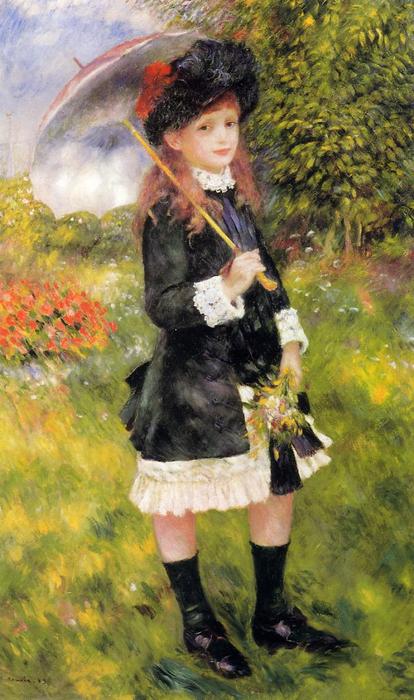
Renoir's 'Girl with a Parasol' captures youthful beauty & Impressionist charm. This iconic painting showcases a serene young woman amidst nature, reflecting Renoir’s evolving style and artistic mastery.
美しい光と色彩を捉える印象派の画家ピエール=オーギュスト・レノワールは、フランスで生まれました。彼の作品は、特に女性のポートレートやパリの日常生活が特徴的で、芸術家たちに大きな影響を与えました。彼の代表作は「ダンス・アット・ル・モゥラン・ドゥ・ラ・ガレット」などであり、印象派の芸術運動を確立する上で重要な役割を果たしました。
The Enigmatic Grace of *Girl with a Parasol*
Pierre-Auguste Renoir’s *Girl with a Parasol (also known as Aline Nunes)*, painted in 1883, isn't merely a portrait; it’s a shimmering distillation of Impressionist ideals and a poignant exploration of fleeting beauty. The painting immediately captivates with its dappled light and delicate color palette—a hallmark of Renoir’s mature style. It depicts a young woman, identified as Aline Nunes, standing in what appears to be a sun-drenched garden or park, her posture relaxed yet imbued with an almost ethereal stillness. She holds a parasol, not aggressively shielding herself from the sun, but rather allowing it to filter through, creating a luminous halo around her face and dress. This subtle gesture speaks volumes about Renoir’s ability to capture not just appearances, but also the very essence of a moment—a feeling of gentle warmth and quiet contemplation. The background is deliberately soft, suggesting an idyllic, almost dreamlike setting, further emphasizing the subject's serene presence. The painting immediately evokes a sense of nostalgia for a bygone era, a time when leisure and beauty were cherished pursuits.
A Renaissance Echo in Impressionism
Renoir’s journey to Italy between 1881 and 1882 profoundly shaped his artistic vision. Inspired by the works of the Italian masters—particularly Raphael and Titian—he began to incorporate elements of classical composition and modeling into his paintings. This influence is strikingly evident in *Girl with a Parasol*. Notice how Renoir meticulously renders the folds of the girl’s dress, creating a sense of volume and texture that departs from the purely optical approach of earlier Impressionists. The subtle shading and careful attention to form recall the techniques of Renaissance portraiture, demonstrating a conscious effort to bridge the gap between modernism and tradition. However, Renoir skillfully avoids becoming overly formal or rigid; he retains his characteristic loose brushstrokes and vibrant colors, seamlessly blending classical influences with his signature Impressionist style. The painting is not simply an imitation of the past but rather a thoughtful reimagining of it, filtered through the lens of a contemporary artist.
The Dance of Light and Color
Renoir’s mastery of light and color is arguably the most compelling aspect of *Girl with a Parasol*. He employs broken brushstrokes—tiny dabs of paint applied in close proximity—to create an effect of shimmering luminosity. The sunlight seems to literally dance across the girl's skin, illuminating her features and casting delicate shadows that add depth and dimension to the scene. The use of complementary colors—the blues and greens of the background contrasting with the warm yellows and pinks of the dress—further enhances the vibrancy of the painting. Renoir wasn’t interested in accurately depicting reality; instead, he sought to capture the *impression* of light and color as it was perceived by the eye at a particular moment. This approach is beautifully exemplified in the way he renders the parasol, transforming it into a radiant source of illumination that permeates the entire composition. The painting feels alive with movement—not through dramatic action, but through the subtle shifts and changes in light and shadow.
Symbolism and the Portrait of an Era
Beyond its technical brilliance, *Girl with a Parasol* is rich in symbolic meaning. The parasol itself represents protection from the sun, but also perhaps a shield against the prying eyes of society—a suggestion of privacy and independence. The girl’s relaxed posture and gentle expression convey a sense of contentment and self-assurance. She embodies the ideals of *joie de vivre* – the joy of living – that were so central to Impressionist culture. The painting also offers a glimpse into the social customs of the late 19th century, when leisurely pursuits like afternoon strolls in parks and gardens were considered essential parts of a refined lifestyle. Aline Nunes herself was a model for Renoir, and her image became synonymous with his artistic vision during this period. *Girl with a Parasol* is therefore not just a portrait; it’s a window into a specific time and place—a celebration of beauty, leisure, and the fleeting moments that make up a life well-lived.
Bringing Renoir's Vision Home
At ArtsDot, we are proud to offer meticulously crafted oil painting reproductions of *Girl with a Parasol*, allowing you to experience the magic of Renoir’s brushstrokes in stunning detail. Our hand-painted reproductions capture not only the visual beauty of the original but also its emotional resonance—the sense of serenity, grace, and timeless elegance that has captivated art lovers for over a century. Whether displayed in your home or office, this reproduction will serve as a constant reminder of Renoir’s artistic genius and his ability to transform ordinary moments into extraordinary works of art. Explore our collection of other Renoir masterpieces and discover the perfect piece to elevate your space and enrich your life.