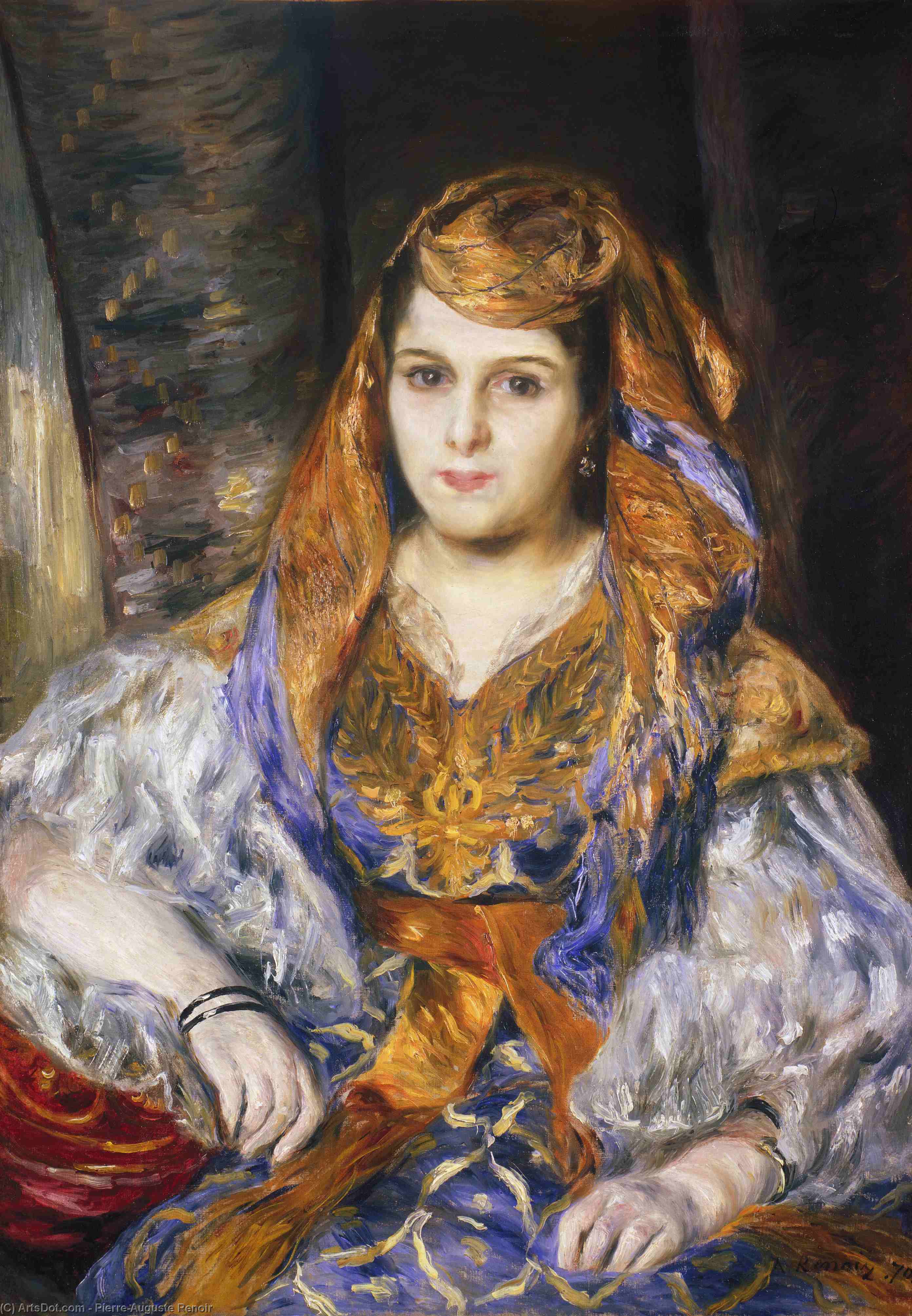
Madame Stora in Algerian Dress – A Portrait Beyond Convention
Pierre-Auguste Renoir’s “Madame Stora in Algerian Dress,” completed in 1870, stands as an intriguing anomaly within the Impressionist canon—a painting that simultaneously embodies the movement's revolutionary spirit and confronts its limitations regarding portraiture. More than just a depiction of a woman adorned in exotic attire, it represents a pivotal moment in Renoir’s artistic journey and sparked considerable debate about his stylistic choices and intentions.
The canvas captures Rebecca Clémentine Stora, née Valensi—a young Sephardic Jewish woman from Algiers—dressed in a vibrant blue gown embellished with shimmering gold threads. Accompanying her is a scarf draped elegantly around her head, reflecting the influence of Orientalist aesthetics prevalent at the time. While seemingly straightforward, this image deviates significantly from Renoir’s earlier explorations of realism and draws inspiration from Delacroix's monumental “Women of Algiers in Their Apartment,” establishing a dialogue with artistic traditions that prioritized grandeur and dramatic narrative over intimate observation.
Renoir’s masterful application of Impressionist techniques—loose brushstrokes, broken color palettes, and an emphasis on capturing fleeting atmospheric effects—creates a palpable sense of immediacy and luminosity. The artist skillfully renders the textures of fabric and stone, conveying depth and dimensionality without resorting to meticulous detail. Light plays across Stora's face and gown, illuminating her serene expression and hinting at the subtle complexities beneath the surface. This careful consideration of light is characteristic of Renoir’s approach throughout his oeuvre—a hallmark of Impressionism that distinguishes it from academic painting styles of the era.
The choice to portray Stora in Algerian costume wasn’t merely a stylistic decision; it reflects the burgeoning interest in ethnographic studies and the fascination with distant cultures during the Belle Époque. However, Renoir himself expressed reservations about the painting's authenticity, lamenting that it lacked the grandeur he sought and questioning whether it truly captured the essence of his subject. This retrospective reflection underscores the artist’s commitment to artistic integrity—a desire to push boundaries while remaining true to his own vision.
Ultimately, “Madame Stora in Algerian Dress” serves as a testament to Renoir's enduring legacy as one of Impressionism’s foremost champions—a painter who dared to challenge conventions and explore new expressive possibilities. Its place within Renoir’s oeuvre remains debated by scholars, yet its undeniable beauty and evocative atmosphere continue to captivate audiences worldwide.
- Artist: Pierre-Auguste Renoir
- Year: 1870
- Style: Impressionism
- Medium: Oil on Canvas
- Location: Fine Arts Museums of San Francisco, California
Key Points:
- Renoir’s stylistic evolution—a move away from realism towards Impressionist techniques.
- Influence of Delacroix and the broader artistic landscape of the time.
- Symbolism: The Algerian costume as a reflection of ethnographic fascination and Renoir's artistic ambition.
- Emotional Impact: Capturing Stora’s serene demeanor and conveying luminosity through masterful brushwork.
Further Exploration:
Consider visiting the Fine Arts Museums of San Francisco to experience “Madame Stora in Algerian Dress” firsthand—a remarkable example of Impressionist art that continues to inspire admiration and scholarly discussion. Also, delve into Renoir’s broader artistic output at Musée d'Art Moderne et Contemporain de Strasbourg for a comprehensive understanding of his stylistic development and contribution to the Impressionist movement.