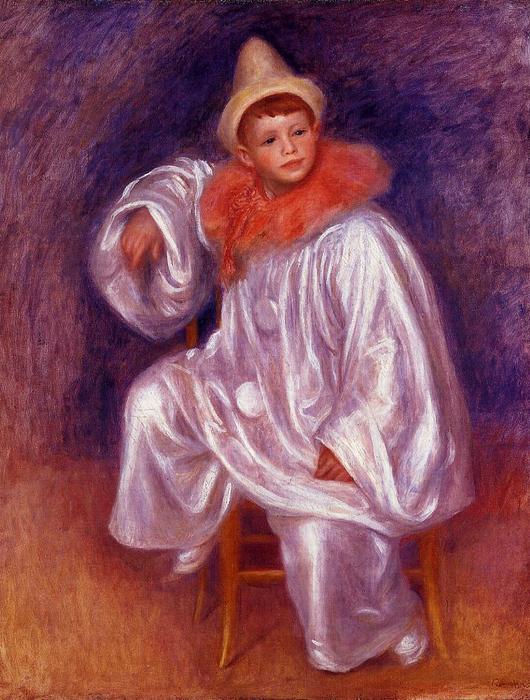
A Moment Frozen in Light: The Essence of The White Pierrot
In the soft, luminous glow of 1902, Pierre-Auguste Renoir captured more than just a portrait; he distilled the very essence of childhood innocence. The White Pierrot serves as a breathtaking window into a private, domestic moment, featuring the artist’s son, Jean Renoir, dressed in the iconic, flowing attire of the theatrical Pierrot character. As the viewer gazes upon this masterpiece, there is an immediate sense of quietude, a stillness that invites us to pause and breathe alongside the young subject. The boy sits with a gentle, contemplative posture, his hands tucked behind him, embodying a sense of serene introspection that belies his youth. It is a painting that does not merely demand attention through grand gestures but earns it through a profound, whispered intimacy.
The technical brilliance of this work lies in Renoir’s masterful command of the Impressionist vocabulary. Eschewing the rigid, heavy outlines of academic tradition, he employs short, broken brushstrokes that dance across the canvas to simulate the play of light upon fabric. The palette is a sophisticated study in subtle tones, dominated by creamy whites and ethereal ivories that give the Pierrot costume a weightless, almost spectral quality. Yet, amidst this sea of muted brightness, Renoir introduces a singular, poignant note of color: the soft red of the clown’s nose. This small, vibrant punctuation provides a warm focal point, anchoring the composition and adding a touch of whimsical humanity to the otherwise cool, pearlescent atmosphere.
Symbolism and the Domestic Sphere
Beyond its surface beauty, the painting functions as a delicate exploration of connection and observation. While Jean Renoir remains the undisputed heart of the piece, the presence of two figures in the periphery adds a layer of narrative depth. These observers, though softly rendered, suggest a protective, familial cocoon—a domestic sphere where every fleeting moment is cherished. The Pierrot costume itself carries a weight of symbolism; traditionally associated with the melancholic, silent clown, here it is repurposed to represent the purity and vulnerability of a child’s imagination. Renoir uses this theatrical element to bridge the gap between reality and dream, turning a simple afternoon sitting into an eternalized moment of poetic grace.
For the discerning collector or interior designer, The White Pierrot offers an unparalleled opportunity to introduce a sense of timeless elegance and emotional warmth into a space. The painting’s ability to harmonize light and shadow makes it a versatile centerpiece, capable of anchoring a room with its quiet dignity. Whether placed in a sun-drenched gallery or a sophisticated contemporary study, this reproduction brings with it the legacy of one of history's greatest masters—a legacy defined by an unwavering belief in the beauty of life and the enduring power of light.