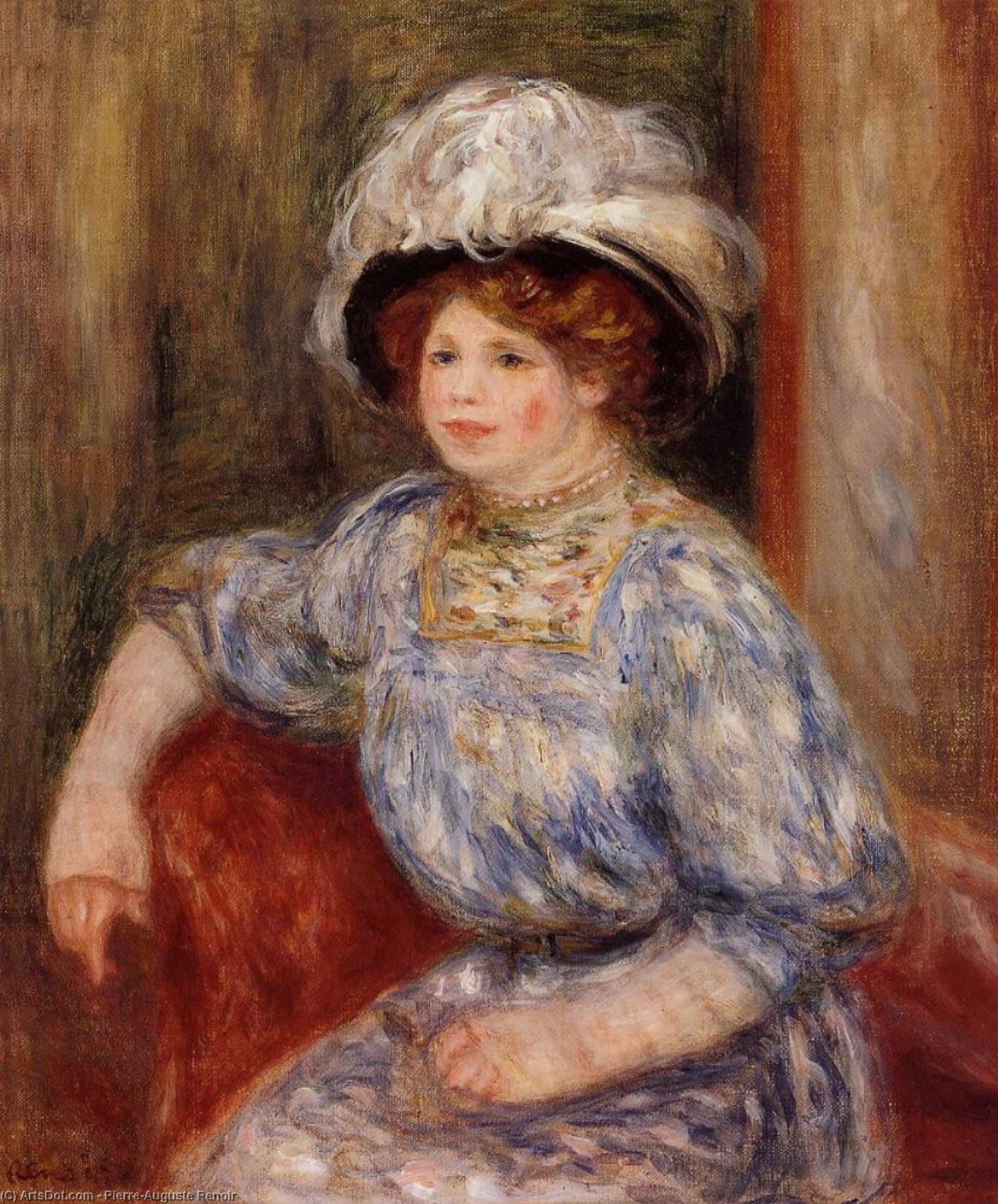
Experience the luminous beauty of Pierre-Auguste Renoir’s "Woman in Blue," a captivating Impressionist portrait showcasing elegance and grace. This exquisite hand-painted reproduction captures Renoir's signature style, inviting you to own a timeless masterpiece.
A Portrait of Grace: Renoir’s ‘Woman in Blue’
Pierre-Auguste Renoir's “Woman in Blue,” painted circa 1885, offers a captivating glimpse into the heart of Impressionist portraiture – a genre where fleeting moments and subjective experience held as much significance as objective representation. This exquisite work, depicting a woman seated with an air of quiet elegance, exemplifies Renoir’s masterful ability to capture not just physical likeness but also the very essence of his subject's personality and the atmosphere surrounding her. The painting immediately draws the eye to the central figure, a woman adorned in a flowing blue dress and a delicate white hat, instantly evoking a sense of refined beauty and gentle composure.
- Subject & Composition: The composition is remarkably balanced, with the seated woman occupying the majority of the canvas. The inclusion of two secondary figures – one subtly positioned near the upper left corner and another on the right side – adds depth and narrative complexity, suggesting a private moment within a social setting. This layering of figures reflects Renoir’s interest in depicting scenes of everyday life, imbued with an emotional resonance.
- Technique & Color: Renoir's signature technique is immediately apparent in the loose, broken brushstrokes that define the forms and create a shimmering effect, particularly noticeable in the fabric of the dress and the light reflecting off its surface. The dominant use of blues – ranging from deep indigo to pale cerulean – creates a serene and contemplative mood, while subtle touches of white and flesh tones add warmth and luminosity.
The Impressionist Vision
“Woman in Blue” is firmly rooted within the Impressionist movement, a revolutionary artistic approach that emerged in France during the mid-19th century. Rejecting the academic traditions of precise detail and idealized forms, Impressionists sought to capture the transient effects of light and atmosphere – ‘impressions’ – as they perceived them at a particular moment in time. Renoir, like his fellow Impressionists, was deeply influenced by the work of Claude Monet and other pioneers who challenged conventional notions of artistic representation. This painting showcases their commitment to depicting the world as seen through the eye of an artist, prioritizing sensory experience over strict adherence to realism.
- Light & Atmosphere: Renoir’s masterful manipulation of light is central to the work's impact. He employs a dappled effect, using short, broken brushstrokes to suggest the play of sunlight on the woman’s dress and skin, creating an illusion of movement and depth.
- Brushwork: The visible brushstrokes are not merely accidental; they are deliberately employed to convey the artist's subjective experience of the scene, inviting the viewer to share in that sensory perception.
Symbolism & Context
While seemingly a simple portrait, “Woman in Blue” resonates with subtle symbolic undertones characteristic of Impressionist art. The blue color itself has long been associated with serenity, tranquility, and nobility – qualities that align with the woman’s poised demeanor. The setting, likely an interior space indicated by the chair, suggests intimacy and privacy, further enhancing the sense of personal connection between the viewer and the subject. Painted during a period of significant social change in France, this work reflects the growing interest in depicting modern life and capturing the spirit of the age.
- Social Context: The painting reflects the burgeoning middle class of Paris, where portraiture was becoming increasingly popular as a means of self-expression and social status.
- Renoir’s Circle: Renoir was part of a vibrant artistic circle that included artists like Monet, Sisley, and Pissarro, who frequently gathered to discuss their work and share ideas – a crucial element in the development of Impressionism.
Emotional Impact & Legacy
“Woman in Blue” transcends its status as a mere portrait; it is an evocative meditation on beauty, grace, and the fleeting nature of time. Renoir’s ability to capture not just the outward appearance of his subject but also her inner state – a sense of quiet contemplation and gentle dignity – creates a powerful emotional connection with the viewer. This painting remains a cornerstone of Impressionist art, admired for its technical brilliance, its sensitive portrayal of human character, and its enduring appeal.