A Window into Domestic Tranquility
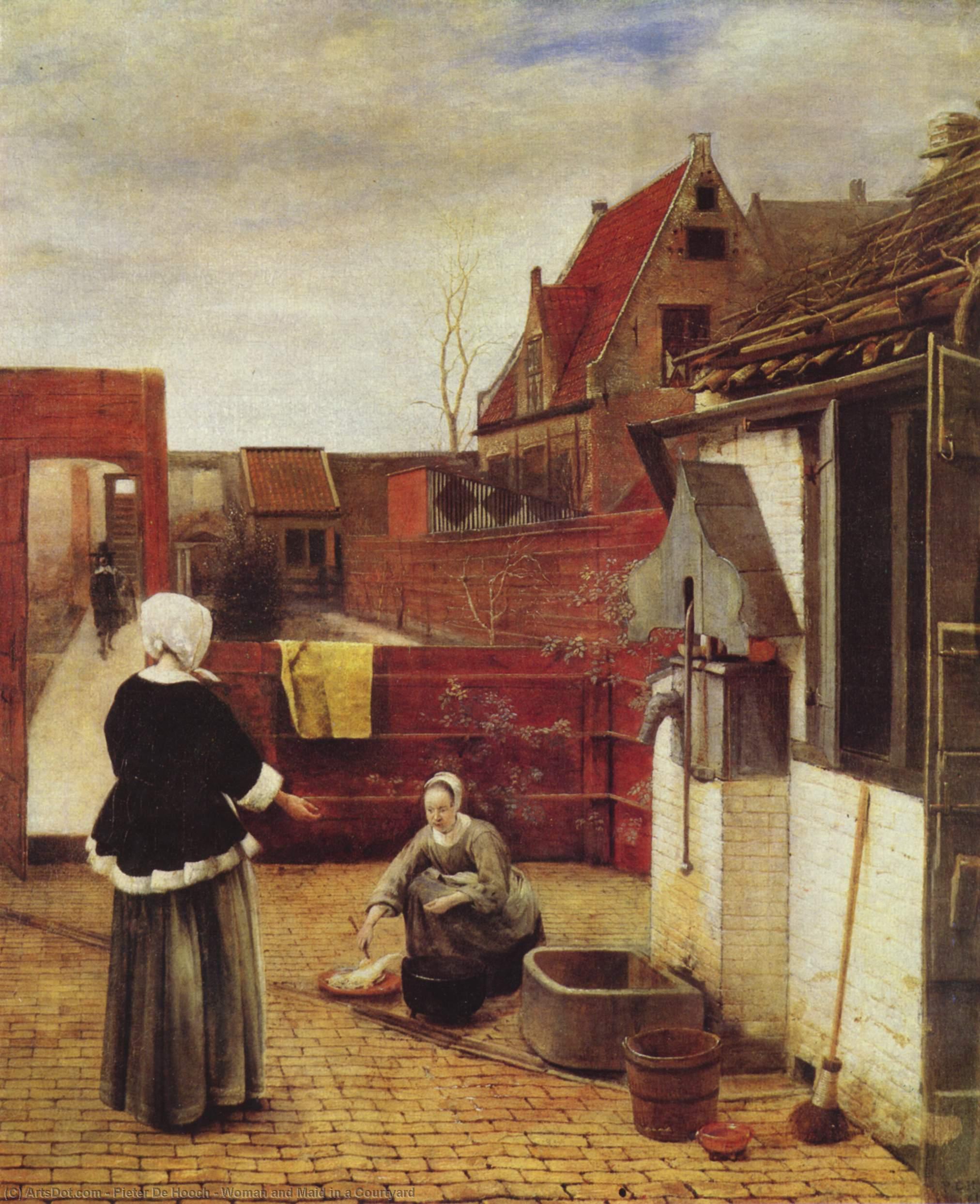
In the quiet corners of the seventeenth century, amidst the bustling commerce of the Dutch Golden Age, Pieter de Hooch captured something far more precious than gold: the profound beauty of the everyday. His masterpiece, "Woman and Maid in a Courtyard," painted circa 1660, serves as an exquisite window into a world of domestic serenity. This is not a scene of grand historical drama or mythological upheaval; rather, it is a tender tableau of human connection and quietude. As we gaze upon the interaction between the standing woman and her kneeling maid, we are invited to step into a sun-drenched courtyard where time seems to slow, offering a momentary escape into a realm of absolute peace.
The composition breathes with a sense of structured intimacy. The figures, draped in long, flowing dresses that anchor them to the earth, exist in a harmonious dialogue with their surroundings. A potted plant sits near the center, acting as a subtle organic bridge between the human subjects and the architectural elements of the background. Through De Hooch’s eyes, even the most mundane domestic chore or quiet conversation is elevated to a level of poetic significance, making this piece an ideal focal point for any space seeking to evoke a sense of calm, stability, and refined grace.
The Alchemy of Light and Texture
What truly distinguishes De Hooch from his contemporaries is his unparalleled ability to manipulate light. While other Baroque masters utilized dramatic, theatrical shadows to command attention, De Hooch employed a more subtle, luminous approach. In this work, he achieves an ethereal glow through the masterful layering of translucent washes. This technique allows light to permeate the scene, softly defining the rough texture of stone walls and the delicate folds of fabric without the need for harsh contrasts. The result is a diffused illumination that feels natural, as if the afternoon sun is filtering gently through a hazy sky.
The artist’s technical precision is further revealed in his treatment of surfaces. Using a sophisticated blend of watercolor and gouache on ivory paper, he creates a tactile experience for the viewer. One can almost feel the coolness of the courtyard walls and the smoothness of the ceramic pots. For the discerning collector or interior designer, this meticulous attention to detail ensures that a high-quality reproduction retains its depth and vitality, bringing a sophisticated, multi-dimensional texture to a room's decor. The interplay of light and shadow creates a rhythmic movement across the canvas, guiding the eye through the composition in a continuous, soothing loop.
A Legacy of Dutch Elegance
To understand "Woman and Maid in a Courtyard" is to understand the soul of the emerging Dutch middle class. During this era, the prosperity of Amsterdam and surrounding cities fostered a new appreciation for the virtues of the home: cleanliness, order, and quiet devotion. De Hooch’s work reflects these societal values, presenting the domestic sphere as a sanctuary of moral and aesthetic excellence. His ability to find the extraordinary within the ordinary resonates deeply with modern sensibilities, where the concept of "hygge" or mindful living finds its historical ancestor in his courtyard scenes.
For those looking to adorn their homes with art that inspires contemplation, this painting offers more than mere decoration; it offers an atmosphere. Whether placed in a sunlit reading nook or as a centerpiece in a formal gallery, the artwork radiates a timeless elegance. It stands as a testament to the enduring power of the Dutch Golden Age—a period where light, life, and legacy converged to create some of the most beloved imagery in the history of Western art.