A Glimpse of Innocence: The Ethereal Charm of Perugino’s Angelic Vision
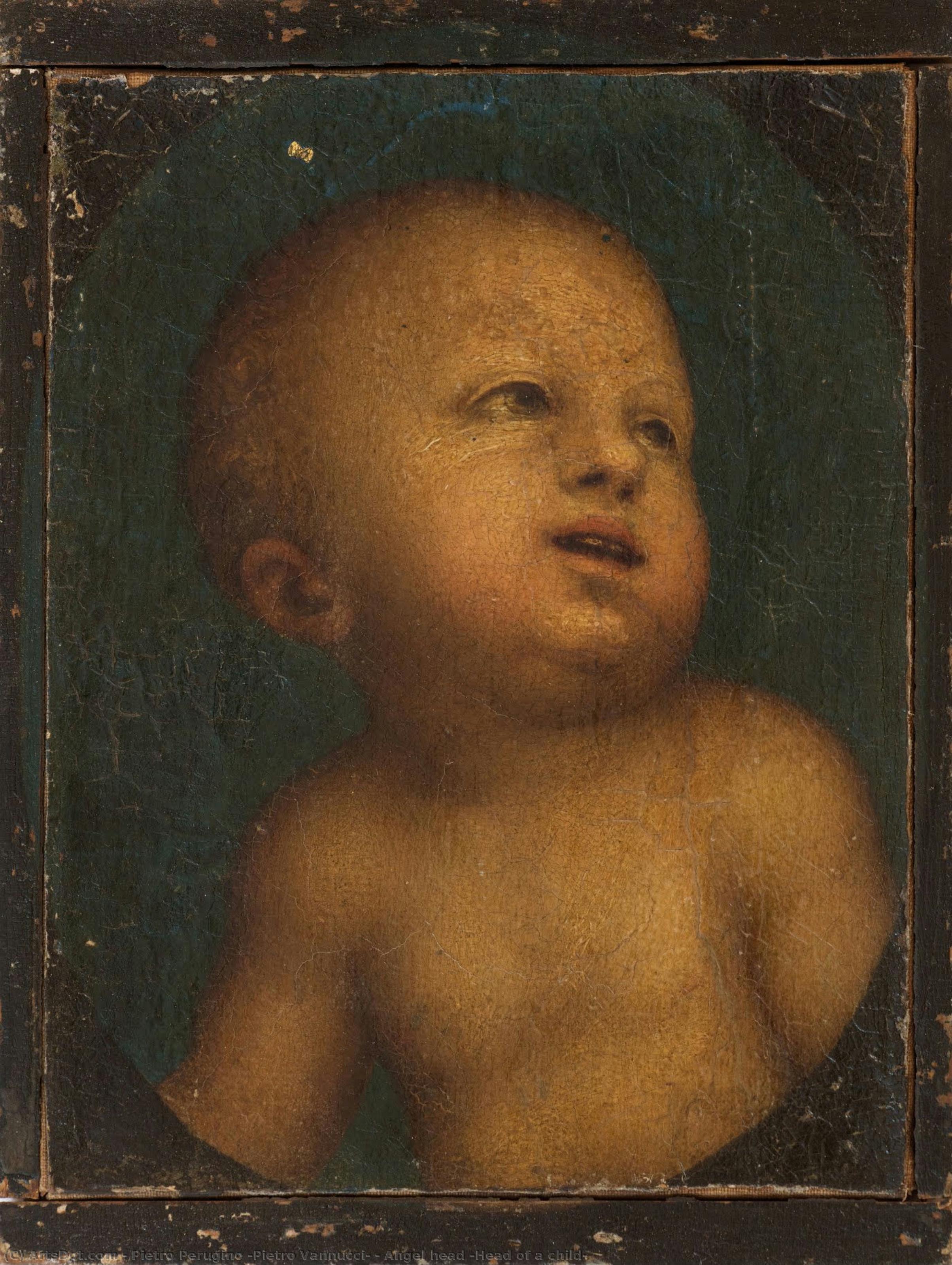
In the quietude of the High Renaissance, few masters captured the profound simplicity of divine grace as tenderly as Pietro Perugino. His work "Angel head (Head of a child)" serves as a breathtaking window into a world where the celestial and the earthly converge through the soft gaze of youth. This intimate portrait, reminiscent of a lost fragment from a larger altarpiece, presents us with the face of a young boy, perhaps an angelic figure, whose presence commands the viewer's attention through sheer, unadorned purity. The painting is a masterclass in the Umbrian style, where the heavy shadows of the background do not serve to obscure, but rather to act as a velvet stage, pushing the luminous skin tones and the curious, bright eyes of the child toward the foreground with startling clarity.
The technique employed here speaks to the legendary precision of the Perugino workshop. One can almost feel the softness of the child's brown hair and the delicate texture of the blue garment that drapes his small frame. The artist utilizes a subtle sfumato, a gentle blurring of edges, to create a sense of atmospheric depth, ensuring that the transition from the subject to the dark, mysterious void behind him feels natural and breathing. This interplay of light and shadow—the classic chiaroscuro—imbues the small-scale work with an unexpected monumentalism. For the discerning collector or interior designer, this piece offers a rare opportunity to possess a fragment of Renaissance serenity, providing a focal point that is both intellectually stimulating and visually soothing.
Symbolism and the Emotional Resonance of the Divine
Beyond its technical brilliance, "Angel head" carries a profound emotional weight that transcends the centuries. In the context of the 15th and 16th centuries, such depictions of children were rarely mere portraits; they were vessels for spiritual contemplation. The child’s expression—a mixture of wide-eyed curiosity and a soulful, knowing stillness—invites the viewer into a state of meditative reflection. There is a vulnerability in the subject that evokes an immediate protective instinct, yet there is also a divine authority in that steady gaze, suggesting that even in the smallest form, the infinite can be found.
For those looking to integrate fine art into a contemporary living space, this reproduction offers more than just decoration; it offers an atmosphere. The deep, moody tones of the background allow the piece to anchor a room, working harmoniously with both minimalist modern aesthetics and more traditional, opulent decors. Whether placed in a sunlit study or a dimly lit gallery hallway, the painting acts as a silent interlocutor, prompting moments of pause and quiet thought. It is an investment in beauty that celebrates the enduring power of innocence and the timeless mastery of the Italian Renaissance.