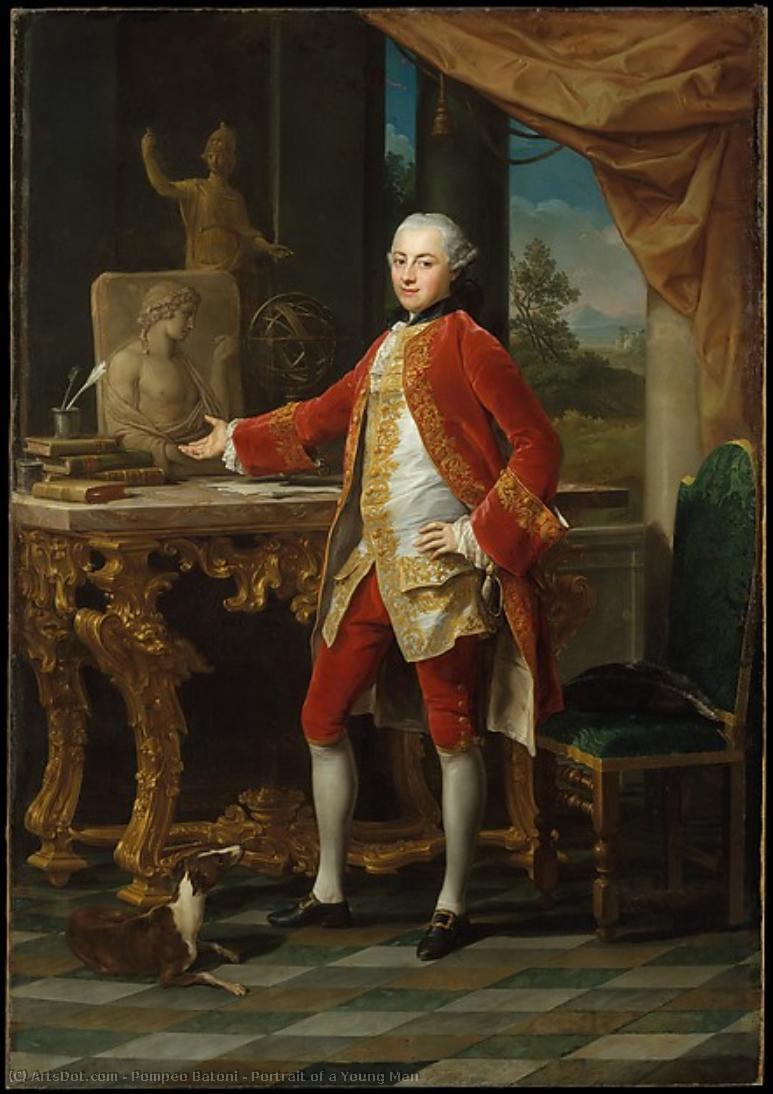
A Vision of Grandeur: The Elegance of Batoni’s Young Man
In the heart of Rome’s Golden Age, amidst the vibrant intellectual and social currents of the mid-eighteenth century, Pompeo Batoni captured more than just a likeness; he immortalized an era. His Portrait of a Young Man, executed around 1760, serves as a breathtaking window into the soul of the Grand Tour—that quintessential journey of cultural refinement undertaken by the European aristocracy. The painting presents a figure of striking poise, draped in rich, muted reds that command attention without sacrificing subtlety. As he stands beside a desk laden with the tools of an enlightened mind, the subject becomes a vessel for the aspirations of his time, embodying a sophisticated blend of classical reverence and contemporary elegance.
The composition is a masterclass in narrative depth, where every object serves as a silent witness to the sitter's status. The presence of books—guides to ancient Rome and Homer’s Odyssey—alongside an armillary sphere and a statue of Minerva, speaks eloquently of a life dedicated to the pursuit of wisdom and the study of antiquity. Even more provocative is the inclusion of a relief sculpture of Antinous, which hints at the complex, often hidden, layers of classical influence and cultural identity that permeated the Roman social landscape. For the discerning collector or interior designer, this piece offers a profound sense of intellectual weight, making it an ideal centerpiece for spaces that celebrate history, literature, and the timeless allure of the classical world.
Technical Brilliance and the Rococo Glow
Batoni’s technical prowess is nothing short of extraordinary, showcasing a seamless fusion of Baroque dynamism and Rococo refinement. His brushwork, though possessing an expressive fluidity that suggests movement and life, remains disciplined enough to render textures with startling realism. One can almost feel the weight of the heavy fabrics and the smooth, cool surface of the polished desk. Through the masterful application of glazing techniques, Batoni builds layers of pigment that allow light to penetrate the surface, creating a luminous quality that makes the skin tones appear supple and the red drapery glow with an inner warmth.
The color palette is a sophisticated dialogue between heat and coolness. The commanding reds of the young man’s attire are expertly balanced by the softer, more tranquil tones of the background, ensuring that the eye is drawn first to the subject before wandering through the intricate details of the room. This careful orchestration of light and shadow—chiaroscuro refined for a more delicate era—imbues the portrait with a palpable atmosphere of serenity and prestige. To possess a reproduction of such a work is to invite a sense of historical majesty and painterly excellence into one's environment, offering an enduring aesthetic pleasure that transcends the passing trends of modern decor.