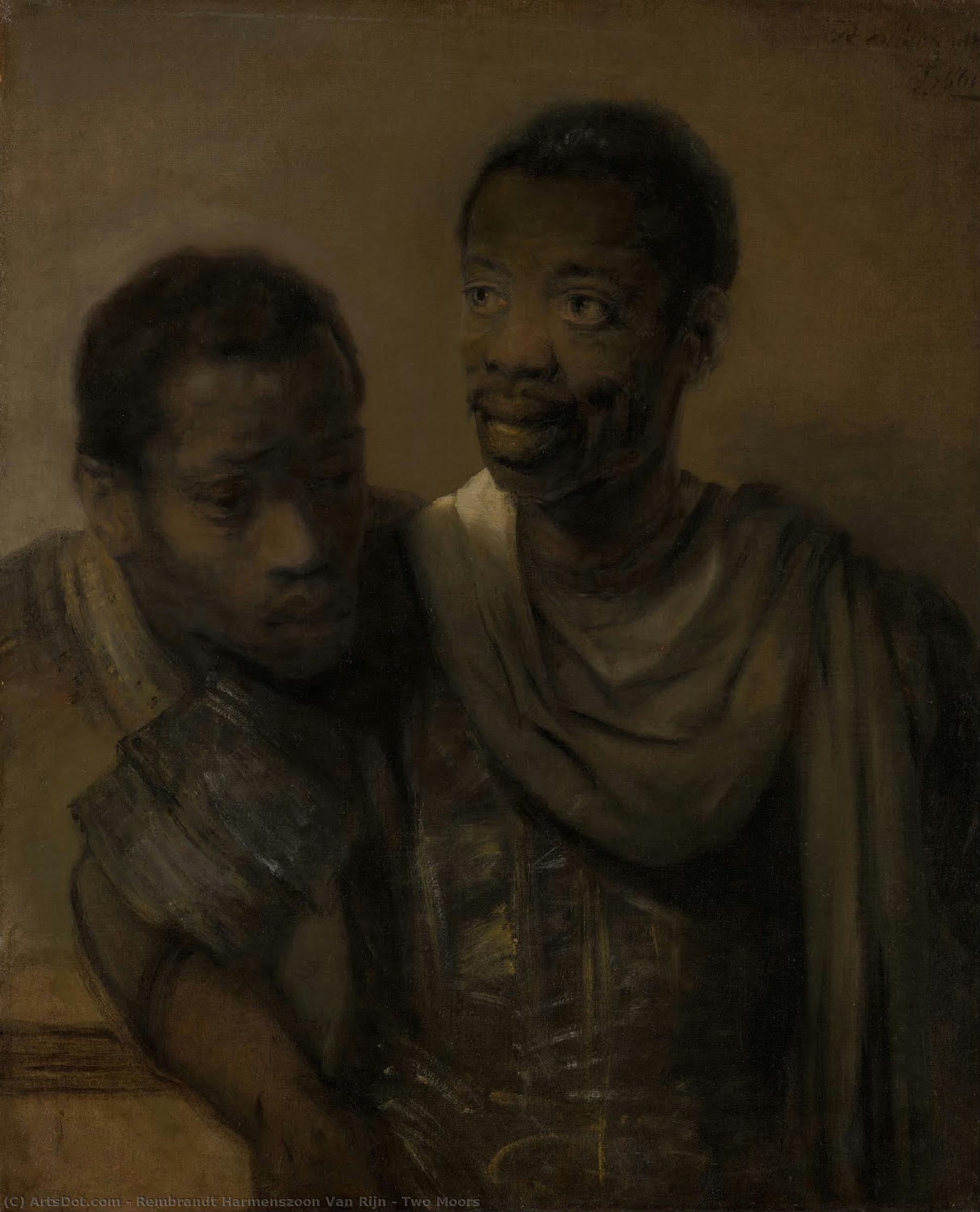
This evocative oil painting by Rembrandt van Rijn portrays two figures standing close together, one supporting the head of the other. Known for his dramatic use of light and shadow, Rembrandt’s meticulous detail brings this biblical scene to life.
A Symphony of Shadow and Soul
In the quiet, amber-hued depths of Rembrandt van Rijn’s 1661 masterpiece, Two Moors, one finds more than just a portrait; one encounters a profound meditation on human connection. The canvas presents two men positioned against a starkly textured wall, their forms emerging from a heavy, atmospheric darkness that is characteristic of the Dutch Baroque. There is an immediate, visceral intimacy in the way one man gently supports the head of his companion, a gesture that transcends mere physical contact to suggest a deep-seated bond of loyalty and shared vulnerability. This is not a scene of grand historical drama or mythological spectacle, but rather a quiet, monumental moment captured in the interplay of light and shadow, inviting the viewer into a private world of unspoken emotion.
The Alchemy of Chiaroscuro
Rembrandt’s technical mastery is nowhere more evident than in his use of chiaroscuro—the dramatic tension between brilliant illumination and impenetrable gloom. He does not merely paint light; he sculpts it. By applying paint in thick, tactile impasto layers, the artist allows light to physically catch on the ridges of the pigment, creating a sense of palpable three-dimensionality. The faces of the two men are bathed in a soft, directional glow that highlights the subtle textures of their skin and the weary dignity in their expressions, while the surrounding shadows seem to press inward, heightening the psychological weight of the scene. This technique serves as an emotional conduit, pulling the observer's gaze toward the center of the human experience, where the light reveals the truth of their connection.
A Rare Glimpse into the Seventeenth Century
To look upon Two Moors is to engage with a rare and significant moment in art history. During the seventeenth century, the depiction of African men—often referred to as Moors—in European portraiture was infrequent and often relegated to the periphery of scenes as servants or exoticized figures. Rembrandt, however, elevates his subjects to a position of profound psychological importance. By focusing on their shared intimacy and the quiet gravity of their presence, he bypasses the societal prejudices of his era to capture a universal human truth. For the modern collector or interior designer, this painting offers a sophisticated layer of historical depth, making it an exquisite centerpiece for spaces that value narrative complexity and the timeless elegance of the Dutch Golden Age.
Timeless Elegance for the Modern Collector
Whether gracing the walls of a contemporary gallery or providing a soulful focal point in a curated residential interior, a reproduction of this caliber brings an atmosphere of contemplative luxury. The painting’s muted palette and rich textures harmonize beautifully with both classical and minimalist aesthetics, offering a sense of permanence and intellectual depth. It is a piece that does not merely decorate a room but transforms it, inviting guests to linger before its shadows and find beauty in the quiet, resilient strength of the human spirit.