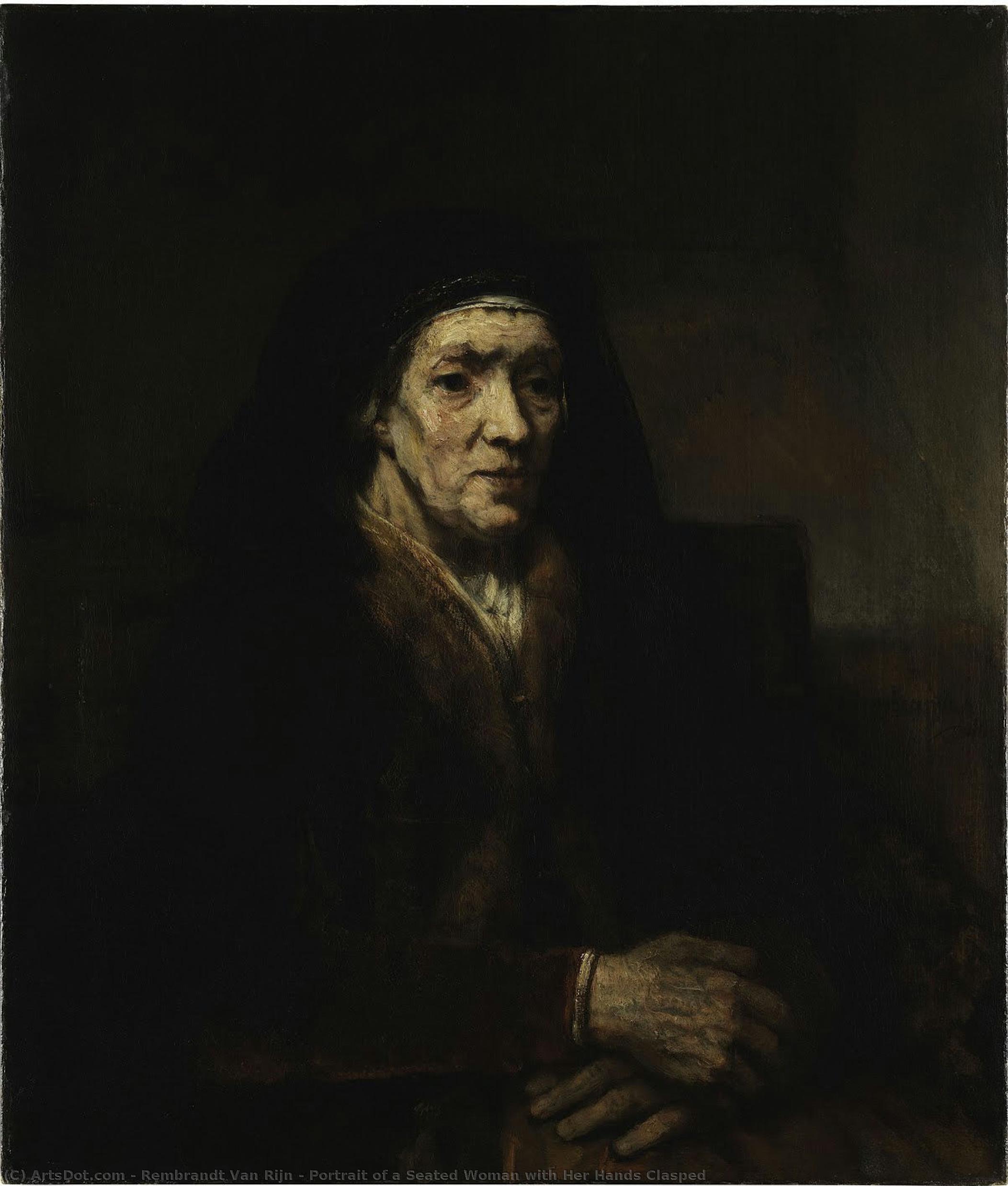
Portrait of a Seated Woman with Her Hands Clasped: A Study in Late Rembrandt
This compelling portrait, painted around 1660 by the Dutch master Rembrandt van Rijn, offers a profound glimpse into the artist’s late style and his unparalleled ability to capture the essence of human experience. Unlike many portraits commissioned for their status or beauty, this work appears to be a character study—a deliberate exploration of an individual's inner life rather than a mere representation of outward appearance. The painting resonates with a quiet dignity and psychological depth that continues to captivate viewers centuries later.
Style and Technique: Embracing Chiaroscuro and Impasto
The artwork is firmly rooted in the Baroque tradition, showcasing Rembrandt’s masterful command of chiaroscuro—the dramatic interplay of light and shadow. A single, focused light source illuminates the woman's face and hands, drawing attention to their texture and expression while plunging the background into a velvety darkness. This technique not only creates a sense of drama but also emphasizes the sitter’s presence, isolating her from the surrounding space. Rembrandt further enhances the painting's tactile quality through his signature impasto technique—the application of thick layers of paint that create a rough, three-dimensional surface. The visible brushstrokes on her skin and clothing are not merely decorative; they contribute to the overall sense of realism and convey the passage of time etched onto her features.
A Portrait Beyond Appearance: Exploring Character and Emotion
Rembrandt’s genius lies in his ability to transcend mere physical likeness. While he meticulously renders the woman's distinct features—the slight cleft in her chin, small mouth, and broad nose—it is her psychological presence that truly dominates the composition. Her clasped hands are particularly significant; they suggest introspection, perhaps even a quiet vulnerability. The somber expression on her face hints at a lifetime of experiences, conveying both wisdom and a touch of melancholy. This isn't a portrait intended to flatter or idealize; it is an honest portrayal of an aging woman, revealing the complexities of human emotion with remarkable sensitivity.
Historical Context: Rembrandt’s Late Period
Painted towards the end of Rembrandt’s career, this portrait reflects a shift in his artistic focus. Having faced personal and financial hardships earlier in life, Rembrandt's later works are characterized by a greater emphasis on psychological depth and emotional honesty. He moved away from the grand narratives and opulent settings that had defined much of his earlier work, choosing instead to explore the lives of ordinary people with profound empathy. This painting exemplifies this shift, offering a poignant reflection on aging, wisdom, and the enduring power of the human spirit during the Dutch Golden Age.
The Artist: Rembrandt van Rijn (1606-1669)
- Rembrandt Harmenszoon van Rijn was born on July 15, 1606, in Leiden, Netherlands – a bustling center during the Dutch Republic’s Golden Age.
- His father, Harmen Gerritszoon van Rijn, was a miller, and his mother, Neeltgen Willemsdochter van Zuytbrouck, came from a family of bakers. This provided Rembrandt with access to education at Leiden’s Latin School.
- Around 1620, he began an apprenticeship with Jacob van Swanenburg in Leiden.
- A crucial six-month period (1624) was spent studying under Pieter Lastman in Amsterdam, whose dramatic use of light and shadow profoundly influenced Rembrandt's early work.
- Upon returning to Leiden, he established his own studio around 1625, sharing it with fellow artist Jan Lievens.