Lucretia: A Portrait of Sacrifice and Baroque Drama
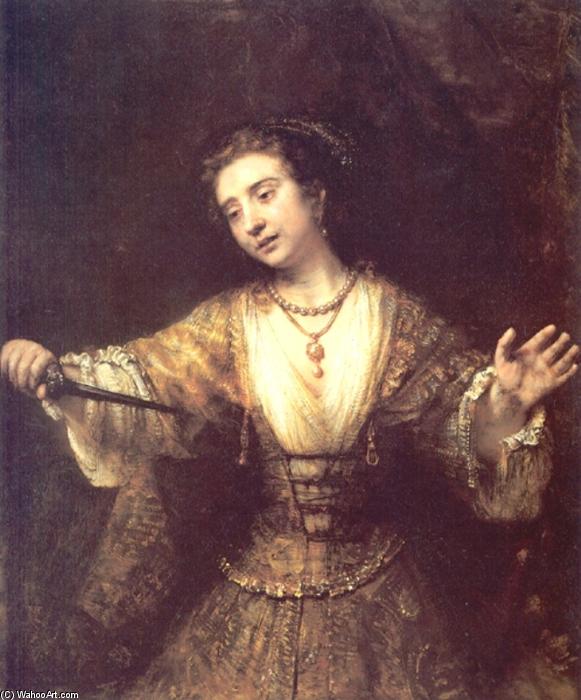
Rembrandt van Rijn’s *Lucretia*, completed in 1664, stands as one of the artist's most poignant explorations of human emotion and biblical narrative—a testament to his unparalleled ability to convey profound psychological depth within a seemingly simple composition. Currently residing at the National Gallery of Art in Washington D.C., this oil on canvas masterpiece transcends mere depiction; it embodies the spirit of the Baroque era’s preoccupation with moral seriousness and dramatic visual storytelling.
The Myth Behind the Canvas
The painting recounts the ancient Roman legend of Lucretia, a noblewoman renowned for her virtue who endured rape by Sextus Tarquinius Superbus, the son of Rome's tyrannical king. Faced with unbearable shame and determined to preserve her honor—and thus protect her family’s reputation—Lucretia took her own life, an act of heroic defiance against oppression. Rembrandt skillfully distilled this tragic tale into a visual representation that resonates powerfully across centuries.
A Masterclass in Baroque Technique
Rembrandt's artistic approach is characterized by masterful chiaroscuro – the dramatic interplay between light and dark – which dominates the canvas. The artist employs deep shadows to envelop Lucretia’s figure, emphasizing her vulnerability and despair while simultaneously highlighting her outstretched hands, conveying a palpable sense of anguish. This technique wasn’t merely stylistic; it served as a crucial tool for Rembrandt to communicate emotion—a cornerstone of Baroque art's ambition to evoke visceral responses from the viewer. The subdued palette contributes to the overall somber mood, reinforcing the painting’s thematic core: suffering and moral fortitude.
Symbolism and Emotional Resonance
The central positioning of Lucretia is deliberate, drawing the eye directly to her face—a gesture that underscores the profound psychological drama unfolding before us. Her hands covering her face are not simply a pose; they symbolize concealment, grief, and the crushing weight of humiliation. The inclusion of a dagger and knife – subtly placed in her hands – serves as a poignant reminder of Lucretia’s ultimate act of sacrifice—a defiant assertion of moral integrity against overwhelming adversity. Rembrandt's genius lies in transforming a historical narrative into an enduring symbol of courage and resilience.
Historical Context and Legacy
Lucretia was a favored subject among Baroque artists, reflecting the period’s fascination with themes of honor, virtue, and religious morality. Rembrandt’s version stands apart for its intensely personal expression—a reflection of his own turbulent life and relationship with Hendrickje Stoffels. The painting's enduring appeal speaks to our innate desire to contemplate profound human experiences and grapple with questions of ethics and sacrifice. As a cornerstone of Dutch Golden Age art, *Lucretia* continues to inspire admiration and scholarly study, cementing Rembrandt’s place as one of history’s greatest masters.
- Artist: Rembrandt Harmenszoon van Rijn
- Birth Year: 1606
- Death Year: 1669
- Birth City: Leiden
- Birth Country: Netherlands
- Medium: Oil on Canvas
- Dimensions: 120 x 101 cm (47 1/4 x 39 3/4 in.)
- Location: National Gallery of Art, Washington D.C., United States
- Provenance: Jean-Joseph-Pierre-Augustin Lapeyrière; Michael M. Zachary; Sale at Phillips, London; Purchased by Sir Thomas Lawrence; Hugh Andrew Johnstone Munro; Sold at Christie Manson & Woods, London; Léon Gauchez
- Notable Features: Dramatic chiaroscuro; Intense emotional portrayal; Symbolism of hands covering face; Representation of Lucretia’s heroic sacrifice
- Related Artists: Pieter Lastman
- Further Exploration: Rembrandt Research Project