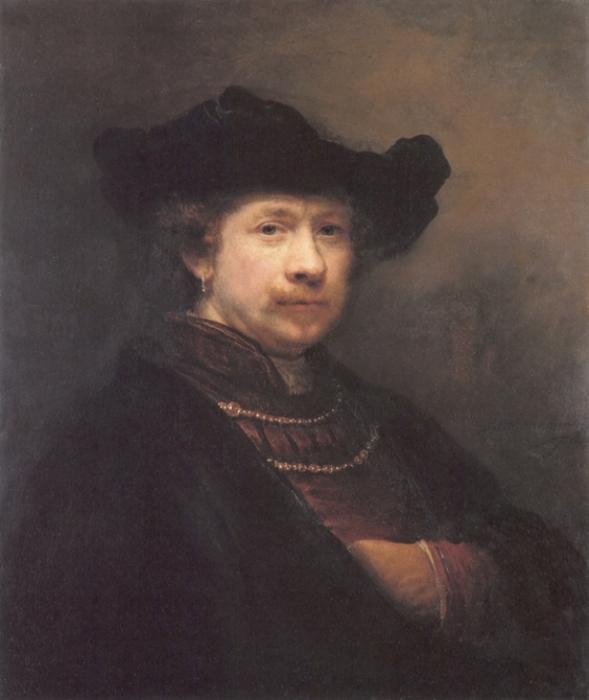
Self Portrait (14): A Window Into Rembrandt’s Soul
Rembrandt van Rijn's
Self Portrait (14) stands as a cornerstone of Dutch Golden Age art and arguably one of the most psychologically astute self-portraits ever conceived. Painted in 1642 during a period of profound personal upheaval—marked by financial difficulties and marital discord—the canvas transcends mere likeness to become an exploration of identity, vulnerability, and artistic contemplation. Measuring 70 x 58 cm, this oil on panel masterpiece exemplifies Rembrandt’s mastery of chiaroscuro, skillfully manipulating light and shadow to sculpt the figure's form and imbue it with palpable emotion.
The Painting: Composition and Technique
The portrait depicts Rembrandt seated in a dimly lit room, his gaze directed outwards—away from the viewer—creating an immediate sense of introspection. He wears a black hat adorned with feathers and a black coat embellished with a gold chain, symbols of his status as a respected artist and intellectual. Beneath the hat, Rembrandt’s face is illuminated by a single candle flame, casting dramatic shadows that accentuate the lines etched into his skin – testament to time and experience. The artist's meticulous attention to detail—particularly in rendering the texture of his clothing and hair—demonstrates Rembrandt’s unparalleled technical skill. He employed a layering technique known as *glazuura*, applying thin washes of color beneath the opaque paint surface, resulting in an astonishing depth and luminosity that continues to captivate viewers today.
Artistic Significance: Exploring Inner Landscape
More than just a depiction of his physical appearance,
Self Portrait (14) delves into Rembrandt’s psychological landscape. The averted gaze speaks to a preoccupation with the world beyond himself—a characteristic that distinguishes Rembrandt's self-portraits from those of many contemporaries. Scholars interpret the painting as reflecting Rembrandt’s anxieties about his declining fortunes and his troubled marriage, suggesting that he sought solace in artistic creation as a means of confronting these challenges. The subtle expression on his face—a mixture of melancholy and quiet dignity—resonates with viewers across centuries, inviting contemplation on themes of mortality and inner resilience.
Historical Context: Rembrandt’s Turbulent Era
Painted during the Dutch Golden Age,
Self Portrait (14) reflects the broader cultural anxieties of the period. Rembrandt’s artistic output coincided with a time of economic instability and political uncertainty—factors that undoubtedly influenced his creative vision. The painting's placement within the Royal Collection underscores its significance as a symbol of Dutch artistic excellence and national pride. Furthermore, it serves as a poignant reminder of Rembrandt’s personal struggles—a narrative interwoven into the very fabric of the artwork itself.
Comparison with Other Works: Rembrandt’s Oeuvre
Rembrandt produced numerous self-portraits throughout his career, each offering unique insights into his evolving artistic style and psychological state. Compared to
Self Portrait, which is characterized by its subdued palette and contemplative mood, other portraits showcase Rembrandt’s bolder experimentation with color and form. For instance,
Self Portrait, a smaller work measuring 16 x 13 cm, demonstrates Rembrandt’s ability to capture his likeness in a more intimate setting—a testament to his versatility as an artist. The enduring fascination with Rembrandt's self-portraits testifies to their profound artistic merit and their capacity to communicate universal human emotions.
Wikipedia References: