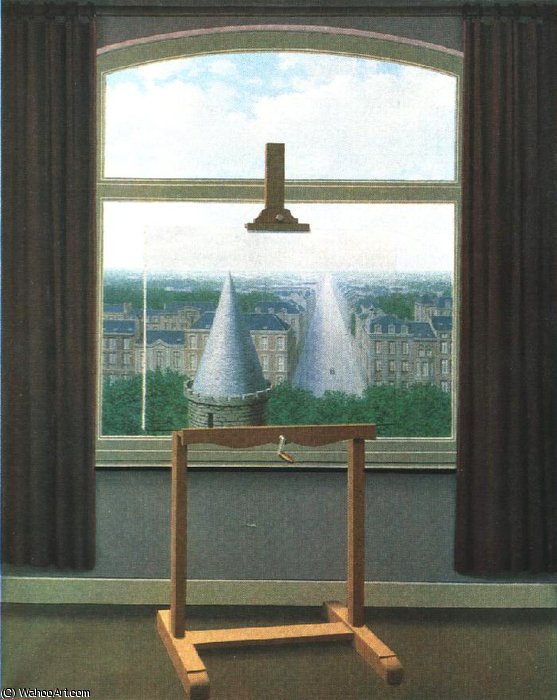
René Magritte's 'Euclidean Walks,' painted in 1955, presents a minimalist interior scene featuring a vacant chair beneath a light fixture and an umbrella hanging from the ceiling. This evocative piece delves into themes of perception and isolation, reflecting Magritte’s signature style—juxtaposing familiar objects with unexpected contexts to provoke contemplation about visual representation.
Euclidean Walks, 1955 – A Paradox of Perception by René Magritte
René Magritte’s “The Promenades of Euclid,” painted in 1955 and housed at the Minneapolis Institute of Art, stands as a quintessential example of Surrealist art—a deceptively simple composition that unravels into a profound meditation on visual illusion and intellectual inquiry. This artwork isn't merely a depiction of a room; it’s an invitation to question our fundamental understanding of reality itself.
- Subject Matter: The painting presents a tranquil interior scene featuring a window overlooking a street, furnished with two chairs positioned beneath a ceiling lamp. Notably absent is a person—a deliberate omission that amplifies the artwork's unsettling effect.
- Style & Technique: Magritte’s signature style blends meticulous realism with fantastical elements. The chair and lamp are rendered with painstaking detail, mirroring traditional still-life conventions. However, the backdrop – a cityscape bathed in muted light – is presented as an idealized projection rather than an accurate representation of what lies outside the window.
- Historical Context: Created during Magritte’s Surrealist period, “The Promenades of Euclid” aligns with the broader artistic movement's preoccupation with exploring subconscious desires and challenging accepted notions of perception. Surrealists sought to liberate art from rational constraints, embracing dreamlike imagery and paradoxical juxtapositions to provoke viewers into confronting hidden truths.
Symbolism & Interpretation: The title itself—taken from Euclid’s geometry—immediately establishes a conceptual framework for understanding the artwork. Euclid's theorems describe how parallel lines appear to converge at infinity, creating an illusion of depth that defies Euclidean space. Magritte cleverly juxtaposes this geometric principle with the visual experience of observing a street scene, suggesting that what we perceive is not necessarily what exists objectively. The empty chair symbolizes absence and contemplation—a reminder that our senses can deceive us and that reality may be more elusive than it initially appears. It’s a subtle critique of how we construct narratives about the world around us.
Emotional Impact: “The Promenades of Euclid” evokes a feeling of quiet unease and intellectual curiosity. The stillness of the room, combined with the deceptive projection of the cityscape, creates an atmosphere of disorientation. Magritte compels viewers to consider the limitations of visual representation and to question their assumptions about how we experience space and time. It’s a painting that lingers in the mind long after viewing, prompting ongoing reflection on the nature of consciousness and perception—a testament to Magritte's mastery of conveying complex ideas through deceptively simple visuals.
- Dimensions: 162.5 x 130 cm
- Medium: Oil on Canvas