A Serene Encounter with the Uncanny
In the quietude of René Magritte’s 1946 masterpiece,
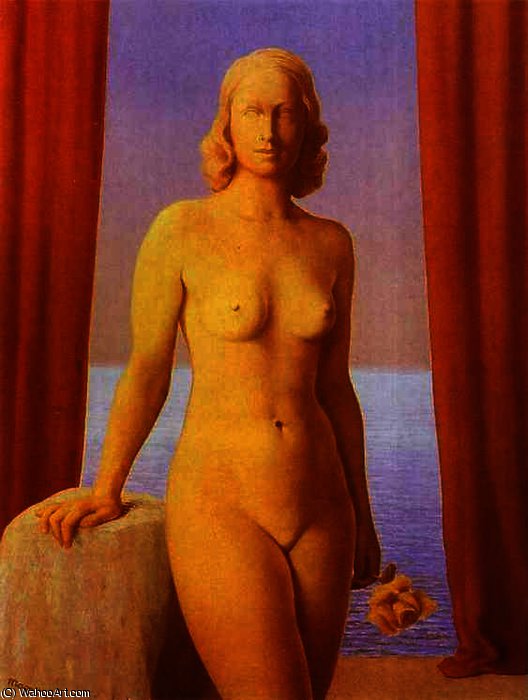
Flowers of Evil, the viewer is first met with a deceptive tranquility. A vast, serene seascape stretches toward the horizon, painted in a palette of muted blues and soft greens that suggest a world at rest. Yet, this peaceful backdrop serves only to heighten the impact of the central figure: a woman of sculptural grace, perched upon a weathered stone pedestal. She stands as a monument to both classical beauty and surrealist disruption, her form rendered with a meticulous realism that feels almost too tangible for the dreamlike landscape she inhabits. The composition possesses an ethereal quality, where the stillness of the sea meets the profound presence of the human form, creating an immediate sense of wonder and quiet tension.
The Architecture of Paradox
Magritte, working during his celebrated
Sunlit Period, masterfully employs a technique where precise, academic realism is used to anchor the impossible. The woman’s skin glows with a warmth that invites the eye, yet the composition is intentionally fractured by elements of profound mystery. A cascade of crimson drapery partially veils her form, creating a haunting interplay between
exposure and concealment—a motif that would become a hallmark of Magritte's psychological depth. In her hand, she delicately holds a bouquet of flowers, an incongruous detail that disrupts the visual harmony and forces the observer to confront the paradox of beauty intertwined with decay. This deliberate contradiction serves as a conduit for exploring subconscious desires and anxieties, making the painting much more than a landscape; it is a window into the fractured nature of reality itself.
A Timeless Presence for the Modern Collector
For the discerning collector or interior designer,
Flowers of Evil offers far more than mere decoration; it provides a profound emotional and intellectual anchor for any space. The painting carries with it the weight of Magritte’s own history—the echoes of his early life and the haunting imagery of veiled faces that emerged from personal tragedy. To feature such a piece is to invite a continuous dialogue into one's environment, challenging the boundaries of perception and inviting deep contemplation.
Whether placed in a minimalist contemporary gallery or a richly textured, classical study, this work commands attention through its ability to evoke both stillness and profound curiosity. It remains an enduring cornerstone for any collection dedicated to the mysteries of the human psyche, offering a sophisticated blend of:
- Visual Depth: A masterful use of light and texture that adds dimension to any room.
- Narrative Power: A subject matter that sparks conversation and intellectual engagement.
- Aesthetic Versatility: A timeless surrealist style that complements both modern and traditional interiors.