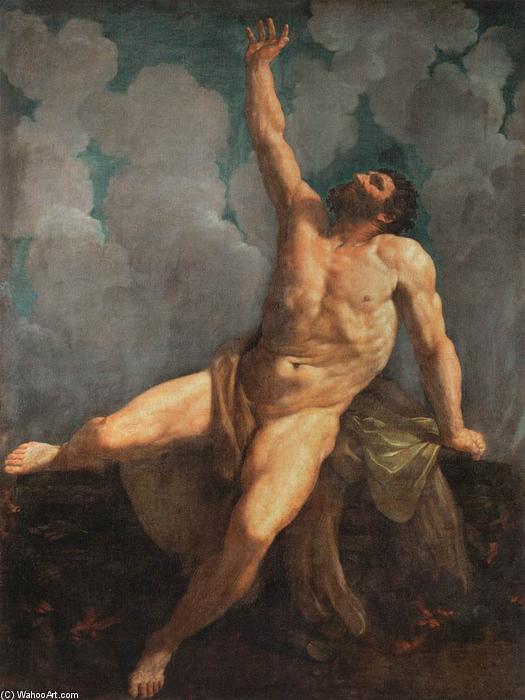
A Masterpiece of Baroque Drama: The Agony and Apotheosis of Hercules
In the grand tapestry of the Baroque era, few works capture the visceral intersection of human suffering and divine destiny as profoundly as Guido Reni’s “Hercules on the Pyre.” Painted in 1617, during the height of Rome’s artistic splendor, this monumental canvas serves as a breathtaking window into the soul of a hero at his most vulnerable. The scene depicts the legendary Hercules at a pivotal moment of transformation—bound to a pyre, enduring the physical and emotional torment that precedes his ascent to Olympus. Reni does not merely illustrate a myth; he invites the viewer into a theater of intense psychological depth, where every ripple of muscle and every shadow cast across the skin tells a story of endurance, sin, and eventual purification.
The technical brilliance of the work lies in Reni’s masterful command of chiaroscuro. Drawing inspiration from the dramatic lighting pioneered by Caravaggio, the artist employs a stark, deliberate contrast between light and dark to sculpt the protagonist's form. The central figure of Hercules dominates the composition, his powerful physique illuminated by a celestial glow that seems to emerge from within the darkness itself. This light does more than reveal anatomy; it emphasizes the tension in his straining limbs and the profound exhaustion etched into his features. As the eye moves across the canvas, the interplay of deep, muted tones and brilliant highlights creates a sense of three-dimensional movement, making the hero's struggle feel immediate and palpably real to anyone standing before the work.
Symbolism and the Weight of Heroism
Beyond its physical grandeur, “Hercules on the Pyre” is steeped in rich mythological symbolism that resonates with the human condition. The pyre itself acts as a dual symbol: it is both an instrument of death and a vessel for purification. For Hercules, this fire represents the shedding of his mortal burdens—the weight of his past labors and the heavy shadow of his earthly transgressions. As he prepares to undergo this ritualistic immolation, the turbulent, cloud-swept sky behind him mirrors his internal tempest. The composition suggests that true greatness is forged in the crucible of hardship, a theme that continues to captivate collectors and historians alike.
For the discerning art lover or interior designer, this painting offers more than just aesthetic beauty; it provides a focal point of profound intellectual and emotional gravity. The way Reni balances the raw, muscular physicality of the hero with an underlying sense of classical elegance makes the piece uniquely versatile. Whether placed in a curated gallery setting or as a commanding centerpiece in a sophisticated study, the artwork commands attention through its ability to evoke empathy and awe. It is a testament to the enduring power of the Baroque style—a period where art was designed not just to be seen, but to be felt deeply within the heart.