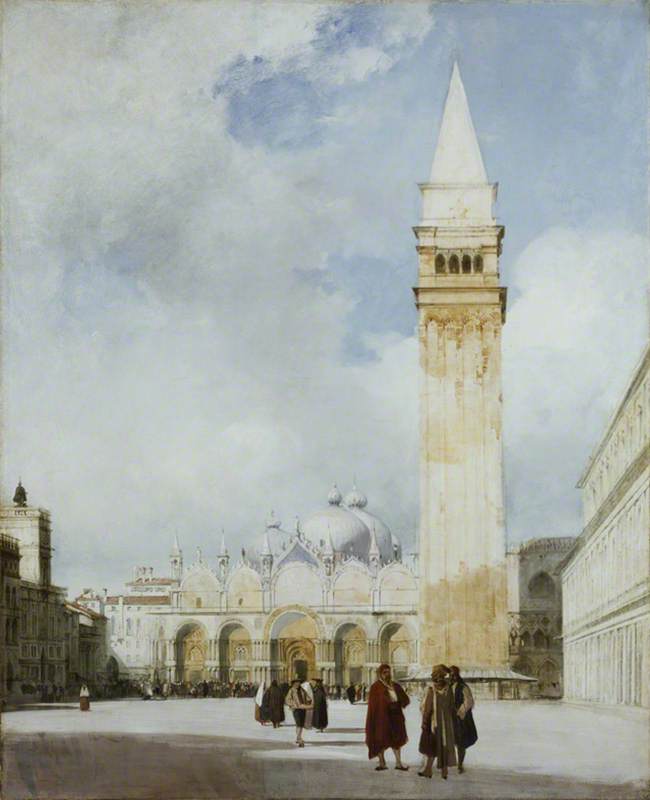
A Moment Frozen in Time: Richard Parkes Bonington’s Venice the Piazza San Marco
Richard Parkes Bonington's “Venice the Piazza San Marco,” completed in 1828, stands as a testament to Romantic Impressionism – a fleeting glimpse of Venetian splendor captured with remarkable sensitivity and technical prowess. More than just a depiction of a famous cityscape, it’s an embodiment of the era’s fascination with capturing atmospheric beauty and conveying emotion through subtle color palettes and loose brushstrokes.
- Subject Matter: The painting focuses squarely on Piazza San Marco, Venice – arguably Europe's most iconic square. Bonington skillfully portrays the Basilica di San Marco and its towering Campanile as dominant architectural features, alongside scattered figures that animate the scene with a sense of everyday life amidst grandeur.
- Style & Technique: Embracing the Impressionistic ethos championed by Monet and Renoir, Bonington eschews meticulous detail in favor of capturing the ephemeral qualities of light and color. The artwork utilizes wet-on-wet technique—a hallmark of Romantic painting—allowing for blended tones and soft edges that contribute to an overall hazy atmosphere. Loose brushstrokes dominate, prioritizing expressive gesture over precise representation.
- Color Palette & Composition: Bonington’s palette is dominated by muted pastel hues – blues mirroring the Venetian lagoon, greens reflecting the surrounding gardens, and yellows hinting at sunlight filtering through the clouds. These colors coalesce seamlessly, creating a tranquil visual experience that evokes nostalgia for a bygone era. The low-angle perspective emphasizes the Basilica's monumental scale and reinforces its position as a focal point of artistic contemplation.
- Historical Context: Created during Bonington’s brief but influential period in Paris, “Venice” reflects the Romantic movement’s preoccupation with sublime landscapes and emotional intensity. It aligns perfectly with the broader artistic currents of the time—a desire to move beyond academic conventions toward a more subjective engagement with visual experience.
- Symbolism & Emotional Impact: Beyond its aesthetic beauty, Bonington's painting speaks to deeper themes of serenity and wonder. The diffused light and soft colors instill a feeling of tranquility, inviting viewers to contemplate the timeless allure of Venice and the artist’s masterful ability to distill emotion into visual form.
A reproduction of “Venice the Piazza San Marco” would bring this evocative scene into any interior space—capturing not only its visual splendor but also the spirit of Romantic Impressionism itself.