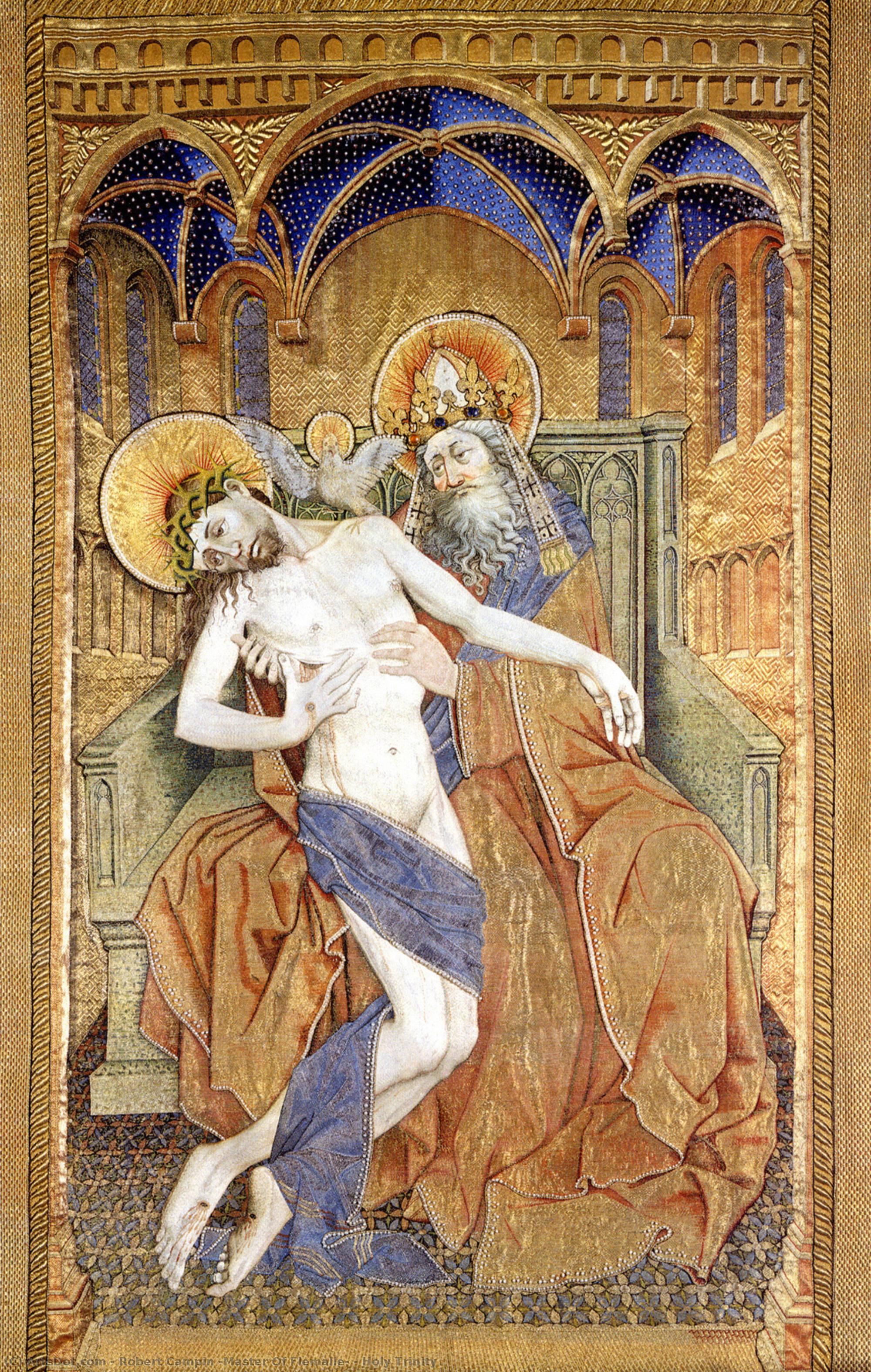
The Silent Majesty of Holy Trinity by Robert Campin
Robert Campin’s “Holy Trinity,” painted in 1433, isn't merely a depiction of Christian iconography; it’s a profound meditation on faith, family, and the nascent realism that would define the burgeoning Netherlandish school of painting. Often referred to as the Master of Flémalle – a title reflecting his unparalleled mastery within his region – Campin crafted this masterpiece in Tournai, Belgium, a pivotal center for artistic innovation during the early 15th century. The painting’s enduring power lies not just in its technical brilliance but also in its ability to evoke a sense of quiet contemplation and intimate spirituality.
The composition itself is remarkably restrained, eschewing the dramatic grandeur favored by some of his contemporaries. Three figures dominate the scene: Jesus Christ, holding aloft the cross; Saint John the Baptist on his left, gesturing towards the heavens; and Mary Magdalene, positioned to Christ’s right, her gaze filled with a poignant blend of sorrow and devotion. These aren't idealized representations; Campin imbues them with a palpable sense of humanity – their faces etched with emotion, their postures conveying both reverence and vulnerability. The figures are arranged within a simple, almost domestic setting, suggesting that the divine is not distant or unattainable but intimately connected to everyday life.
A Window into Early Netherlandish Technique
Campin’s mastery of oil paint – a relatively new medium at this time – is immediately apparent. He employs a meticulous layering technique, building up color and texture with astonishing detail. The fabrics—Mary Magdalene's flowing robes, John the Baptist’s cloak—are rendered with an almost photographic realism, capturing the subtle nuances of light and shadow. Notice particularly the way he depicts the folds of cloth; they aren’t simply painted flat but are sculpted through careful observation and a deep understanding of form. This attention to detail extends to the architectural background, which is subtly integrated into the scene, creating a sense of depth and spatial awareness.
Furthermore, Campin's use of *sfumato* – a technique borrowed from Italian Renaissance masters but adapted with his own distinctive style—blurs the edges of forms, softening outlines and lending an ethereal quality to the figures. This creates a sense of atmospheric perspective, drawing the viewer into the scene and inviting them to linger on the details.
Symbolism and the Domestic Sacred
Beyond its technical brilliance, “Holy Trinity” is rich in symbolic meaning. The placement of the figures—Jesus at the center, flanked by John and Mary—reflects traditional Christian iconography, but Campin subtly alters these established conventions. The setting itself – a modest interior with two chairs – suggests that faith is not confined to grand cathedrals or elaborate rituals but can be found in the simplest of domestic spaces. The inclusion of the figures’ personal attributes—Mary Magdalene's sorrowful expression, John the Baptist’s gesture—adds layers of emotional depth and invites viewers to contemplate their own relationship with faith.
The presence of a small table and a simple wooden bench further reinforces this sense of domesticity. It’s as if Campin is suggesting that the divine is accessible not through elaborate displays of piety but through quiet contemplation and personal devotion. The painting subtly elevates the ordinary, transforming everyday objects into symbols of spiritual significance.
A Legacy of Realism and Spiritual Depth
Robert Campin's “Holy Trinity” stands as a pivotal work in the development of Early Netherlandish painting. It represents a shift away from the stylized conventions of Gothic art towards a more naturalistic and emotionally resonant style. His innovative use of oil paint, his meticulous attention to detail, and his subtle deployment of symbolism paved the way for future generations of artists, including Jan van Eyck and Rogier van der Weyden. Today, reproductions of this remarkable painting continue to inspire awe and admiration, offering a glimpse into the artistic genius of one of the most important figures in European art history.