A Vision of Mid-Century Modernism
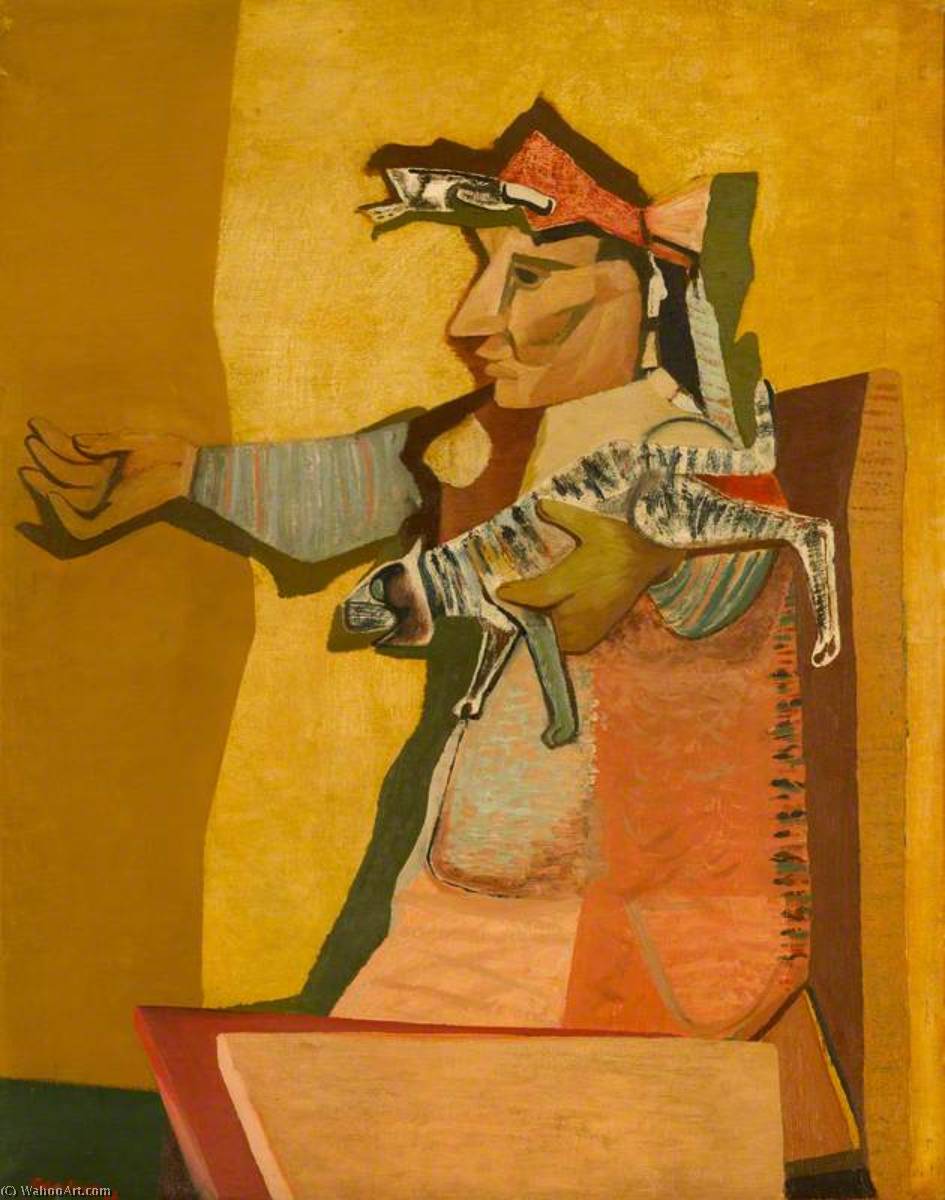
In the evocative landscape of mid-century British art, few works capture the tension between simplicity and profound emotion as effectively as Robert Colquhoun’s Seated Woman and Cat. Painted in 1946, this striking oil on canvas serves as a masterclass in early modernism, blending the structural rigor of Cubism with the raw, visceral energy of Expressionism. The composition immediately commands attention through its bold, geometric architecture, where flattened planes and sharp angles coalesce to create a world that feels both grounded and dreamlike. A dominant, sun-drenched yellow background envelops the scene, casting a warm yet strangely unsettling glow that permeates the entire canvas, inviting the viewer into a space where reality is secondary to emotional truth.
The subject matter—a stylized figure cradling a fish alongside a feline companion—transcends mere domesticity. While the presence of the fish might initially suggest themes of bounty or the quiet rhythms of coastal life, Colquhoun imbues the scene with a deeper, more enigmatic symbolism. The figure is rendered through simplified, blocky forms and heavy outlines, stripping away unnecessary detail to focus on the weight and presence of the subject. This reductionist approach allows the painting to function as a meditation on existence itself; the interplay between the human, the animal, and the elemental becomes a poetic dialogue about sustenance, survival, and the quiet companionship found in moments of solitude.
Technique and Tactile Brilliance
For the discerning collector or interior designer, the technical mastery displayed in this piece offers immense visual depth. Colquhoun utilizes a limited but powerful palette of ochre, deep oranges, fiery reds, and stark blacks to build a sense of rhythmic movement across the 97 x 76 cm surface. The application of oil paint is notably textured, with visible, broad brushstrokes that lend the work a rugged, tactile quality. This impasto-like approach ensures that the painting interacts dynamically with light; as shadows shift within a room, the heavy outlines and layered pigments create a sense of shifting perspective and life.
The absence of traditional spatial recession is perhaps the artwork's most daring feature. Rather than relying on vanishing points to create depth, Colquhoun uses overlapping planes and strong, expressive lines to guide the eye through the composition. This creates a flattened, graphic impact that makes the piece an extraordinary focal point for contemporary interiors. Whether placed in a minimalist gallery setting or a richly textured living space, Seated Woman and Cat acts as an anchor of historical significance and aesthetic sophistication. It is a work that does not merely decorate a wall but transforms the atmosphere of a room, offering a window into the soulful, avant-garde spirit of post-war Britain.