A Fiery Soul Captured on Canvas: The Emotional Depth of Rosso Fiorentino
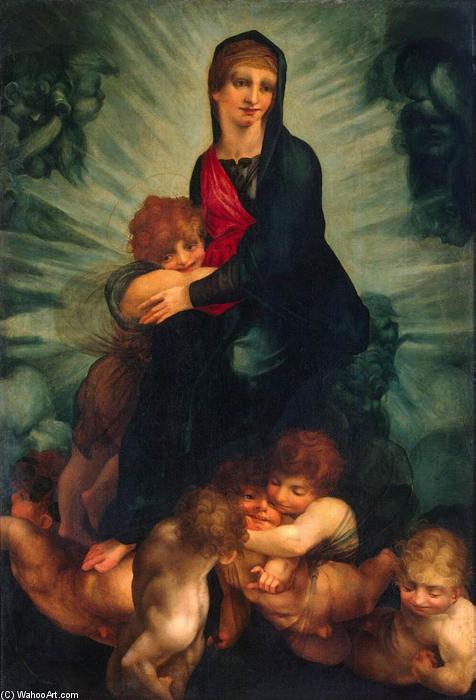
In the grand tapestry of the Italian Renaissance, few threads shimmer with as much turbulent energy as the works of Giovanni Battista di Jacopo, known eternally as Rosso Fiorentino. His masterpiece, Madonna and Child with Putti, painted in 1522, serves as a profound window into a soul that refused to be bound by the serene, mathematical perfection of the High Renaissance. While his contemporaries often sought a divine, unshakeable balance, Rosso embraced the beautiful friction of Mannerism. In this evocative oil on canvas, currently held within the hallowed halls of The Hermitage, we encounter not just a religious icon, but a psychological landscape where grace meets an unsettling, human vulnerability.
The composition centers upon the Madonna, whose presence is both commanding and deeply tender. She cradles the Christ Child with a maternal devotion that feels startlingly real, stripped of the distant, porcelain idealism favored by Raphael. Clad in a rich, crimson cloak that seems to pulse with life, she exists within a space defined by chiaroscuro—a masterful interplay of dramatic light and encroaching shadow. This technique does more than merely sculpt the figures; it breathes an atmospheric tension into the scene, casting a soft glow upon the infant while leaving parts of the surrounding world in a mysterious, swirling haze of clouds and foliage.
The Dance of Innocence and the Shadows of History
Surrounding this central pair is a celestial troupe of putti, those cherubic figures that embody the lightness of spirit and the joy of creation. They drift through the composition in various playful poses, some reaching toward the holy duo with infantile curiosity, others seemingly dancing amidst the clouds. Yet, even within this display of innocence, there is a palpable sense of movement and asymmetry that prevents the scene from feeling static. Rosso deliberately avoids the rigid geometric stability of his predecessors, opting instead for a dynamic imbalance that mirrors the shifting political and social tides of early 16th-century Italy.
To look upon this painting is to feel the echoes of a world in flux. Created during an era marked by profound instability—leading up to the devastating Sack of Rome—the artwork captures a specific brand of artistic anxiety. The subtle distortions in proportion and the heightened emotional intensity suggest a departure from certainty toward a more complex, nuanced reality. For the discerning collector or interior designer, this piece offers much more than mere decoration; it provides a focal point of profound intellectual and emotional gravity. It is a work that invites contemplation, making it an exquisite addition to any space curated for depth, history, and the celebration of the human spirit's enduring complexity.