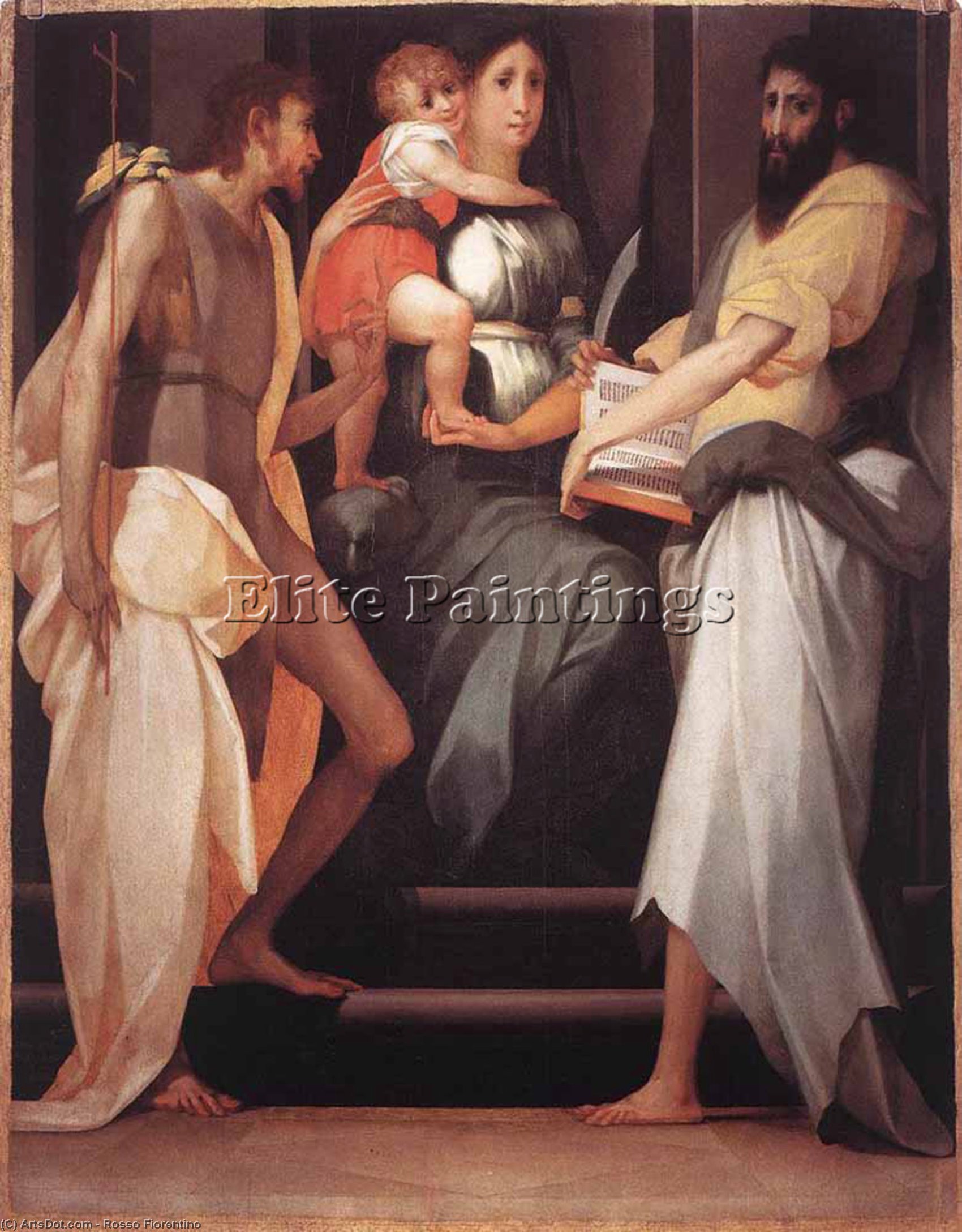
A Vision of Devotion: Rosso Fiorentino’s *Madonna Enthroned between Two Saints*
Rosso Fiorentino's 1521 masterpiece, *Madonna Enthroned between Two Saints*, is a profoundly moving testament to the emotional core of Renaissance art. This painting, measuring 169 x 133 cm, immediately captivates with its depiction of a tender maternal moment – a young mother holding her child, framed by the solemn presence of two revered saints. Executed in the style characteristic of Rosso’s mature work, it exemplifies the burgeoning Mannerist movement's emphasis on psychological intensity and stylized forms rather than strict adherence to classical ideals.
The Artist and His Time
Born Giovanni Battista di Jacopo in Florence in 1495, Rosso Fiorentino quickly established himself as a pivotal figure within the Florentine art scene. Trained under Andrea del Sarto, he swiftly surpassed his teacher, developing a distinctive style marked by dramatic lighting, elongated figures, and an almost unsettling emotional depth. His career coincided with a period of intense political and religious upheaval in Italy – the Sack of Rome in 1527 being a particularly devastating event that profoundly impacted artistic production. Rosso’s work reflects this turbulent era, imbued with a sense of urgency and spiritual searching. The painting's creation aligns perfectly with his exploration of complex emotional states within religious iconography.
Composition and Technique
The composition is meticulously constructed to draw the viewer into the scene. The central Madonna, rendered with exquisite detail in oil on panel, dominates the canvas, her gaze direct and compassionate. Her flowing robes, a rich crimson hue – hence his nickname “The Red Florentine” – create a sense of luxuriousness and divine grace. The child, nestled securely in her arms, embodies innocence and vulnerability. The two saints flanking the Madonna—likely Saint Lucy and Saint Catherine—add layers of symbolic meaning. Their presence elevates the scene to a realm of spiritual authority and intercession. Rosso’s masterful use of *sfumato*, a technique perfected by Leonardo da Vinci, softens the edges of forms, creating an atmospheric haze that enhances the painting's emotional impact. The subtle gradations of light and shadow contribute significantly to the work’s palpable sense of depth and realism.
Symbolism and Emotional Resonance
*Madonna Enthroned between Two Saints* is rich in symbolic meaning. The throne upon which the Madonna sits represents her divine authority and role as Queen of Heaven. The inclusion of two saints, traditionally associated with light and darkness respectively (Lucy and Catherine), underscores the duality inherent in faith – the balance between earthly concerns and spiritual aspirations. More than a mere depiction of religious figures, Rosso Fiorentino captures a universal human experience: the profound love and devotion between mother and child. The painting’s emotional intensity—a palpable sense of tenderness, serenity, and perhaps even melancholy—resonates powerfully with viewers centuries later. It is a timeless meditation on faith, family, and the enduring mysteries of the human heart.