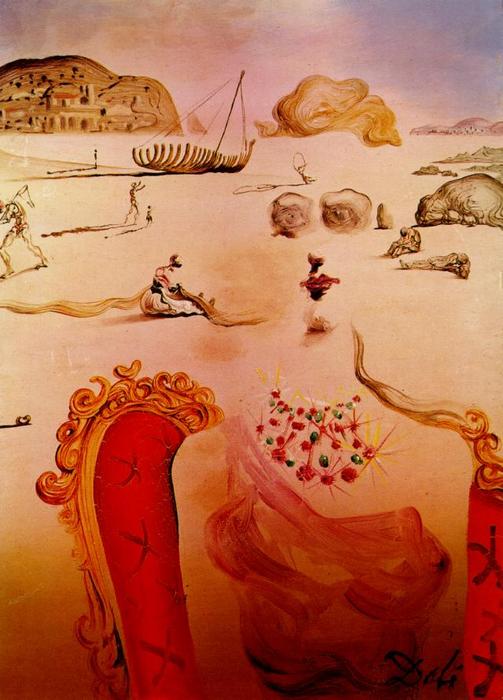
Paranoia (Surrealist Figures): A Descent into the Subconscious
Salvador Dalí’s “Paranoia (Surrealist Figures),” painted in 1944, isn't merely a landscape; it’s an immersive journey into the fractured psyche. Born from the anxieties of wartime Europe and deeply rooted in Dalí’s exploration of Freudian psychoanalysis, this work represents a pivotal moment in his artistic evolution – a deliberate plunge into the realm of paranoia and subjective experience. The painting immediately confronts the viewer with a desolate, almost lunar landscape, dominated by a stark, ochre-colored sky and a barren terrain punctuated by unsettlingly distorted forms. It’s a scene designed not to offer comfort or clarity, but rather to evoke a sense of disorientation and unease – a feeling perfectly aligned with the title's core concept.
Dalí meticulously crafted this world using his signature meticulous technique, honed over years of practice. The precision of each brushstroke, the careful rendering of textures—from the dry, cracked earth to the shimmering heat haze—creates an illusionistic depth that draws the eye into the scene’s unsettling details. He employed a restricted palette of warm browns, yellows, and reds, intensifying the feeling of isolation and amplifying the psychological drama. The use of oil paint allowed for layering and blending, creating subtle gradations of color and light that contribute to the painting's dreamlike quality.
The Language of Symbols: Deconstructing Reality
“Paranoia (Surrealist Figures)” is a rich tapestry of symbolic imagery, reflecting Dalí’s fascination with Freudian concepts of the subconscious. The prominent red figure in the foreground, resembling a distorted chair, immediately commands attention. This isn't simply an object; it represents a sense of oppressive authority and perhaps even a self-imposed confinement – a visual manifestation of paranoia itself. The elongated sailboat, adrift on the dry land, symbolizes lost hope or a yearning for escape, while the translucent veil draped over a form suggests hidden desires and obscured identities. The scattered figures throughout the landscape—some standing, some seated, others lying prone—represent fragmented memories and distorted perceptions.
Dalí himself described his artistic process as “paranoiac-critical method,” a technique he developed to access his own subconscious mind. This involved systematically analyzing his thoughts and images, identifying recurring patterns and symbols, and then translating them into visual form. “Paranoia (Surrealist Figures)” is a prime example of this method in action – a deliberate attempt to externalize the internal chaos of a paranoid state. The painting isn’t about depicting a literal landscape; it's about representing the *feeling* of paranoia, its distortions and anxieties.
Historical Context & Dalí’s Surrealist Journey
Created in 1944, during the tumultuous years of World War II, “Paranoia (Surrealist Figures)” reflects a broader cultural climate marked by uncertainty, fear, and disillusionment. Surrealism, as a movement, emerged in response to the horrors of war and the perceived failures of rational thought. Dalí’s work aligns perfectly with this spirit, offering a visual antidote to the logic-driven world of the time. It's important to note that Dalí was deeply influenced by Sigmund Freud’s theories on psychoanalysis, particularly his exploration of dreams and the unconscious mind.
Following his departure from Spain in 1940 due to the rise of Franco, Dalí spent much of this period in America, enjoying considerable commercial success. However, he returned to Spain in 1948, embracing a more conservative outlook and aligning himself with the Catholic Church. This shift is reflected in some of his later works, which often incorporated religious imagery and themes. “Paranoia (Surrealist Figures)” represents a transitional period in Dalí’s career, bridging the gap between his earlier, more overtly subversive Surrealist paintings and his later, more introspective and spiritually-oriented work.
Emotional Resonance & Artistic Legacy
“Paranoia (Surrealist Figures)” is not a painting to be passively observed; it demands engagement. It evokes a profound sense of unease, disorientation, and perhaps even a touch of melancholy. The painting’s unsettling imagery lingers in the mind long after viewing, prompting reflection on the nature of reality, perception, and the hidden depths of the human psyche. Dalí's masterful manipulation of color, form, and symbolism creates an experience that is both visually arresting and emotionally resonant.
Today, “Paranoia (Surrealist Figures)” remains a cornerstone of Dalí’s oeuvre and a powerful example of Surrealism at its most evocative. Reproductions offer a remarkable opportunity to bring this extraordinary artwork into your home or office, allowing you to experience the unsettling beauty and profound psychological insights that lie within its dreamlike landscape.