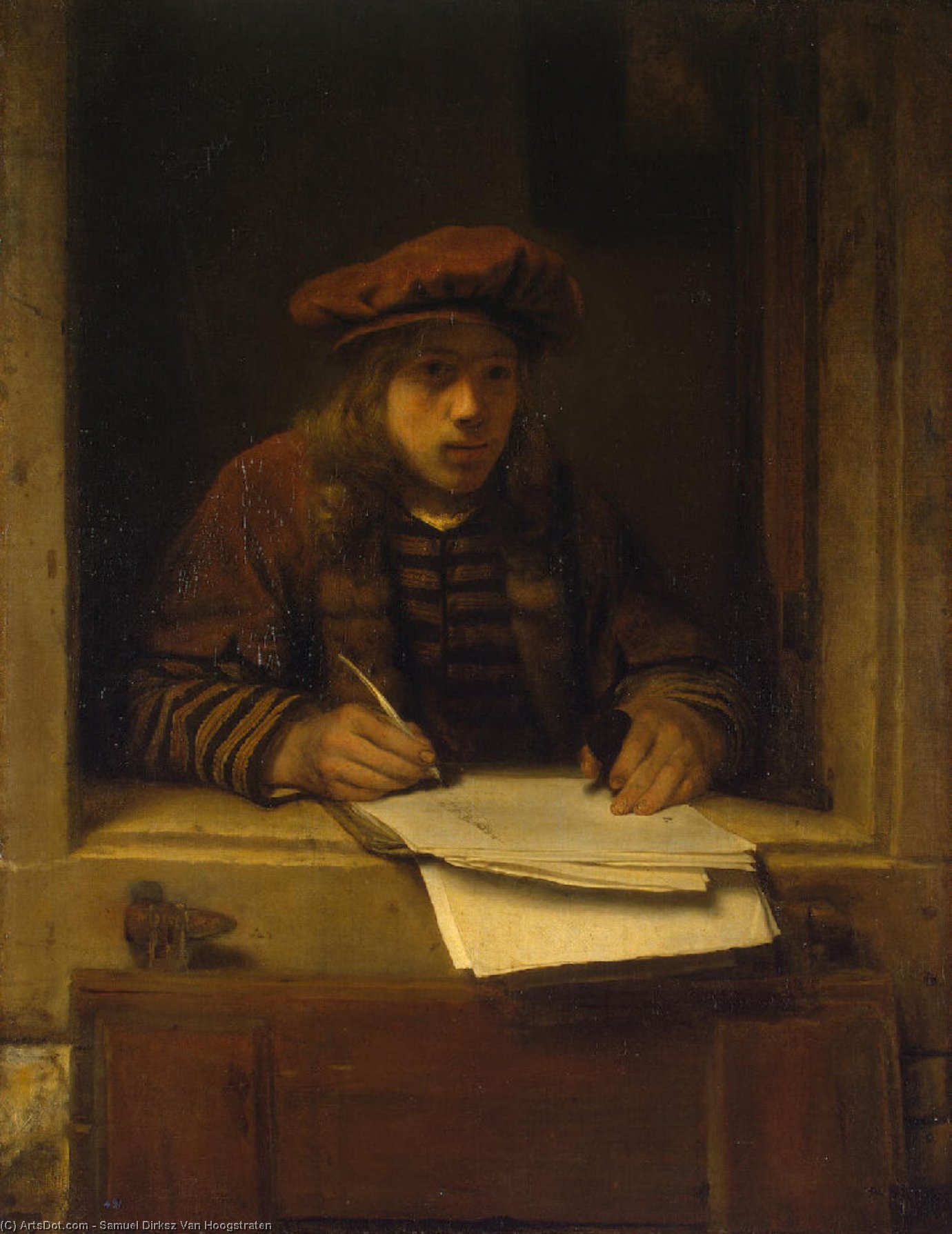
Van Hoogstraten’s meticulous attention to detail – particularly the trompe-l'oeil illusion of depth created by the window and bookshelves – reflects his groundbreaking approach to perspective and visual representation.
サミュエル・ファン・ホーストラッハ(1627-1678):レンブラントの影響を受けたオランダ黄金時代の画家。トロンプ・ルイユ(だまし絵)、透視図法を用いたボックス、そして美術理論書で知られる。
エルミタージュ美術館
(Saint Petersburg, Russia)
エルミタージュ美術館
ロシア
ミハイル・ピオトロフスキー
サンクトペテルブルク
エルミタージュ美術館
ルネサンス絵画
年間281万2913人(2022年)
300万点以上
芸術と文化
1764年
サンクトペテルブルクのエルミタージュ美術館へ!ルネサンスから現代まで、息をのむような名作が歴史的な宮殿に展示。芸術と文化の旅に出かけましょう。
A Window into Genius: Examining Samuel Dirksz van Hoogstraten’s Self Portrait
Samuel Dirksz van Hoogstraten, a luminary of the Dutch Golden Age (1627-1678), stands as a testament to artistic ambition and intellectual prowess. More than merely capturing his likeness on canvas, he undertook a profound exploration of perception itself—a characteristic hallmark of his era and a cornerstone of his enduring legacy. This meticulously crafted self-portrait, completed in 1647, transcends the conventions of portraiture, presenting us with an image brimming with symbolic resonance and technical brilliance that continues to captivate viewers centuries later.
The Baroque Vision: Style and Technique
Van Hoogstraten’s artistic approach firmly rooted him within the Baroque movement—a stylistic paradigm defined by dramatic contrasts of light and shadow, opulent ornamentation, and a fervent desire to evoke emotion. The painting employs trompe-l'oeil techniques with masterful precision, blurring the boundaries between reality and illusion. Notice how the artist skillfully renders the window frame and its reflection as if it were an actual architectural element within the composition—a technique designed not just for visual spectacle but also to heighten the viewer’s sense of depth and immersion. Brushstrokes are deliberate and controlled, conveying a palpable energy while simultaneously achieving remarkable smoothness and tonal gradation. The pigment choices – predominantly reds and browns – contribute to the painting's rich palette and underscore its solemn mood.
A Reflection on Observation: Composition and Symbolism
The composition itself is carefully considered—a balanced arrangement that draws the eye inward toward the central figure. Positioned slightly off-center, Van Hoogstraten gazes out of the window, suggesting contemplation and introspection. The inclusion of two books – one prominent in the foreground and another nestled amongst the folds of his robe – speaks to the artist’s intellectual pursuits and underscores the importance of knowledge within his worldview. These symbols aren't merely decorative; they represent Van Hoogstraten’s engagement with humanist ideals prevalent during his time—a preoccupation with reason, observation, and understanding the complexities of human experience. The chair behind him serves as a grounding element, anchoring the figure amidst the expansive vista beyond the windowpane.
Historical Context: Dordrecht and Artistic Innovation
Created in Dordrecht, Netherlands, during the height of Dutch mercantile prosperity and artistic flourishing, this self-portrait reflects the broader cultural landscape of its time. Van Hoogstraten’s formative years were spent within his father's workshop—a crucible for honing fundamental artistic skills—before embarking on a journey to Amsterdam, where he immersed himself in the vibrant artistic milieu of the Golden Age. He was influenced by Rembrandt’s masterful use of chiaroscuro and sought to emulate his ability to convey psychological depth through visual representation. This painting stands as an exemplar of Dutch Baroque artistry—a genre characterized by its dramatic flair and intellectual sophistication.
Emotional Resonance: Beyond Mere Representation
Ultimately, ‘Self Portrait’ transcends the limitations of a simple likeness. It communicates a profound sense of solitude and thoughtfulness—a glimpse into the artist's inner life as he confronts the world outside his window. The gaze is direct yet melancholic, inviting viewers to contemplate their own perceptions and experiences. Van Hoogstraten’s achievement lies not merely in replicating visual reality but in capturing its emotional essence—a feat that cements his place among the most influential artists of his era and ensures that this captivating image continues to inspire admiration for generations to come.