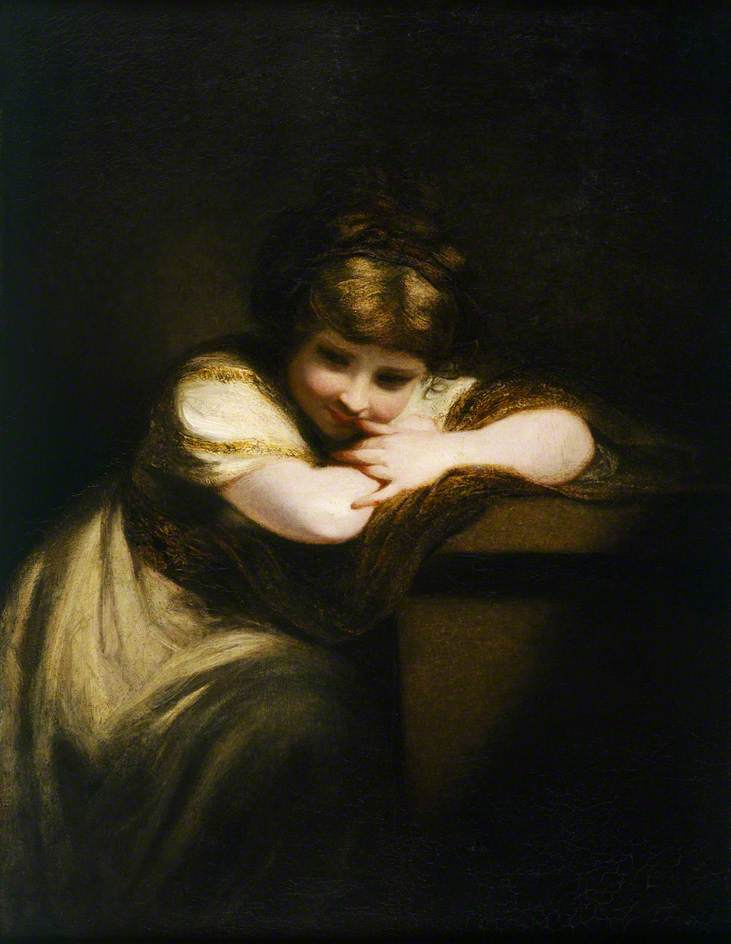
A Vision of Enlightenment Grace
In the soft, luminous glow of Sir Joshua Reynolds’ “Girl Leaning on a Pedestal,” we encounter more than just a portrait; we step into the very heart of the British Enlightenment. Executed between 1775 and 1782, this masterpiece captures a moment of profound stillness and youthful vitality. The subject, often affectionately known as “The Laughing Girl,” rests with an effortless elegance upon a stone ledge, her posture striking a delicate balance between casual ease and aristocratic poise. Reynolds, a titan of the eighteenth-century art world, does not merely record a likeness; he constructs an ideal. Through his masterful use of pyramidal composition, he directs our eyes upward, ensuring that the viewer’s gaze is inevitably drawn to the radiant warmth of her face, which seems to glow from within.
The painting serves as a breathtaking window into an era defined by humanist ideals and classical revival. As the first president of the Royal Academy, Reynolds was a pioneer of the Grand Style, a movement dedicated to elevating portraiture through the infusion of dignity, intellectual depth, and classical beauty. In this work, the subject’s gentle expression and the soft, flowing drapery of her attire evoke the timelessness of ancient sculpture, yet the palpable sense of life and emotion remains intimately human. For the discerning collector or interior designer, this piece offers a sense of historical weight and sophisticated charm, making it an anchor for any space that values classical refinement and narrative depth.
The Alchemy of Light and Brushwork
To behold this work is to witness Reynolds’ unparalleled command over light and texture. The artist employs a sophisticated technique of glazing, layering translucent washes of pigment to achieve a breathtaking luminosity. This method allows light to penetrate the upper layers of paint, reflecting back from the base to create an ethereal, pearlescent quality in the girl's skin and the delicate folds of her gown. His brushwork, though often characterized by energetic and rapid strokes, is applied with such precision that it achieves a seamless realism, particularly in the way light dances across the fabric and settles upon the stone pedestal.
The interplay between shadow and brilliance creates a profound sense of three-dimensional space. The background, a muted and atmospheric wall, recedes into soft obscurity, ensuring that the subject remains the undisputed protagonist of the scene. This deliberate manipulation of depth ensures that the portrait does not feel static; rather, it possesses a breathing, rhythmic quality. For those seeking to adorn a home or gallery with a high-quality reproduction, the ability of this painting to command attention through its subtle tonal shifts and rich textures provides an unparalleled decorative impact, bringing a touch of 18th-century splendor to a contemporary setting.
An Enduring Legacy for the Modern Collector
Beyond its technical brilliance, “Girl Leaning on a Pedestal” resonates with an emotional sincerity that transcends the centuries. There is a subtle vulnerability in her gaze, a quiet confidence in her repose, and a joy that feels remarkably modern. It is this intersection of historical grandeur and intimate human emotion that makes Reynolds’ work so enduringly relevant. The painting does not demand attention through loud colors or jarring compositions; instead, it seduces the viewer through its grace, inviting long periods of contemplation.
Integrating a reproduction of such a significant work into an interior design scheme allows for the introduction of a "conversation piece" that bridges the gap between the past and the present. Whether placed in a sunlit study, a formal dining room, or a curated gallery wall, the painting lends an air of intellectual sophistication and timeless beauty. It is an investment in atmosphere, offering anyone who views it a momentary escape into a world of light, elegance, and the enduring spirit of the Enlightenment.