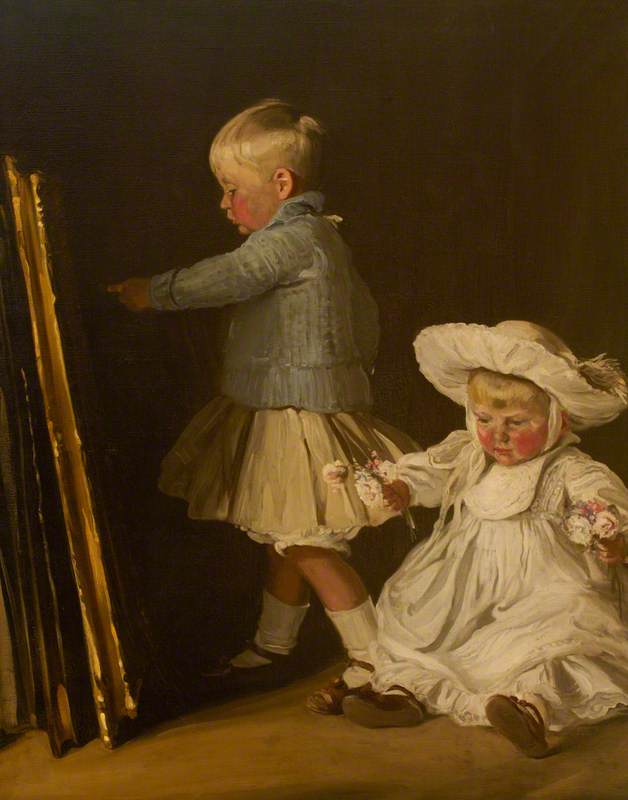
A Portrait of Childhood Innocence: William Nicholson’s ‘Francis and Christopher Bacon’
William Nicholson's 1907 painting, “Francis and Christopher Bacon,” is more than just a charming depiction of two young boys; it’s a poignant window into the early 20th century, imbued with a quiet dignity and a subtle exploration of familial bonds. Commissioned by Thomas W. Bacon, a prominent figure in the art world connected to Ramsden Hall in Essex, the painting captures his sons, Francis and Christopher, posed playfully before a mirror – an element that immediately draws the eye and subtly complicates the scene’s narrative.
Nicholson, a key member of the influential Beggarstaff Studios alongside Bertram MacPherson and Frank Hendy, was renowned for his strikingly realistic portraits and evocative scenes of London life. However, this work demonstrates a shift towards a more intimate and psychologically nuanced approach. The boys aren’t presented as subjects for mere amusement; they possess an understated seriousness, their gazes holding a hint of awareness beyond their years. The careful attention to detail – the texture of their clothing, the slight asymmetry of their features, the way the light catches on their faces – speaks volumes about Nicholson's mastery of observation and his ability to capture fleeting moments of human experience.
A Study in Light and Reflection
Technically, “Francis and Christopher Bacon” is a testament to Nicholson’s skill with oil paint. He employs a loose, almost impressionistic brushstroke, allowing the colors to blend seamlessly and creating a sense of atmospheric depth. The use of light is particularly noteworthy; it's diffused and gentle, bathing the boys in a warm glow that softens their features and evokes a feeling of nostalgia. The mirror itself isn’t merely a decorative element but acts as a crucial focal point, reflecting not just their physical appearances but also hinting at an internal world – perhaps a reflection of their personalities or aspirations.
Nicholson's background, shaped by his father’s engineering prowess and his mother’s lineage tracing back to Oxfordshire’s artistic traditions, instilled in him both discipline and an appreciation for aesthetic beauty. This blend is evident in the painting’s balanced composition and its harmonious color palette. The subtle gradations of tone and hue contribute to a sense of quiet elegance, elevating the scene beyond a simple portrait.
Historical Context and Familial Significance
The Bacon family's connection to Ramsden Hall, a prestigious estate in Essex, provides valuable context for understanding the painting’s significance. Thomas W. Bacon was a prominent figure in the art world, and his sons were likely exposed to artistic influences from an early age. The mirror, a recurring motif in Nicholson’s work, can be interpreted as a symbol of self-reflection and familial legacy – a visual representation of the boys' connection to their father and the broader Bacon family history.
Furthermore, 1907 represents a pivotal moment in British art. The late Victorian era was giving way to the modern age, with artists experimenting with new styles and techniques. Nicholson’s work reflects this shift, moving away from the rigid conventions of academic portraiture towards a more subjective and expressive approach. The painting stands as a beautiful example of this transition, capturing a moment in time while simultaneously hinting at the changing social and artistic landscape.
Symbolism and Emotional Resonance
Beyond its technical merits, “Francis and Christopher Bacon” resonates with viewers on an emotional level. The boys’ quiet contemplation suggests a depth of character that belies their age. There's a sense of vulnerability and innocence in their expressions, inviting the viewer to connect with them on a human level. The mirror, as a symbol of self-awareness, adds another layer of complexity to the scene, prompting us to consider the boys’ future paths and the legacy they will leave behind.
Ultimately, Nicholson's painting is a subtle yet powerful meditation on childhood, family, and the passage of time. It’s a work that rewards careful observation and invites repeated viewing, revealing new layers of meaning with each encounter.