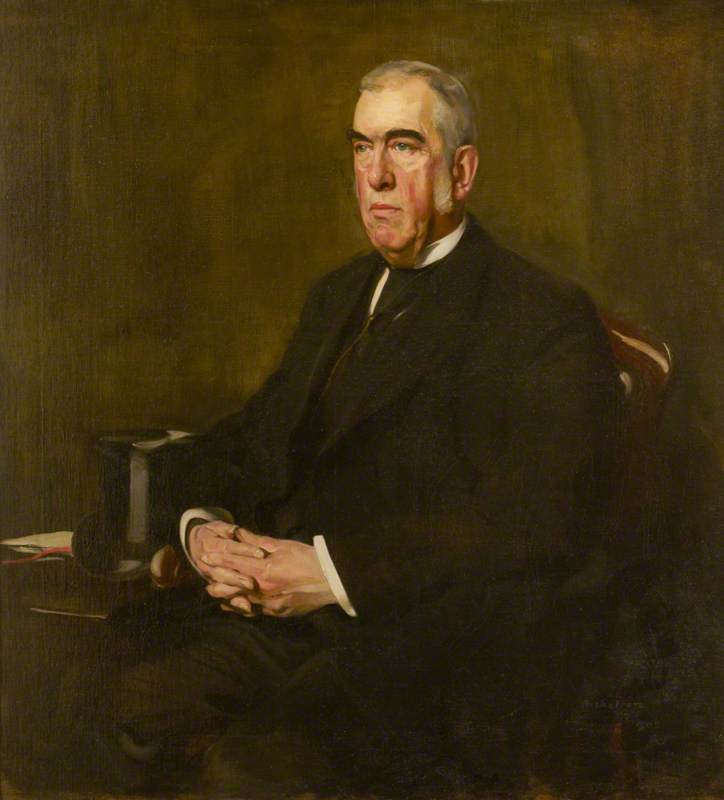
A Portrait of Quiet Contemplation: James Samuel Beale
Sir William Nicholson’s 1905 portrait of James Samuel Beale is more than a simple likeness; it's a carefully constructed tableau of Victorian formality and subtle introspection. Painted during a period of significant social and artistic change, the work offers a poignant glimpse into the life of a man lost to history, rendered with Nicholson’s signature blend of meticulous detail and evocative atmosphere. The painting immediately draws the eye to Beale’s posture – seated in a chair positioned slightly off-center, his hands clasped together before him as if engaged in silent thought. This gesture, combined with the downward cast of his gaze, suggests a depth of contemplation, hinting at private concerns or perhaps simply a moment of quiet reflection amidst the bustle of late 19th-century London.

The composition is remarkably restrained, relying on a muted palette of browns, greys, and creams to create a sense of dignified solemnity. Nicholson’s masterful use of light – subtly illuminating Beale's face and hands while leaving the background in shadow – further emphasizes the subject’s presence and draws attention to his internal state. The details are exquisite: the texture of the tweed suit, the sheen of the tie, the delicate lines of the mustache—all rendered with painstaking accuracy, reflecting Nicholson’s commitment to realism and his ability to capture the nuances of human appearance.
The Beggarstaff Legacy and Artistic Context
To fully appreciate this portrait, it's essential to understand Nicholson’s artistic context. He was a key member of the Beggarstaffs, a celebrated partnership with James Pryde that revolutionized illustration in Britain during the late Victorian era. The Beggarstaffs were known for their witty and often satirical posters and advertisements, characterized by bold lines, dynamic compositions, and a distinctly modern aesthetic. This experience undoubtedly informed Nicholson’s approach to portraiture, encouraging him to move beyond mere likeness and instead strive to capture the personality and character of his subjects. The influence of Japanese woodblock prints – particularly those of Hiroshige and Hokusai – is also evident in Nicholson's use of atmospheric perspective and simplified forms.
Painted in 1905, the portrait reflects a society grappling with rapid industrialization, social change, and anxieties about modernity. Beale himself was a prominent figure—a lawyer and businessman—and his image serves as a visual record of the Victorian elite. However, Nicholson’s portrayal transcends simple documentation; it offers a moment of intimacy, inviting us to contemplate the inner life of this man from the past.
Symbolism and Emotional Resonance
The portrait's power lies not just in its technical skill but also in its subtle symbolism. The seated posture, with hands clasped together, is a universal gesture of contemplation and perhaps even humility. Beale’s downward gaze suggests introspection, a willingness to confront his own thoughts and feelings. While the painting lacks overt emotional expression, it evokes a sense of quiet dignity and melancholy—a feeling that resonates deeply within the viewer. The muted color palette contributes to this mood, creating an atmosphere of subdued seriousness.
Furthermore, the choice of Beale as the subject is intriguing. His reserved demeanor and dignified appearance suggest a man who valued order and restraint – qualities often associated with Victorian values. Yet, his contemplative posture hints at a hidden complexity beneath the surface, inviting us to imagine the thoughts and experiences that shaped his life.
A Timeless Masterpiece for Reproduction
Reproductions of “James Samuel Beale” by Sir William Nicholson offer an exceptional opportunity to bring this evocative portrait into any interior space. The painting’s timeless quality—its combination of realism, symbolism, and emotional resonance—makes it a perfect addition to both traditional and contemporary settings. Whether displayed in a formal study or a more relaxed living room, this artwork will undoubtedly serve as a focal point, sparking conversation and inviting contemplation.