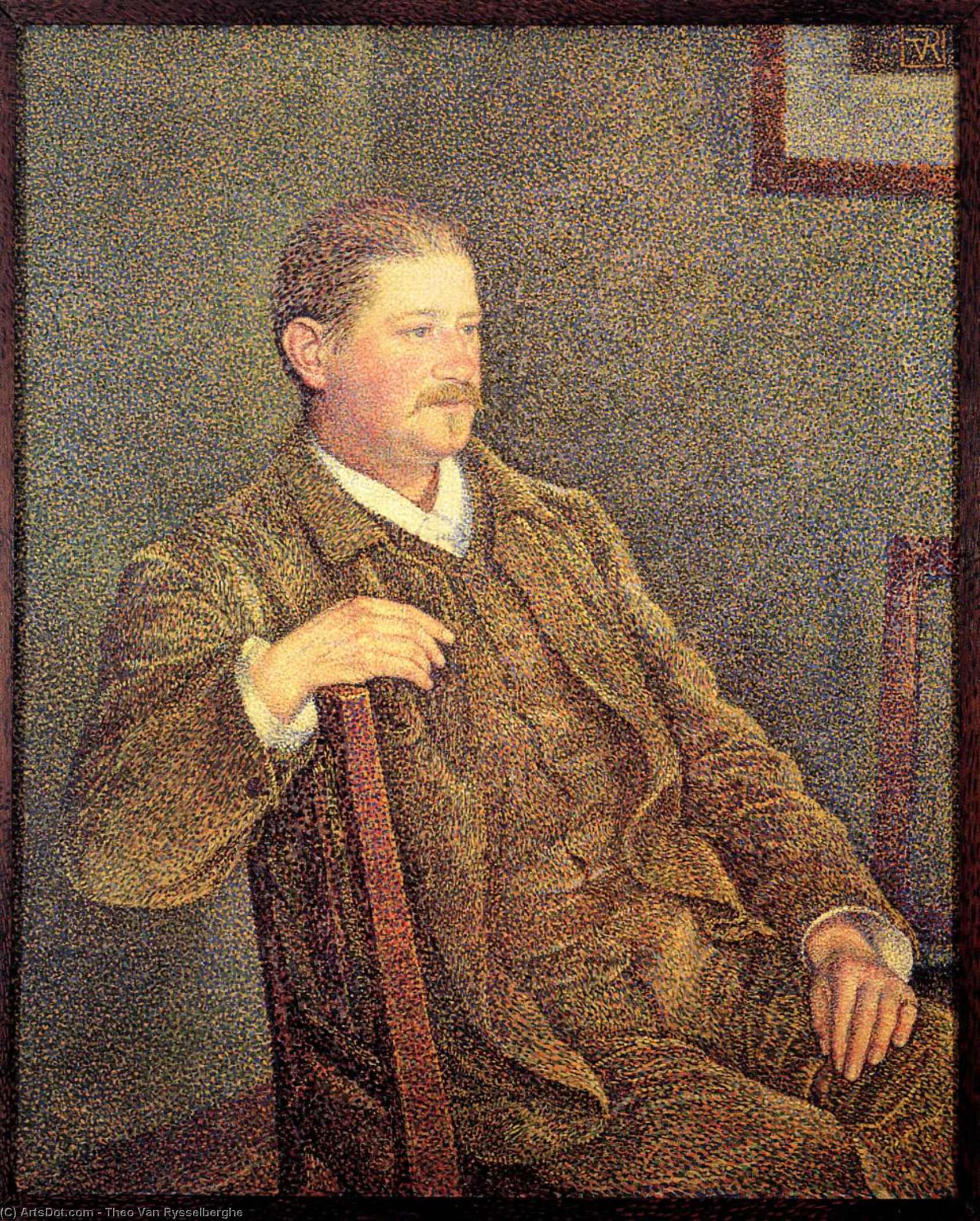
Theo van Rysselberghe’s luminous Post-Impressionist painting ‘Five Minutes Late,’ rendered in meticulous Pointillist dots, captures a contemplative man seated in repose amidst an understated Parisian scene. Explore this exquisite reproduction and bring artistic brilliance into your home.
A Study in Quiet Dignity: Exploring Theo Van Rysselberghe’s “Five Minutes Late”
Theo van Rysselberghe's "Five Minutes Late," painted in 1892, stands as a quintessential example of Neo-Impressionism—a movement that sought to elevate Impressionism beyond mere fleeting impressions of light and color into a more deliberate exploration of visual sensation. Born in Ghent, Belgium, in 1862, van Rysselberghe’s artistic trajectory wasn't marked by an abrupt stylistic shift but rather a gradual refinement honed through extensive travel and intellectual engagement with the burgeoning avant-garde circles of Paris. Initially trained at the Academy of Ghent under Theo Canneel and subsequently pursuing formal studies at the Académie Royale des Beaux-Arts in Brussels, he absorbed the influence of Belgian artistic traditions while simultaneously embracing the revolutionary ideas circulating within European art discourse.
The painting itself depicts a solitary man seated comfortably in a chair, his hands crossed thoughtfully on his lap—a posture conveying both repose and contemplation. His facial features are rendered with meticulous detail: a prominent beard and mustache lend him an air of distinguished seriousness, reflecting the societal values prevalent during his time. He is dressed impeccably in a suit and tie, symbolizing professionalism and social decorum. However, the scene isn’t devoid of subtle dynamism; two figures occupy positions on either side of the chair, engaged in activities seemingly unconnected to the central subject—a deliberate compositional choice that invites viewers to consider the complexities of human interaction and circumstance.
- Style: Neo-Impressionism – Characterized by its methodical application of small dots or taches of pure pigment, meticulously blended to create luminous surfaces and heighten visual impact.
- Technique: Oil on Canvas – The textured surface lends itself beautifully to capturing the subtleties of light and shadow, allowing for a nuanced portrayal of form and atmosphere.
- Historical Context: Painted during the late 1890s, “Five Minutes Late” reflects the broader artistic currents of its era—a reaction against Impressionism’s ephemeral aesthetic and an aspiration to achieve greater permanence through scientific observation and controlled color palettes.
The painting's muted palette – predominantly browns, creams, and subtle greens – contributes significantly to its emotional resonance. Rather than aiming for dramatic expression, van Rysselberghe skillfully employs color to convey a sense of quiet dignity and understated introspection. The diffused light bathing the scene evokes feelings of tranquility and contemplation, prompting viewers to ponder themes of solitude, observation, and perhaps even unspoken communication. It’s a portrait not merely of a man but of a state of mind—a testament to van Rysselberghe's ability to distill complex emotions into deceptively simple visual elements.
Further Exploration: Consider commissioning a high-quality reproduction from ArtsDot.com to bring this evocative artwork into your home or interior design project. Its timeless elegance and masterful technique will undoubtedly serve as a focal point of conversation and inspiration. Viewing more works by Theo van Rysselberghe on ArtsDot.com offers invaluable insight into the artist’s broader artistic vision and his enduring contribution to Neo-Impressionism.
Recommended Museum Visit: The Museum The University of Reading (Reading, United Kingdom) houses a notable collection showcasing artworks from various artists including Joan Soler i Casanovas—whose “The Sitges Boundary Cross” exemplifies similar stylistic considerations regarding color and composition. Explore ArtsDot.com for additional information on Joan Soler i Casanovas’s oeuvre.