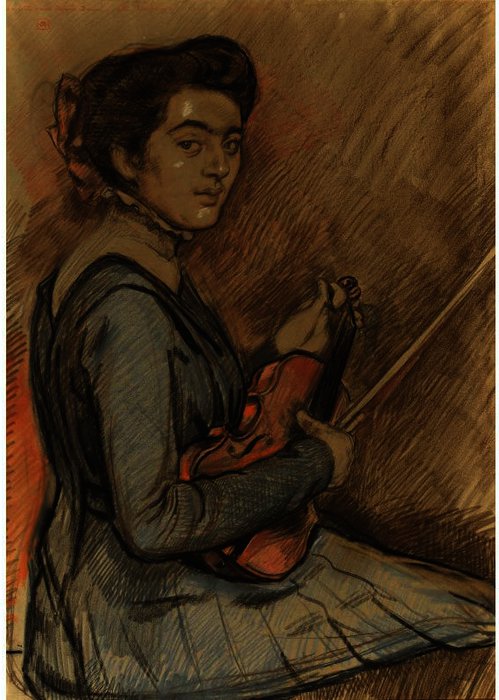
Renee Druet with Violin: A Glimpse into Belle Époque Elegance
Theo van Rysselberghe's "Renee Druet with violin," painted in 1910, is a captivating portrait that exemplifies the Post-Impressionist movement and showcases the artist’s mastery of Pointillism. This piece isn't merely a likeness; it's an exploration of color, light, and atmosphere, offering a window into the refined world of Belle Époque society.
The Portrait and Its Subject
The painting depicts Renee Druet, a prominent figure in Parisian artistic circles known for her musical talent. She is portrayed seated, gracefully holding a violin with her left hand while her right arm rests gently on the bow. Her attire—a dark dress accented by a lighter collar and delicate lace detailing—speaks to the elegance of the era. Druet’s gaze, directed slightly off-canvas, conveys a sense of quiet contemplation and focused artistry. The background is rendered in warm hues, suggesting an interior setting, possibly a room with soft drapery or a wall, further enhancing the intimate atmosphere.
Pointillism and Post-Impressionist Technique
Van Rysselberghe’s technique is central to the painting's allure. As a leading figure in Neo-Impressionism, he embraced Pointillism—a method where small, distinct dots of pure color are applied to the canvas, intended to blend optically when viewed from a distance. This meticulous approach creates a shimmering effect and imbues the portrait with a vibrant luminosity. The visible brushstrokes, characteristic of Post-Impressionism, move beyond mere representation; they become an integral part of the artwork's expressive power. The artist skillfully uses color—earth tones punctuated by accents of red and blue—to define form and create depth, moving away from traditional modeling techniques.
Historical Context and Symbolism
Created in 1910, "Renee Druet with violin" reflects the artistic climate of the Belle Époque – a period marked by optimism, innovation, and cultural flourishing. Neo-Impressionism emerged as a reaction against the perceived subjectivity of Impressionism, seeking to apply scientific principles of color theory to create more structured and harmonious compositions. The choice of subject—a woman engaged in musical performance—underscores the importance of artistic pursuits within high society. The violin itself symbolizes music, artistry, and perhaps introspection or solitude, adding layers of meaning beyond a simple portrait.
Emotional Impact and Artistic Legacy
“Renee Druet with violin” evokes a sense of quiet elegance and refined beauty. The painting’s luminous quality and the subject's contemplative expression invite viewers to connect with her on an emotional level. Van Rysselberghe’s masterful use of Pointillism not only demonstrates his technical skill but also creates a visually captivating experience that continues to resonate with art enthusiasts today. This work stands as a testament to van Rysselberghe’s contribution to the Post-Impressionist movement and his ability to capture both the outward appearance and inner essence of his subjects.