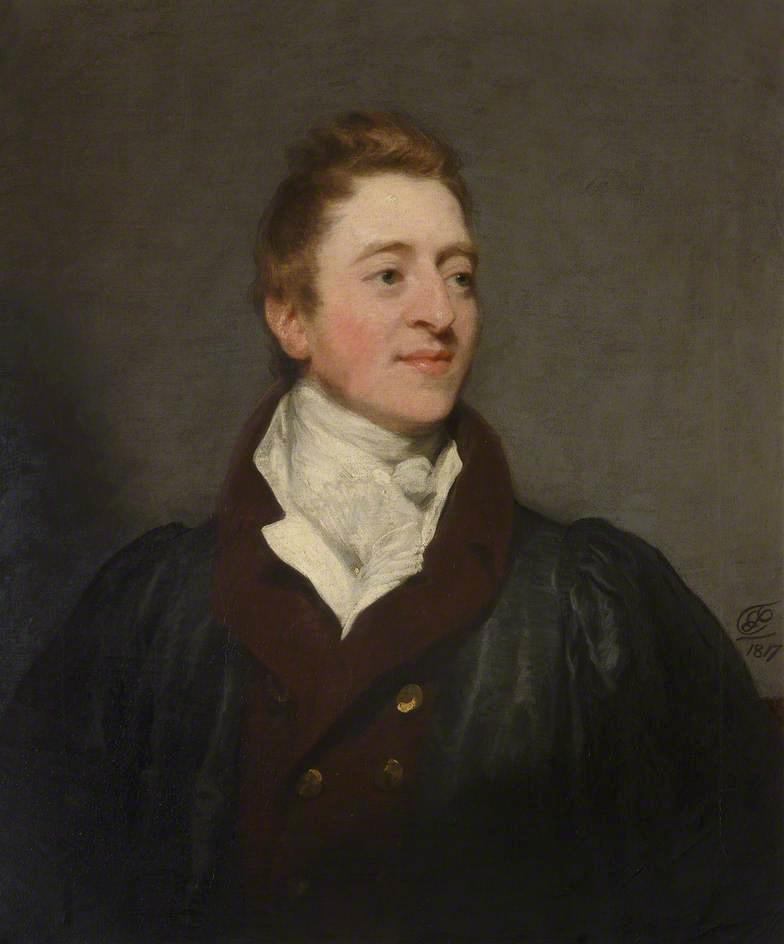
A Portrait of Command: Hugh Percy, 3rd Duke of Northumberland
Thomas Phillips’s 1817 portrait of Hugh Percy, 3rd Duke of Northumberland, is more than simply a likeness; it's a carefully constructed tableau of power, duty, and restrained dignity. Rendered in the rich, controlled palette characteristic of late Georgian and early Romantic portraiture, the painting offers a glimpse into the life of a prominent figure navigating the complexities of British society during a period of significant political and social change. The Duke himself—a man of considerable military experience, serving with distinction in the American War of Independence and later as Lord Lieutenant of Ireland—projects an aura of composed authority, his gaze direct yet subtly contemplative.
The composition is classically balanced, adhering to a three-quarter pose that allows for detailed observation of the subject’s features. Phillips masterfully employs chiaroscuro – the dramatic interplay of light and shadow – to sculpt Percy's form, emphasizing the strength of his jawline, the firmness of his brow, and the subtle texture of his coat. The muted grey-brown background serves not as a distraction but rather as a grounding element, allowing the Duke’s figure to command attention and anchor the scene within a space of quiet formality. The careful use of lines defines the contours of his face, clothing, and hair with precision, while organic shapes—the folds in his coat, the curve of his neck—lend a sense of naturalism and human warmth to the otherwise structured arrangement.
A Window into Regency Society
To fully appreciate this portrait, it’s crucial to understand its historical context. The early 19th century was a time of immense social and political upheaval in Britain, following the Napoleonic Wars and the tumultuous years of the French Revolution. The aristocracy held considerable sway, yet faced increasing scrutiny from reformers and radicals demanding greater accountability. Portraits like this one were not merely decorative; they served as powerful statements of status, lineage, and civic responsibility. The Duke’s attire—the richly embroidered coat, the lace cravat—are all deliberate indicators of his wealth, rank, and connection to established traditions.
Further research reveals that Hugh Percy was a key figure in British politics, holding various important positions including Lord Lieutenant of Ireland. His involvement in military campaigns, particularly during the American War of Independence, shaped his character and contributed to his reputation for both bravery and strategic acumen. The portrait captures this complex legacy—a man simultaneously embodying the virtues of the established order and reflecting the challenges of a rapidly changing world.
The Art of Phillips: Technique and Detail
Thomas Phillips was a highly respected artist known for his meticulous attention to detail and his ability to capture both the physical likeness and the psychological essence of his subjects. His technique is characterized by layered brushwork, carefully blended colors, and a masterful understanding of light and shadow. The texture of Percy’s coat—the subtle sheen of the fabric, the delicate weave—is rendered with remarkable realism, inviting the viewer to almost feel its weight and smoothness.
Phillips's skill is particularly evident in his depiction of facial features. The Duke’s eyes, though somewhat distant, convey a sense of intelligence and self-awareness. The subtle lines around his mouth hint at both experience and perhaps a touch of melancholy. The artist’s use of highlights—particularly on the skin—creates a luminous effect that draws attention to the subject's face and adds depth to the overall composition. The portrait is a testament to Phillips’s dedication to capturing not just an image, but also the very spirit of his sitter.
Symbolism and Emotional Resonance
Beyond its technical merits, the portrait holds subtle symbolic significance. The Duke's posture—straight, dignified, and slightly turned towards the viewer—conveys a sense of authority and self-assurance. His gaze suggests both confidence and contemplation, inviting the viewer to engage with his thoughts and experiences. While the painting avoids overt emotional displays, it subtly communicates a feeling of stability, strength, and unwavering commitment to duty.
The muted color palette—dominated by browns, greys, and creams—contributes to the overall sense of gravitas and formality. It’s a deliberate choice that reflects the conservative values of the era and reinforces the Duke's position as a pillar of the establishment. Ultimately, Hugh Percy, 3rd Duke of Northumberland, is not merely a portrait; it’s a carefully crafted representation of a man—a leader, a soldier, and a symbol of an age.