A Moment of Whimsical Serenity
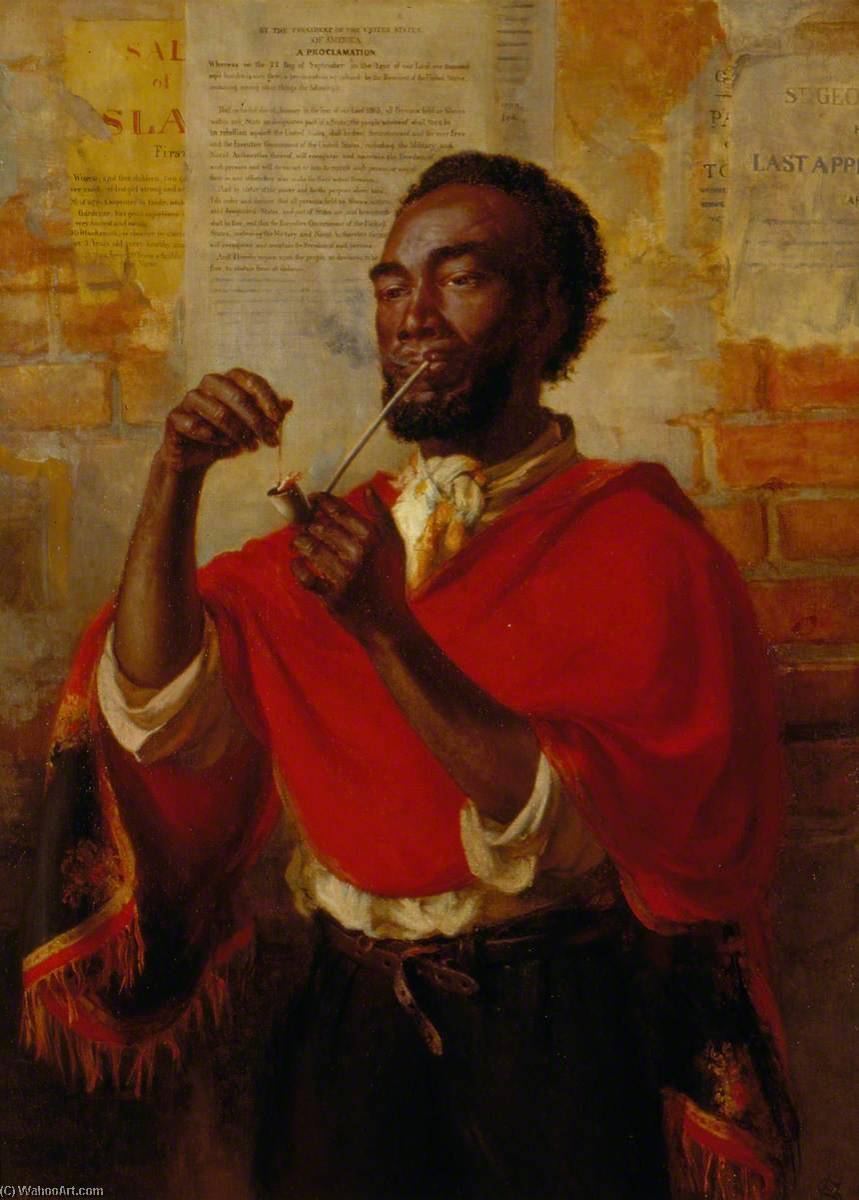
In the evocative portrait known as The Pipe of Freedom, Thomas Stuart Smith captures a fleeting, intimate moment that transcends the boundaries of time. The painting presents us with a man lost in a private ritual of pleasure, his face alight with a mischievous, perhaps even jubilant, expression. As he holds his pipe, the smoke and the spirit of the moment seem to drift toward the viewer, inviting us into his personal sanctuary. Clad in a striking red robe that commands immediate attention, the subject provides a vibrant focal point against the more muted, textured backdrop of a brick wall. This splash of crimson does more than just provide visual contrast; it serves as a pulse of life within the composition, suggesting warmth, passion, and the unbridled joy found in simple, earthly comforts.
The setting, which hints at a workspace or a quiet study, is meticulously layered with details that ground the subject in a tangible reality. Scattered papers and the presence of books—one tucked near the upper corner and another resting toward the bottom—suggest an intellectual life interrupted by a well-deserved respite. These elements create a narrative of balance between labor and leisure, between the rigors of the mind and the relaxation of the soul. The interplay of light and shadow across the brickwork and the parchment adds a profound sense of depth, making the scene feel less like a static image and more like a window into a living, breathing room.
Mastery of Texture and Victorian Spirit
Technically, Smith demonstrates his remarkable ability to bridge the gap between Romantic Idealism and the meticulous observation of everyday life. The brushwork, while purposeful in defining the heavy folds of the red garment, possesses a softness that captures the ephemeral nature of the man's smile. There is a tactile quality to the painting; one can almost feel the roughness of the brick and the smoothness of the paper. This mastery of texture is essential for any collector or interior designer looking to introduce a piece with significant character and "weight" into a room. The composition uses these varied surfaces to guide the eye in a circular motion, ensuring that the viewer lingers on both the man's expressive features and the subtle environmental clues.
Historically, this work serves as a poignant reflection of the mid-19th century, an era where the tension between industrial progress and the desire for individual peace was palpable. The title itself, The Pipe of Freedom, imbues the act of smoking with a deeper symbolic meaning—it is not merely a habit, but a ritualistic escape from the constraints of societal expectations. For those seeking to adorn a sophisticated interior, this reproduction offers more than just aesthetic beauty; it provides a conversation piece that speaks to the enduring human need for autonomy and the quiet celebration of the present moment.