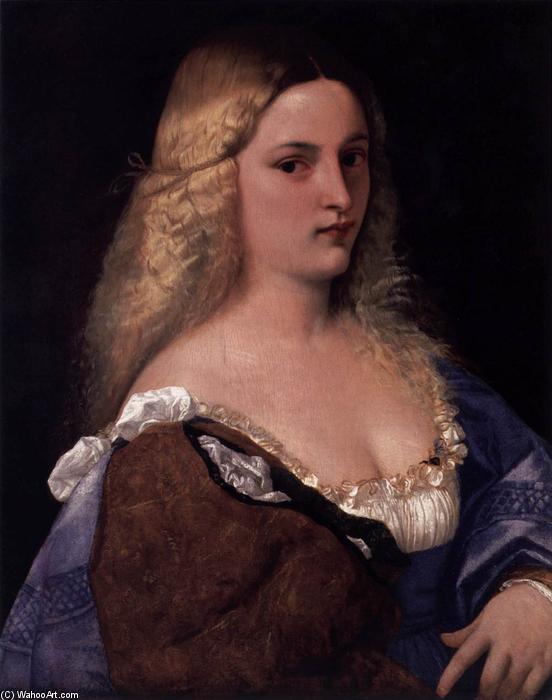
A Portrait of Renaissance Grace: Titian’s *Violante (La Bella Gatta)*
Tiziano Vecellio's *Violante (La Bella Gatta)*, painted in 1514, is more than just a portrait; it’s a shimmering distillation of the Venetian Renaissance at its most captivating. This oil-on-canvas masterpiece, currently residing within the Kunsthistorisches Museum in Vienna, offers a glimpse into a world where beauty, power, and artistic innovation converged with breathtaking elegance. The painting immediately draws the eye to Violante herself – a young woman radiating an almost ethereal quality. Her long, flowing blonde hair is meticulously arranged in a complex braid that cascades down her back, a deliberate choice reflecting both contemporary fashion trends and a desire for visual richness characteristic of Titian’s style.
Her gaze, direct and serious, holds the viewer captive. It's not a coy or flirtatious look, but one of quiet contemplation, suggesting an inner life beyond the confines of the painted scene. The rich blue of her dress – a deep, saturated hue indicative of Venetian dyes at the time – provides a striking contrast to her pale skin and blonde hair, further emphasizing her beauty and creating a harmonious balance within the composition. Notice also the subtle modeling of her features; Titian’s masterful brushwork allows for an incredible sense of volume and texture, bringing Violante's face to life with remarkable realism.
The Influence of Rome: Mosaic Echoes and Oil’s Potential
To fully appreciate *Violante*, it’s crucial to understand the artistic climate in which it was created. The early 16th century witnessed a vibrant revival of classical art and architecture in Rome, fueled by the patronage of Pope Nicholas IV. This “Roman Renaissance” brought with it a renewed interest in mosaics – intricate works of art crafted from tiny tesserae that adorned churches and palaces. Titian, deeply influenced by this artistic fervor, was experimenting with new techniques to achieve similar levels of detail and luminosity.
Unlike the static nature of mosaics, oil paint offered unparalleled flexibility. It allowed for layering, blending, and subtle gradations of tone – a level of realism previously unattainable. Titian’s use of *sfumato*, a technique involving hazy, blurred outlines, is particularly evident here, softening the edges of Violante's features and creating an atmospheric depth that adds to the painting’s overall allure. The background figures, though less detailed than the central subject, contribute to the scene’s narrative complexity, hinting at a life unfolding beyond the immediate portrait.
Symbolism and Context: A Glimpse into Venetian Society
The presence of the two secondary figures adds layers of meaning to *Violante*. While their identities remain somewhat enigmatic, they likely represent members of Violante’s social circle – perhaps a husband, family member, or attendant. Their engagement in seemingly mundane activities—conversation and observation—suggests a world of courtly life, where appearances were carefully cultivated and social interactions held significant importance. The inclusion of these figures elevates the portrait beyond a simple likeness, transforming it into a window onto Venetian society.
Furthermore, *Violante* reflects the prevailing ideals of beauty during the Renaissance – an emphasis on youth, grace, and refined elegance. The subject’s pose, with her hand resting lightly on her dress, embodies a sense of poised dignity and self-assurance. It's a visual representation of the era’s fascination with classical forms and its celebration of human potential.
A Timeless Masterpiece: Reproduction and Beyond
*Violante (La Bella Gatta)* remains a testament to Titian’s genius and a cornerstone of Renaissance art history. ArtsDot offers meticulously crafted, hand-painted reproductions that capture the essence of this iconic painting with stunning accuracy. Each reproduction is created by skilled artists using traditional techniques, ensuring that you receive an authentic representation of Titian's masterpiece. Whether displayed in a grand salon or cherished as a personal treasure, a ArtsDot *Violante* reproduction allows you to experience the beauty and artistry of this remarkable work firsthand.
Consider how this painting’s evocative qualities can enrich your interior design – its rich colors and dynamic composition will undoubtedly become a focal point. Explore our range of sizes and framing options to find the perfect way to bring *Violante* into your home or office, connecting you with centuries of artistic legacy.