A Celestial Duel of Melody and Myth
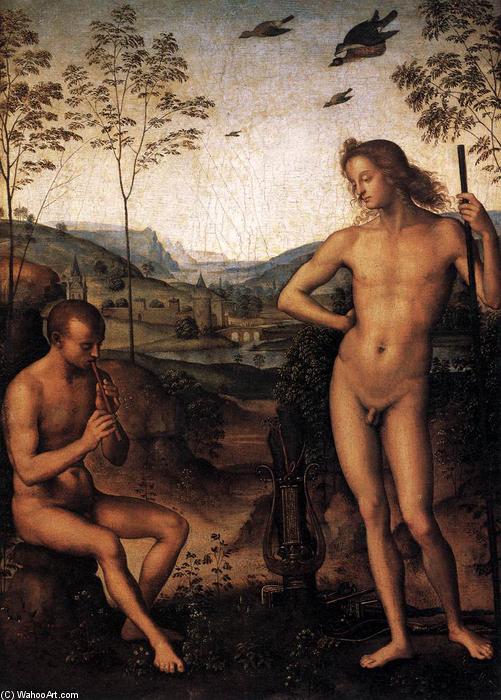
In the delicate dance of light and shadow that defines the High Renaissance, Pietro Perugino’s Apollo and Marsyas emerges as a profound meditation on the tension between divine order and earthly passion. Created in 1495, this exquisite oil on wood masterpiece invites the viewer into a tranquil yet charged mythological encounter. On one side of the composition, we encounter Apollo, the radiant god of music and prophecy, his youthful features bathed in a soft, ethereal glow as he holds his flute to his lips with effortless grace. Opposite him stands Marsyas, the satyr whose very presence introduces a raw, rhythmic energy to the scene. As they engage in their legendary musical contest, the painting captures more than just a performance; it captures a moment of suspended animation where the heavens and the earth seem to hold their breath.
The artistry of Le Perugino is masterfully displayed through his signature Umbrian style, characterized by an unparalleled sense of harmony and atmospheric perspective. The landscape behind the figures is not merely a backdrop but a living, breathing extension of the narrative. Rolling hills, verdant trees, and a clear, luminous sky stretch toward the horizon, creating a sense of infinite depth that draws the eye deep into the Italian countryside. Perugino’s use of color is subtle yet evocative, employing warm earth tones and delicate transitions that lend a realistic weight to the figures while maintaining a dreamlike, idealized quality. This mastery of light and shadow—the sfumato effect—softens the edges of reality, allowing the divine and the mortal to coexist within a single, seamless plane.
Symbolism and the Renaissance Spirit
Beyond its aesthetic splendor, Apollo and Marsyas serves as a complex allegory for the intellectual and cultural shifts of the late 15th century. To the Renaissance mind, this musical duel was far more than a myth; it represented the eternal struggle between ratio (reason) and passio (emotion). Apollo, with his disciplined flute playing, embodies the structured, mathematical perfection of divine intellect, while Marsyas, through the primal sound of the double flute, represents the untamed, instinctive impulses of the human spirit. For collectors and historians alike, the painting acts as a window into the humanist ideals of the era, where the pursuit of beauty was inextricably linked to the pursuit of truth and cosmic order.
For the discerning interior designer or art enthusiast, bringing a high-quality reproduction of this work into a space offers an opportunity to introduce a sense of classical serenity and intellectual depth. The painting’s balanced composition and muted, sophisticated palette make it a versatile centerpiece, capable of anchoring a room with its quiet authority. Whether placed in a sunlit gallery or a private study, the presence of Perugino’s masterpiece evokes a timeless elegance, reminding us of an era when art was the ultimate bridge between the human experience and the divine.