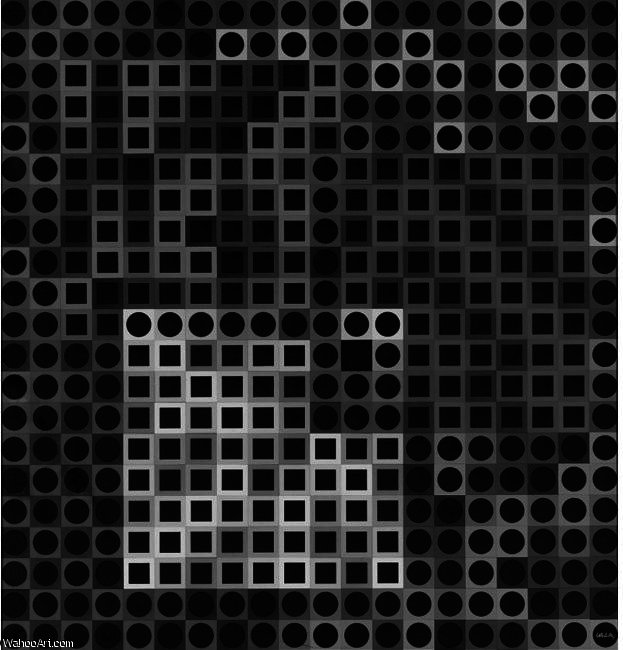
Experience Victor Vasarely’s ‘Orion Noir,’ a mesmerizing Op Art masterpiece that employs dynamic geometric patterns and monochromatic shades to create an illusion of movement. This iconic artwork, characteristic of the 1960s, invites you to explore its captivating visual effects.
A Dance of Perception: Exploring Victor Vasarely’s *Orion Noir*
Victor Vasarely's Orion Noir is more than just an image; it’s an invitation to question the very nature of visual perception. Created in the heart of the Op Art movement, this striking work by the Hungarian artist embodies a fascination with optical illusions and the dynamic relationship between form and space. Born Károly Vaszary in 1906 in Pécs, Croatia, Vasarely’s journey began unexpectedly – initially pursuing medicine before dedicating himself fully to the visual arts in 1927. His formative years at the Podolini-Volkmann Academy and, crucially, Sándor Bortnyik's ‘Műhely’ workshop, deeply influenced by the Bauhaus principles, laid the foundation for his groundbreaking approach to abstraction.
- Geometric Precision: The artwork’s core is a meticulously constructed grid of squares and rectangles, rendered in a stark monochrome palette of grays. This deliberate arrangement isn't merely decorative; it’s a calculated manipulation of visual stimuli designed to trick the eye.
- Op Art’s Legacy: Vasarely was a key figure in Op Art, a movement that sought to evoke an illusion of three-dimensional space through two-dimensional means. He achieved this by exploiting our brain's inherent tendency to interpret patterns and shapes.
Decoding the Visual Illusion
The immediate impact of *Orion Noir* is one of restless movement, despite its static presentation. The varying sizes of the squares and rectangles create a subtle but powerful distortion, leading the viewer’s eye across the composition in a perpetual state of flux. This effect isn't accidental; it’s a deliberate tactic employed by Vasarely to engage our visual cortex and challenge our assumptions about reality. The absence of traditional perspective or shading further intensifies this illusion, forcing us to actively participate in constructing the image.
- Dynamic Equilibrium: The artwork achieves a remarkable balance between order and chaos. The rigid grid provides a framework, while the subtle distortions create a sense of unrestrained movement.
- A Study in Contrast: The monochromatic palette amplifies the optical effects, highlighting the interplay of light and dark within the geometric forms.
Symbolism and Context
*Orion Noir* resonates with themes prevalent throughout Vasarely’s oeuvre – a fascination with order, symmetry, and the underlying structures of the universe. The title itself, referencing the prominent constellation, subtly suggests celestial patterns and the ordered systems that govern the cosmos. Vasarely's work was deeply rooted in the intellectual currents of his time, reflecting a broader interest in scientific advancements and the exploration of new visual languages. His meticulous technique, likely utilizing screen printing or similar methods, ensured the precise reproduction of these complex geometric arrangements – a hallmark of his artistic practice.
Emotional Resonance & Acquisition
Beyond its technical brilliance, *Orion Noir* possesses a profound emotional resonance. The artwork’s unsettling yet captivating effect invites contemplation on perception, reality, and our relationship to visual information. A hand-painted reproduction offers an exceptional opportunity to bring this iconic piece into your space, adding a touch of intellectual stimulation and artistic dynamism to any interior design scheme. Its timeless appeal ensures that *Orion Noir* will remain a compelling addition to any art collection for generations to come.