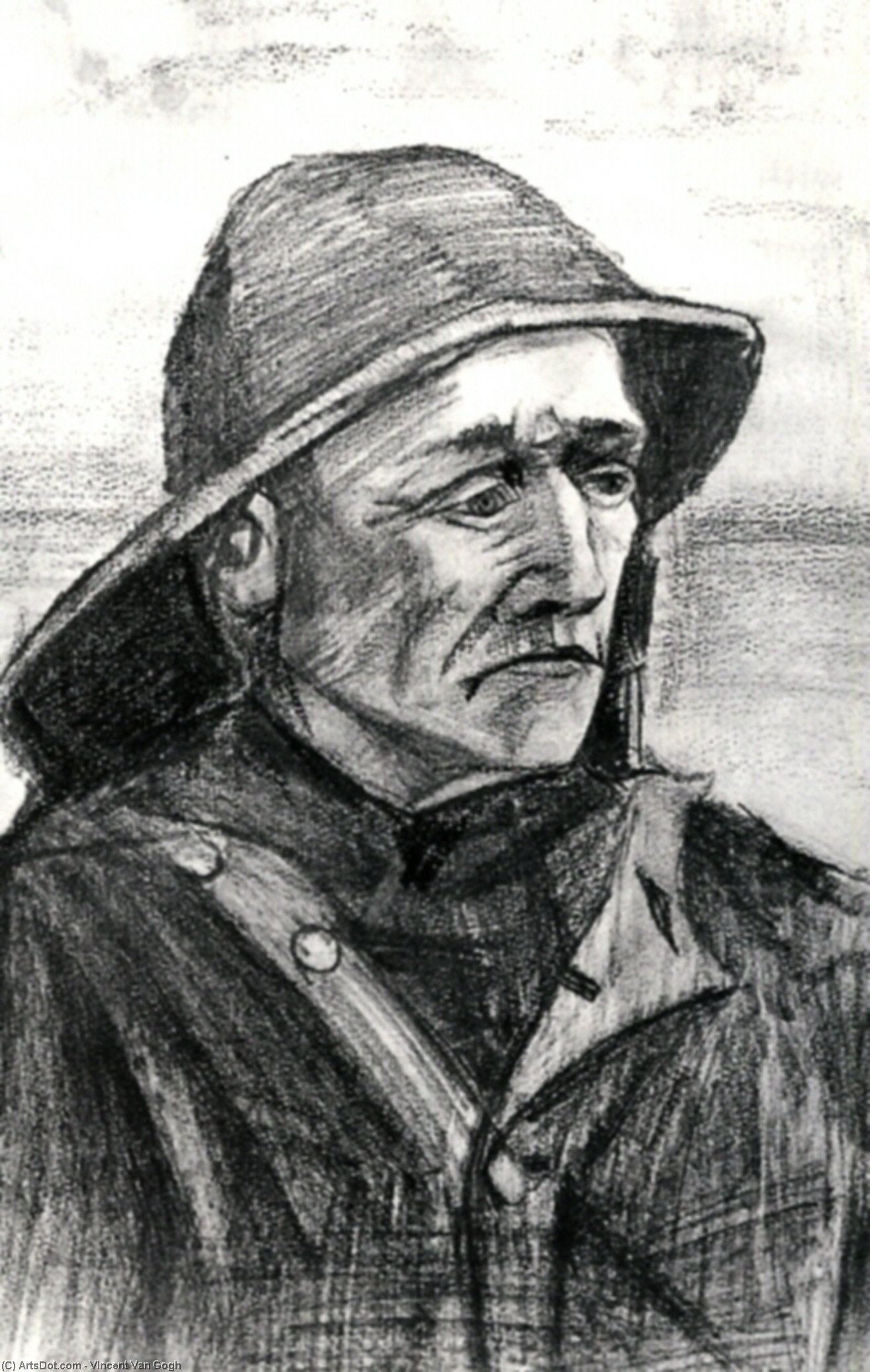
A Portrait of Resilience: Examining Vincent van Gogh’s “Fisherman with Sou’wester”
Vincent Willem van Gogh's “Fisherman with Sou’wester,” completed in 1883, stands as a poignant testament to the artist’s unwavering dedication to capturing the essence of everyday life and conveying profound emotion. This unassuming portrait transcends mere representation; it embodies Van Gogh’s signature style—a blend of realism infused with expressive brushwork that anticipates his later masterpieces.
- Subject Matter: The artwork depicts a solitary fisherman, rendered in meticulous detail against a muted gray backdrop. He wears a sou’wester hat and coat, symbols of maritime labor and resilience—elements reflecting Van Gogh's fascination with the working class and his desire to portray their dignity.
- Style & Technique: Executed entirely in graphite pencil on paper, “Fisherman with Sou’wester” exemplifies Van Gogh’s masterful use of hatching and cross-hatching. These techniques skillfully build up tonal values, creating a textured surface that mimics the roughness of weathered skin and clothing—a deliberate choice designed to imbue the image with palpable physicality.
- Composition & Perspective: The tightly cropped composition focuses intently on the fisherman’s head and upper torso, fostering an intimate connection between viewer and subject. Secondary figures positioned subtly on either side contribute to the background depth without distracting from the central figure's expressive gaze.
Symbolism Beyond Appearance
More than just a depiction of a fisherman’s physical form, “Fisherman with Sou’wester” resonates with symbolic significance. The downward gaze of the subject—a characteristic gesture in Van Gogh's drawings—suggests contemplation and perhaps a quiet sorrow. Coupled with his prominent beard and mustache, these features convey an aura of experience and hardship, hinting at a life spent confronting adversity.
- Emotional Impact: The artist’s deliberate use of shading creates dramatic lighting effects, emphasizing the fisherman's face and highlighting the vulnerability inherent in human existence. It speaks to Van Gogh’s profound empathy for those marginalized by society—a sentiment powerfully conveyed through his artistic vision.
- Historical Context: Created during Van Gogh’s formative years in Paris, “Fisherman with Sou’wester” reflects the influence of Impressionism and Japonisme – movements that encouraged artists to explore new perspectives and embrace vibrant color palettes. However, Van Gogh deliberately eschewed these trends, prioritizing tonal gradation and textural detail to achieve his desired expressive outcome.
A Masterful Exercise in Texture & Tone
The remarkable achievement of “Fisherman with Sou’wester” lies not only in its subject matter but also in Van Gogh's unparalleled ability to translate emotion onto paper. The dense pencil strokes—characterized by hatching and crosshatching—produce a surface that feels remarkably tactile, mirroring the weathered appearance of the fisherman’s clothing.
- Material & Craftsmanship: Graphite pencils were meticulously applied to paper, demonstrating Van Gogh's unwavering commitment to capturing subtle nuances of light and shadow. This painstaking process underscores his dedication to artistic precision—a hallmark of his oeuvre.
A high-quality reproduction of “Fisherman with Sou’wester” allows viewers to appreciate the enduring beauty and emotional depth of this iconic artwork, transporting them back to a moment in time when Van Gogh bravely pursued his artistic vision amidst personal struggles—a testament to the transformative power of art.