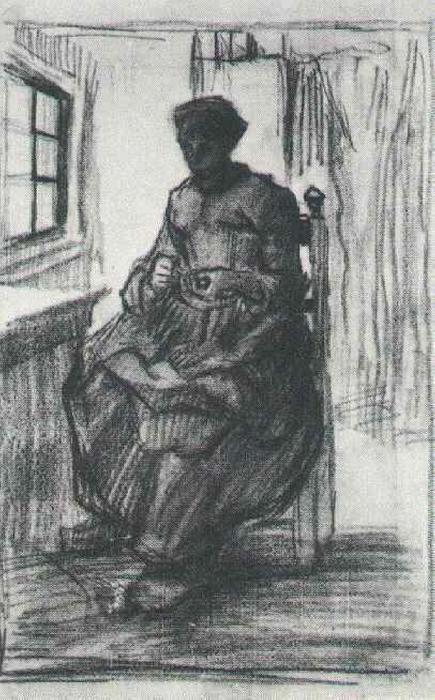
Interior with Peasant Woman Sewing
Vincent van Gogh’s “Interior with Peasant Woman Sewing,” created in 1885, stands as a poignant testament to the artist's unwavering fascination with depicting the dignity and quiet beauty of rural life. More than just a visual record, it embodies Van Gogh’s distinctive artistic vision—a blend of realism infused with expressive emotion that anticipates the stylistic breakthroughs of Expressionism.
- Subject Matter: The artwork centers on a solitary peasant woman diligently sewing at a table bathed in soft light emanating from a window. This deliberate choice reflects Van Gogh’s profound empathy for the working class and his desire to portray ordinary individuals with compassion and respect—a core element of his artistic philosophy.
- Style: While firmly rooted in Realism, “Interior with Peasant Woman Sewing” transcends mere representation. The artist employs a flattened perspective, prioritizing the subject’s presence over meticulous spatial accuracy. This stylistic decision aligns closely with influences from Japanese prints—particularly their use of asymmetrical compositions and simplified forms—a trend that captivated European artists during this period.
- Technique: Van Gogh executed this piece primarily in chalk on paper, utilizing a masterful technique characterized by dense hatching and cross-hatching. These meticulous lines aren’t merely descriptive; they actively convey texture and movement, mirroring the subtle vibrations of life itself. The artist skillfully manipulates pencil pressure to achieve tonal variation, creating dramatic contrasts between light and shadow that heighten the emotional impact.
- Historical Context: Painted during Van Gogh's time in Nuenen—a deliberate retreat from Paris and a conscious effort to immerse himself in the rural landscape—the artwork speaks to the broader artistic currents of the Barbizon School. Artists like Millet championed depictions of peasant life as noble subjects, elevating the commonplace to the realm of artful contemplation.
- Symbolism: Beyond its straightforward depiction of domestic labor, “Interior with Peasant Woman Sewing” carries symbolic weight. The woman’s posture—seated calmly amidst the dim interior—suggests introspection and resilience—qualities that resonate deeply within Van Gogh's oeuvre. The single window casting a warm glow symbolizes hope and spiritual illumination, mirroring Van Gogh’s own yearning for transcendence.
The drawing possesses a palpable sense of vulnerability and quiet dignity. Its muted palette—dominated by earthy browns and creams—further underscores the artwork's connection to its surroundings. Consider how this piece might enrich an interior space, bringing forth a feeling of serenity and contemplation—a reflection of Van Gogh’s enduring legacy as one of art history’s most emotionally resonant figures.