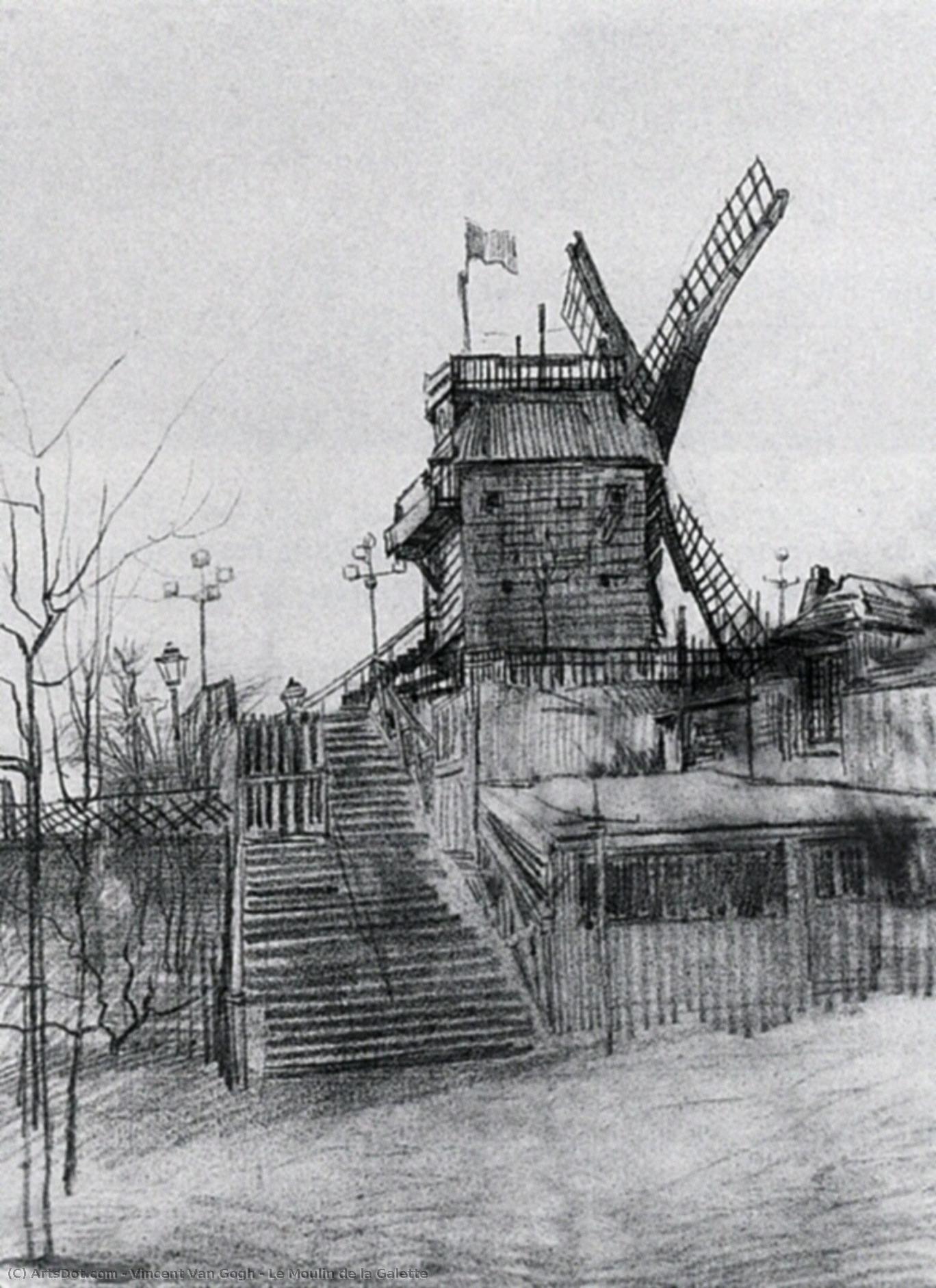
Experience the vibrant Impressionist charm of Vincent van Gogh's Le Moulin de la Galette, a 1886 masterpiece capturing dappled sunlight and rural life, now available to bring historical elegance to your home collection.
A Window into Rural Holland: Exploring Vincent van Gogh’s “Le Moulin de la Galette”
Vincent Willem van Gogh's "Le Moulin de la Galette," painted in 1886, transcends mere depiction; it embodies the very essence of Impressionism and offers a poignant glimpse into the artistic soul of its creator. Captured on paper with charcoal and pastel, this deceptively simple landscape speaks volumes about Van Gogh’s fascination with capturing fleeting moments of everyday life and conveying profound emotion through subtle tonal shifts. The drawing portrays a windmill situated in a village square, bathed in dappled sunlight – a scene meticulously observed by the artist during his time in Auvers-sur-Oise, France.
- Subject Matter: The Moulin de la Galette isn’t just a windmill; it's a symbol of rural Holland and its industrious spirit. Van Gogh deliberately chose this location to represent the vitality of peasant life and the beauty found in seemingly unremarkable surroundings.
- Style & Technique: Characteristic of Impressionism, the artwork prioritizes capturing light and atmosphere over precise detail. Van Gogh employed a technique known as “pointillisme,” applying tiny dots of pastel pigment to build up color gradually—a method that lends an ethereal quality to the scene and enhances its luminosity.
The historical context surrounding "Le Moulin de la Galette" is crucial to understanding its significance. Painted during Van Gogh’s final year of artistic productivity, it reflects his growing preoccupation with capturing the immediacy of experience and conveying inner feelings. He was grappling with mental instability at this time, yet amidst these challenges, he persevered in his pursuit of artistic expression—a testament to his unwavering dedication. The windmill itself holds symbolic weight; windmills were integral to Dutch agriculture and represented hard work, perseverance, and connection to the land – themes deeply resonant within Van Gogh’s worldview.
Emotional Impact: Despite its tranquil appearance, “Le Moulin de la Galette” pulsates with emotion. The artist's masterful use of pastel hues conveys a sense of warmth and serenity, juxtaposed against the darker tones that hint at underlying melancholy. It invites contemplation on themes of beauty, solitude, and the passage of time—elements that are central to Van Gogh’s artistic vision and continue to captivate audiences today.
- Interior Designers Note: Consider incorporating shades of ochre and pale yellow – mirroring the pastel tones of the original drawing – into a living room or dining area to evoke a feeling of rustic elegance and tranquility.
- Collectors Insight: This reproduction captures not only the visual splendor of Van Gogh’s masterpiece but also the artist's profound sensitivity—a quality that elevates it beyond mere decoration and transforms it into an enduring symbol of artistic achievement.
Ultimately, “Le Moulin de la Galette” stands as a remarkable accomplishment – a testament to Van Gogh’s ability to distill complex emotions into a deceptively simple visual form. Its enduring appeal lies in its capacity to transport viewers back to a bygone era and to inspire them with the beauty of observation and the transformative power of artistic expression.